Attended the Trade Association-hosted 'Post-Corona Trade Order Virtual International Conference'
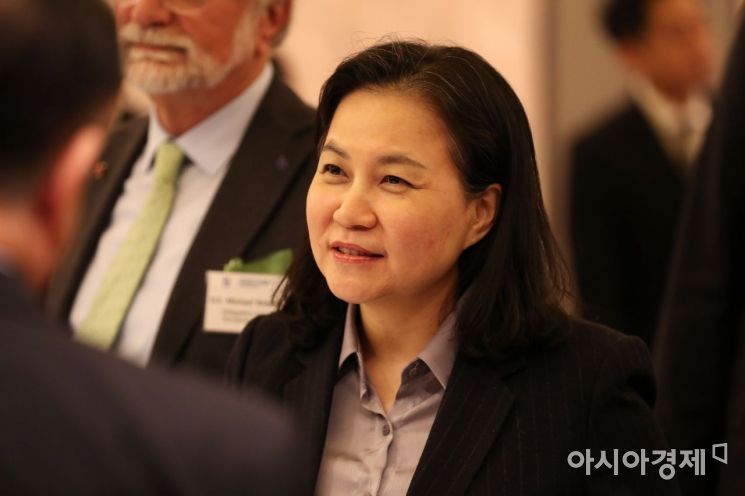 Yoo Myung-hee, Chief Negotiator of the Ministry of Trade, Industry and Energy. / Photo by Moon Ho-nam munonam@
[Asia Economy Reporter Moon Chaeseok] 'Rapid crisis response, timely solution proposals, and building a robust global trade order.' The government conveyed a message to the world that three trade principles must be upheld in the post-COVID-19 era.
Yoo Myung-hee, Head of the Trade Negotiations Division at the Ministry of Trade, Industry and Energy, stated this on the 27th at the "Post-COVID Trade Order Virtual International Conference" hosted by the Korea International Trade Association. The conference was held in a webinar (web + seminar) format. Attendees included Head Yoo, Mary Ng, Canadian Minister of Trade, Alan Wolff, Deputy Director-General of the World Trade Organization (WTO), Deborah Elms, Director of the Asia Trade Center, Wendy Cutler, Vice President of the Asia Society Policy Institute, Mary E. Lovely, Senior Fellow at the Peterson Institute for International Economics, and Ahn Deok-geun, President of the Korean International Trade Association.
Head Yoo said, "The global trade and commerce environment after COVID-19 will become a 'Next Normal' different from before," adding, "The full-scale rise of economic nationalism in each country, the restructuring of global value chains (GVC), and the acceleration of digital economy transformation will be representative trends." He then proposed three measures to expand the role of the multilateral trade system and restore trust: Responsiveness, Relevance, and Resilience.
Head Yoo emphasized that we must first be able to respond swiftly to global crises. To this end, he suggested the need to establish a "Global Trade and Investment Crisis Response Guideline" that guarantees essential trade and movement of personnel even in similar future crisis situations. He also stressed the importance of providing timely solutions to changes in the trade environment. He underscored the need to restore the weakened rule-making capacity of the WTO, especially emphasizing efforts to establish unified international rules in the digital sector.
Furthermore, Head Yoo urged efforts to create a sustainable and resilient global trade order. He highlighted the need to strengthen multilateral cooperation during the economic recovery process after COVID-19, including GVC restructuring and digital transformation. This is to minimize gaps between companies and countries and to ensure no groups are left behind.
Head Yoo stated, "In this process, Korea will maintain an open economic stance and lead cooperation with middle powers to contribute to building a better world order after COVID-19."
Minister Ng of Canada emphasized the importance of maintaining open and stable supply chains and highlighted cooperation with Korea and joint efforts by both countries in the international community.
She referred to the "Ministerial Declaration on the Action Plan for Facilitating Essential Workforce Movement and Trade" led by Korea on the 1st (involving five countries: Korea, Canada, Singapore, Australia, and New Zealand), the "APEC Trade Ministers' Joint Declaration on COVID-19 Response" adopted on the 5th, and the Korea-Canada Trade Ministers' virtual meeting held on the 13th.
Minister Ng stressed maintaining and strengthening the multilateral system, guaranteeing the movement of essential personnel such as businesspeople, supporting economic recovery efforts of all countries including developing nations, providing opportunities and benefits of free trade to all businesses including women-owned enterprises, and upholding rule-based trade orders such as the WTO.
Deputy Director-General Wolff stated that the WTO will play a leading role in applying zero tariffs on key items, facilitating cross-border movement of essential personnel, and withdrawing trade restrictive measures. He also mentioned advancing discussions on ongoing negotiations on e-commerce and fisheries subsidies, as well as WTO reform, through virtual meetings.
Director Elms recalled that tariff reductions and improved market access through Free Trade Agreements (FTAs) can be the most effective from a business perspective. She particularly emphasized that the Regional Comprehensive Economic Partnership (RCEP) can serve as a platform for cooperation among Asia-Pacific countries in various fields including trade.
An official from the Ministry of Trade, Industry and Energy said, "Based on the discussions at the conference, we plan to establish and announce a 'Post-COVID New Trade Strategy' next month," adding, "We will continue to hold various virtual international conferences leveraging Korea’s enhanced international status through K-quarantine to lead international cooperation in the post-COVID era."
© The Asia Business Daily(www.asiae.co.kr). All rights reserved.

















