Real Estate Regulations and Economic Slowdown Overlap
Seoul Apartment Prices Fall for 8 Consecutive Weeks
Reconstruction Apartments Under 900 Million Won in Short Supply
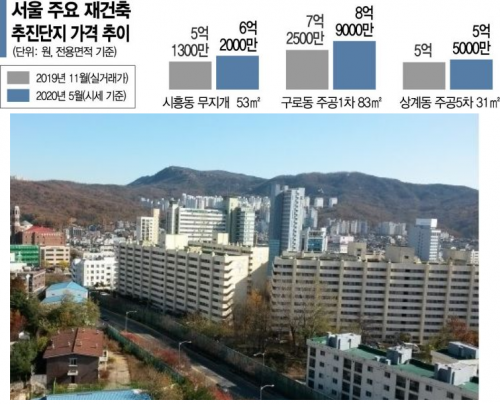
[Asia Economy Reporter Onyu Lim] The value of mid-to-low-priced reconstruction apartments on the outskirts of Seoul is rapidly rising. Although Seoul apartment prices have fallen for eight consecutive weeks due to strengthened real estate regulations and a slowdown in the real economy, reconstruction apartments priced under 900 million KRW with high investment value in Nowon, Dobong, Gangbuk (No-Do-Gang) and Geumcheon, Gwanak, Guro (Geum-Gwan-Gu) districts are experiencing a shortage.
According to the real estate industry on the 27th, the 53㎡ unit of Mujigae Apartment in Siheung-dong, Geumcheon-gu, Seoul, was traded at 513 million KRW (highest price) as recently as November last year, but the current market price has jumped to around 620 million KRW. The last transaction was in December last year at 540 million KRW, and currently, there are almost no listings. A representative from nearby A real estate agency said, "With the Shinansan Line coming to the nearby Siheung Intersection, there are only two 53㎡ units available for transaction," adding, "There are no listings for 67㎡ and 84㎡ units, so transactions have practically stopped, but prices seem to have risen by about 200 million KRW compared to before the December 16 measures last year."
The reason for this price surge is the expectation of reconstruction. Built in 1980 and now 40 years old, this apartment recently passed the Seoul city architectural review for reconstruction, attracting investors. According to the architectural review plan, the existing 639-unit Mujigae Apartment will be transformed into a new apartment complex with up to 35 floors and 993 units through reconstruction.
This contrasts with the struggles of reconstruction complexes in Gangnam, such as Eunma Apartment in Daechi-dong, Gangnam-gu, where prices exceed 2 billion KRW. In the third week of May, Seoul apartment prices continued their eight-week decline, centered on reconstruction complexes in Gangnam-gu, Songpa-gu, and Seocho-gu. This is due to the December 16 measures that blocked loans for apartments over 1.5 billion KRW and the sluggish real economy. On the other hand, No-Do-Gang and Geum-Gwan-Gu, where mid-to-low-priced apartments under 900 million KRW are concentrated and free from strict regulations, continue to rise. In particular, investment in reconstruction apartments with excellent locations and prospects for transformation into new apartments is becoming active.
Besides Mujigae Apartment, the market price of Jugong Apartments (Phases 1 and 2) in Guro-dong, Guro-gu, built in 1986, is also rising sharply. The 83㎡ unit in Phase 1, which was traded at 725 million KRW in November last year, was sold for 872 million KRW in February this year. This is a rapid increase of about 150 million KRW in three months. Coupled with positive factors such as the relocation of the Guro vehicle depot, the current market price is reported to be between 890 million and 900 million KRW. This complex submitted a proposal for designation as a reconstruction maintenance zone to Guro-gu Office in March.
In the area of Sanggye-dong, Nowon-gu, where old Jugong Apartments are concentrated, the value of Phase 5, where project progress is relatively fast, is rising sharply. The 31㎡ unit, which was traded at 500 million KRW in November last year, was sold for 550 million KRW in February this year. Although a first-floor unit was sold last month for a lower price of 530 million KRW, the current market price remains around 550 million KRW. The Sanggye Jugong Phase 5 Reconstruction Promotion Preparation Committee plans to hold a resident briefing session soon regarding the designation of the maintenance zone.
Ham Young-jin, head of the Zigbang Big Data Lab, analyzed, "Reconstruction complexes in Gangnam and along the Han River have high price burdens and higher barriers due to strengthened loan regulations and funding plans, whereas reconstruction complexes in the outskirts have lower price burdens and relatively weaker regulations, causing a leveling effect." However, he advised, "Since there is great uncertainty such as the speed of collecting consent forms, early entry before the establishment of reconstruction associations should be approached from a long-term perspective."
© The Asia Business Daily(www.asiae.co.kr). All rights reserved.

















