'Death with Dignity Act' Life-Sustaining Treatment Decision System 2 Years
Nearly 100,000 Decisions to Withhold or Withdraw Life-Sustaining Treatment by April
Advance Directives for Life-Sustaining Treatment Exceed 600,000
More Than Triple Increase in One Year

[Asia Economy Reporters Song Seung-yoon and Lee Jung-yoon] Kim Jong-su (86, pseudonym), who was diagnosed with stage 2 colon cancer, recently underwent surgery at a university hospital. Although the surgery was successful, Kim faced another concern. He instinctively felt that his life was drawing to a close and began to contemplate death and the process surrounding it. Having endured a painful treatment process, he did not want his final days to be spent struggling to live a little longer while being hooked up to numerous medical devices. During this time, he happened to hear about the life-sustaining treatment decision system from a fellow patient hospitalized with him.
Strongly motivated by the thought of "not wanting my children to suffer because of me," he wrote and registered an advance directive for life-sustaining treatment with the help of a care worker.
Two years after the implementation of the so-called "Dignified Death Act," more people are choosing to forgo life-sustaining treatment and accept death naturally. The life-sustaining treatment decision system allows patients to decide whether to discontinue treatments such as cardiopulmonary resuscitation or hemodialysis, which are unlikely to be effective but prolong life. Patients can express their intention to end life-sustaining treatment in writing or with the consent of two or more family members.
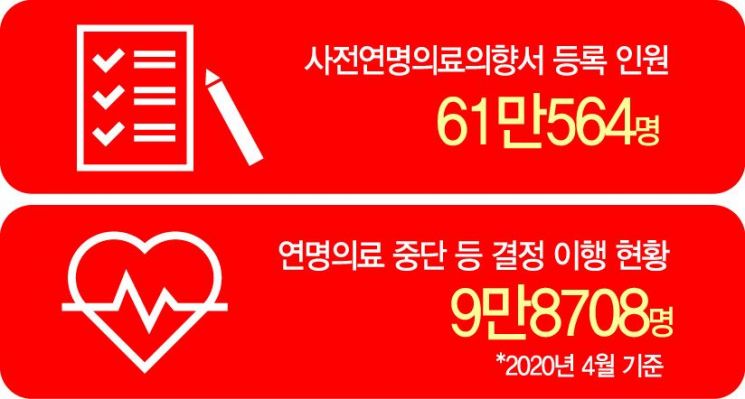
According to statistics from the National Bioethics Policy Institute on the 27th, as of last month, 98,708 patients have decided to withhold or withdraw life-sustaining treatment, approaching 100,000. The number of people who have written advance directives for life-sustaining treatment has also surpassed 600,000, reaching 610,564. This is more than three times the 189,467 people who had written such directives by the same month last year.
By age group, those aged 70-79 accounted for the largest share at 46%, followed by 60-69 years (22%) and those 80 and older (19%). The under-30 age group was the smallest, with 1,537 people. While middle-aged and older adults overwhelmingly dominate, there are relatively younger individuals as well, mostly those who have witnessed family members undergoing life-sustaining treatment.
Kang Seong-bok (31, pseudonym) is one such case. Kang said, "A few years ago, my grandfather passed away while receiving life-sustaining treatment, and I witnessed how difficult his final days were." He added, "At that time, my family did not agree to stop treatment, but later, thinking that something similar could happen to me, I expressed my intention not to receive life-sustaining treatment in advance."
A Ministry of Health and Welfare official stated, "As social interest in well-dying increases, the number of people writing advance directives for life-sustaining treatment is also rising annually. Since the system has only been in place for two years, it is still relatively early, but we plan to expand the number of designated registration institutions and strengthen publicity to fully inform the public about this system."
Professor Yoon Young-ho of Seoul National University College of Medicine explained, "Aside from the increasing number of participants two years after implementation, there is a need to refine the system to align with its original purpose. The system is intended for all terminal patients to decide on their treatment themselves, but currently, family members sometimes infringe on patients' autonomy. Therefore, improvements should be made to enhance self-determination."
© The Asia Business Daily(www.asiae.co.kr). All rights reserved.


















