
[Asia Economy Reporter Choi Saeng-hye] Liquid-type e-cigarette device manufacturer JFT pointed out fatal errors in the "Study on Tax Adjustment Measures for Liquid-type E-cigarettes" presented at the "Discussion on the Reform Plan for Liquid-type E-cigarette Tax Burden" held on the 19th.
On the 27th, JFT issued an official statement saying, "The study proposed Option 1 from an active perspective (229% increase in tobacco consumption tax) and Option 2 from a conservative perspective (178% increase in tobacco consumption tax)," adding, "The study is based on the U.S. liquid-type e-cigarette brand 'Juul,' which cannot serve as a tax standard for liquid-type e-cigarettes in Korea and does not align with the theory presented by the researcher."
According to JFT, the study was premised on the theory that taxation should be based on "the best-selling product in the market" to increase "tax efficiency," but it used Juul, which has already withdrawn from Korea due to poor sales, as the standard. This contradicts the theory presented by the researcher. Instead, it is more appropriate to refer to liquid-type e-cigarette devices that have been sold in Korea after the government's implementation of nicotine distribution regulations below 10 mg/ml.
The study considered 10 inhalations of combustible cigarettes and liquid-type e-cigarettes as "the same user behavior" and aimed to secure "tax burden equity" based on the amount of liquid consumed, presenting 0.9 ml as the amount for one pack. However, the study cited "Source: Ministry of Food and Drug Safety 0.8~1.0 ml per 10 inhalations (equivalent to one cigarette)" and when converted to 20 cigarettes (one pack), the liquid consumed per inhalation is 16~20 ml, which does not support the study's calculation of 0.9 ml per pack. JFT claims this reveals an error in the preparation of the research data.
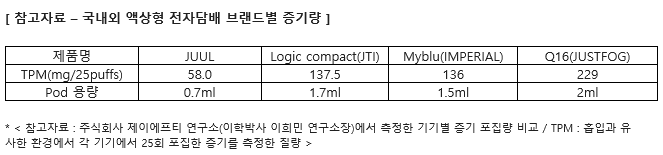
JFT stated, "Juul produces less vapor compared to other devices sold in Korea and Europe," adding, "Due to the characteristics of CSV liquid-type e-cigarettes, fewer vapor amounts lead to a higher number of inhalations." They further explained, "Liquid-type e-cigarette devices vary according to the nicotine content limits allowed in each country, and JFT also adjusts vapor amounts based on these standards to develop and sell liquid-type e-cigarette devices worldwide."
Lee Hee-seung, Vice President of the Electronic Cigarette Association Federation and CEO of JFT, said, "It is right to establish taxation standards for tax equity and public health, but only when there is a deeper understanding of liquid-type e-cigarettes and 'effective policies' are prepared can liquid-type e-cigarettes properly exist under government management," adding, "Government ministries must definitely refer to advice from industry stakeholders."
He also stated, "If the tax plan is forcibly implemented based on this study, it will deprive smokers of their choice regarding liquid-type e-cigarettes and force them back to combustible cigarettes, which would be a policy moving in the exact opposite direction of public health promotion."
© The Asia Business Daily(www.asiae.co.kr). All rights reserved.
![User Who Sold Erroneously Deposited Bitcoins to Repay Debt and Fund Entertainment... What Did the Supreme Court Decide in 2021? [Legal Issue Check]](https://cwcontent.asiae.co.kr/asiaresize/183/2026020910431234020_1770601391.png)

















