Population Cliff Becomes Reality... First Annual Decline Possible This Year↑
[Sejong=Asia Economy Reporter Kim Hyunjung] As the number of births sharply declined and the number of deaths increased, South Korea's population naturally decreased for five consecutive months for the first time in history. If this trend continues, it is highly likely that the population will show a natural decrease on an annual basis as well.
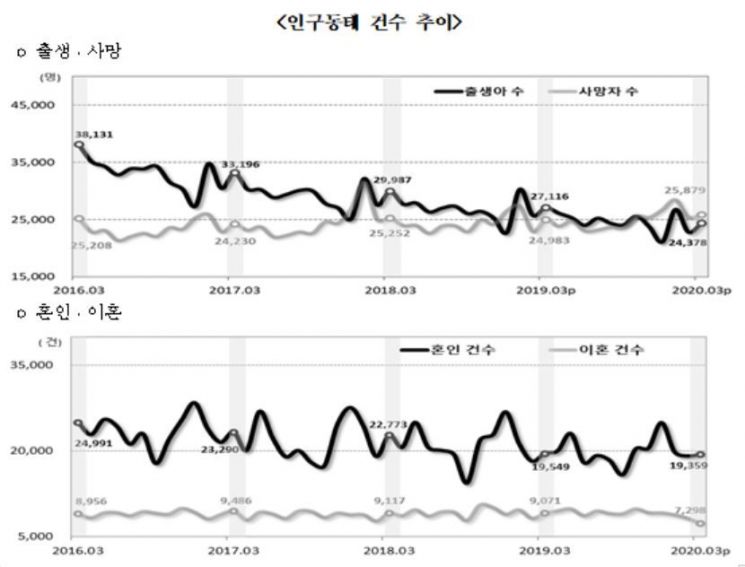
According to the 'March Population Trends' released by Statistics Korea on the 27th, the number of births nationwide in March was 24,378, a decrease of 2,738 (10.1%) compared to the previous year. The number of births has been declining year-on-year for 52 consecutive months since December 2015, and the March figure is the lowest since related statistics began in 1981. On the other hand, the number of deaths in March was 25,879, an increase of 895 (3.6%) compared to one year ago. In terms of deaths, this was the second highest March figure since 1983, following 2015 (26,493 deaths).
Accordingly, the natural increase (births minus deaths) in March recorded a negative figure of -1,501. The natural increase has been declining for five consecutive months since November last year, the first time since statistics began in 1983.
The total fertility rate, which is the expected number of children a woman will have in her lifetime, was 0.90 in the first quarter of this year, down 0.12 from the same period last year. This is the lowest level recorded for the first quarter since 2009. The number of 'large families' having a second or third child or more continues to decline. Looking at the composition ratio of births by birth order, first-born children accounted for 56.2%, up 1.3 percentage points from the previous year, while second-born children accounted for 35.5%, down 1.0 percentage point, and third-born or higher accounted for 8.3%, down 0.3 percentage points.
Kim Jin, head of the Population Trends Division at Statistics Korea, explained regarding the population decline, "The low birthrate trend continues, leading to a decrease in the number of births, and the number of women of childbearing age as well as the number of marriages have also significantly decreased."
The number of marriages in March was 19,359, down 190 (1.0%) from the previous year, and divorces were 7,298, down 1,773 (19.5%) during the same period.
© The Asia Business Daily(www.asiae.co.kr). All rights reserved.
![User Who Sold Erroneously Deposited Bitcoins to Repay Debt and Fund Entertainment... What Did the Supreme Court Decide in 2021? [Legal Issue Check]](https://cwcontent.asiae.co.kr/asiaresize/183/2026020910431234020_1770601391.png)















