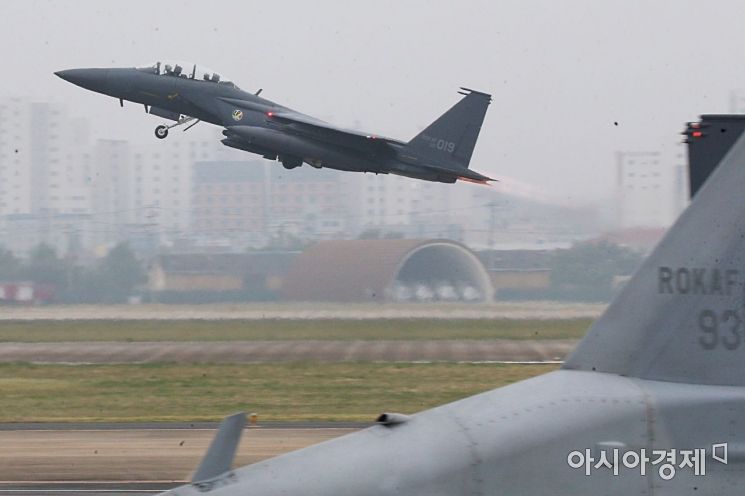
 On the 1st, in celebration of Armed Forces Day, an F15K fighter jet is taking off to carry out its mission at Daegu Air Base (11th Fighter Wing) during the '71st Armed Forces Day event.' /Daegu=Photo by Joint Press Corps
[Asia Economy Reporter Yang Nak-gyu]A close-in defense weapon system that protects friendly ships from enemy high-speed infiltration boats and anti-ship guided missiles is being researched and developed domestically. Additionally, the Air Force F-15K fighter jets will be equipped with a Joint Tactical Data Link (Link-16) system that prevents jamming and enables secure communication.
According to the Defense Acquisition Program Administration (DAPA) on the 27th, DAPA held the 127th Defense Acquisition Promotion Committee (hereinafter referred to as the Committee) meeting on the 26th and approved the basic strategy plan for the Close-In Weapon System-II project and the revised procurement plan for the aircraft anti-jamming GPS system project (F-15K performance upgrade phase 3).
The Close-In Weapon System-II project refers to a weapon system that defends friendly ships at the final stage against threats such as anti-ship guided missiles and high-speed infiltration boats. It was decided at this meeting to develop it domestically. A budget of 350 billion KRW will be invested from next year until 2030.
The close-in weapon system developed with indigenous technology is expected to be installed on the Korean Destroyer Experimental (KDDX), known as the "mini Aegis ship," and the new Ulsan-class Batch-III frigates.
The KDDX is larger than the 4,200-ton Korean Destroyer (KDX-II) but smaller than the 7,600-ton Aegis destroyer (KDX-III), which is the main force of the Navy's mobile fleet, hence it is called the "mini Aegis ship." It will replace existing close-in weapons such as the 20mm Phalanx CIWS and the 30mm Goalkeeper CIWS.
The aircraft anti-jamming GPS system project involves equipping the Air Force F-15K fighter jets with anti-jamming antennas, Identification Friend or Foe (IFF) equipment, and the Joint Tactical Data Link (Link-16) to enhance jamming resistance and encryption (secure communication) capabilities.
At this meeting, the negotiation start conditions were changed to enable swift and smooth negotiations in accordance with the required performance for the transition to the IFF equipment "Mode-5." The contract is expected to be signed in the second half of this year. DAPA stated that 300 billion KRW will be invested by 2025.
© The Asia Business Daily(www.asiae.co.kr). All rights reserved.

















