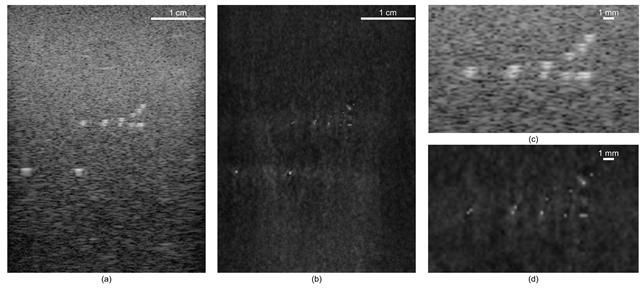
 This is a comparison image between conventional ultrasound and the ultrasound developed by the research team. (a) is an ultrasound image reconstructed using the conventional B-mode imaging method. (b) is an ultrasound image reconstructed using the random interference method proposed by the research team. (c) and (d) are images showing a 2x magnification of the ultrasound images restored by the conventional B-mode imaging method and the proposed method, respectively.
[Asia Economy Reporter Hwang Junho] Domestic researchers have developed a technology that improves the resolution of diagnostic ultrasound, commonly used in health checkups, by four times. It is expected to open the way to obtain clearer human body images at a lower cost compared to other diagnostics such as MRI (Magnetic Resonance Imaging) and CT (Computed Tomography).
The research team developed an ultrasound system that obtains images of the target through random interference of artificially generated ultrasound waves and mathematical optimization. They also succeeded in distinguishing nylon threads as thin as 0.25 nanometers (nm).
Existing diagnostic ultrasound devices provide images that can distinguish sizes down to 1 nm by focusing ultrasound intensively on the area to be observed using beamforming methods.
Professor Lee Heung-no said, "This research is significant as it is one of the 'Seeing Through Computation' technologies, which means 'you can see better through computation.' By applying this technology to the field of ultrasound imaging, we developed a new fundamental technology that greatly enhances the resolution of ultrasound imaging devices," adding, "It is expected to greatly contribute to creating ultrasound imaging devices with clearer and cleaner image quality in the future."
Meanwhile, this research was introduced in the academic journal in the field of ultrasound imaging, IEEE Transactions on Ultrasonics, Ferroelectrics, and Frequency Control.
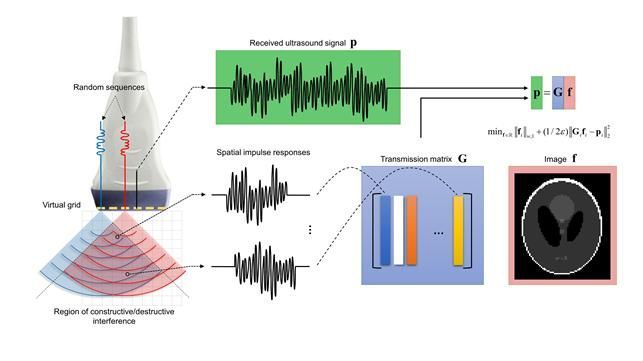 This illustration explains the ultrasonic system developed by the research team. Each element of the linear transducer is excited by ultrasonic waves in a random pattern. The transmitted wavefront exhibits a spatially random pressure distribution due to the interference of multiple ultrasonic waves. Each column of the transmission matrix is obtained through the impulse response at a virtual grid point. Thanks to the interference effect of the random sequence, the spatial impulse responses have low correlation with each other. High-resolution ultrasonic images are reconstructed using the measured ultrasonic signals and the transmission matrix.
© The Asia Business Daily(www.asiae.co.kr). All rights reserved.


















