-Yuan Value Hits Lowest Since February 27, 2008
-Currency War Emerges Amid US-China New Cold War Concerns
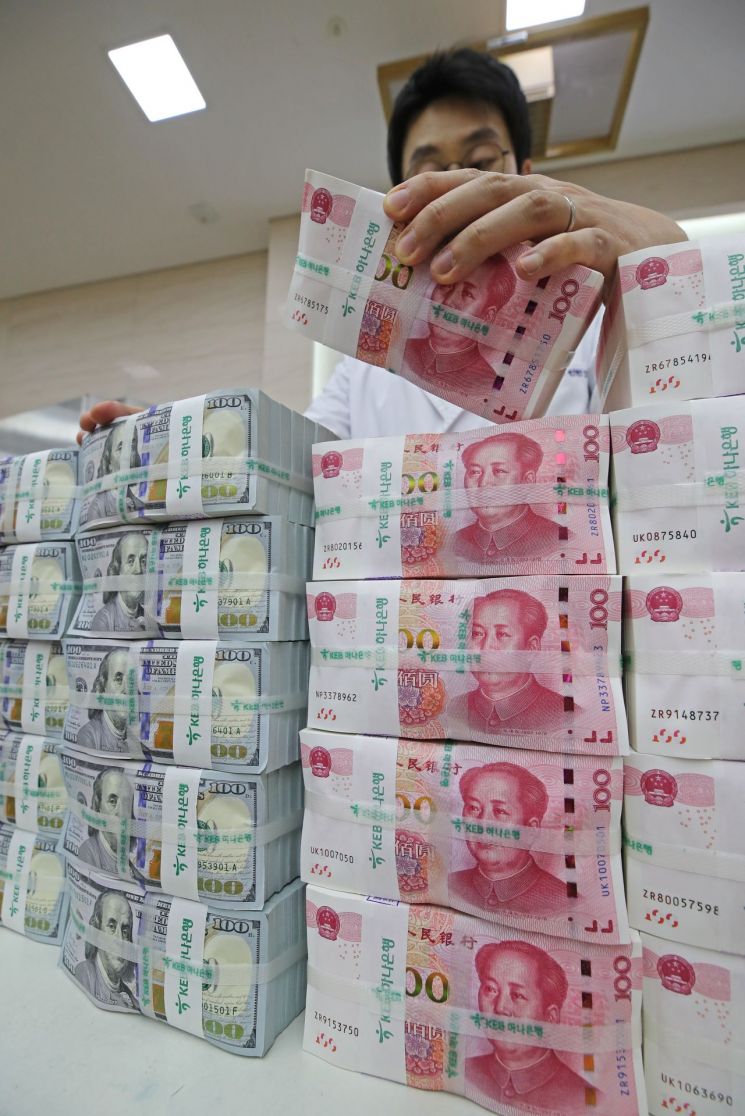
[Asia Economy Beijing=Special Correspondent Park Sun-mi] The value of the Chinese yuan has fallen once again. Amid emphasis on boosting domestic consumption to revive the economy hit by the spread of the novel coronavirus infection (COVID-19), the exchange rate was adjusted to favor exports. This has led to a convincing interpretation that it is largely aimed at the United States. China has expanded its war zone with the U.S. to currency.
On the 26th, the People's Bank of China announced the yuan's official midpoint exchange rate against the dollar at 7.1293 yuan, up 0.12% from the previous trading day. Following a 0.38% increase on the previous day?the largest since the 16th of last month?the rate was adjusted upward by 0.5% over two days. The official exchange rate is the highest since February 27, 2008. This means the yuan's value against the dollar has dropped to its lowest level in over 12 years. Since the yuan exchange rate traded in the foreign exchange market can move within a 2% range above or below the official midpoint rate, the official rate announced by the People's Bank serves as a benchmark for exchange rate movements.
The yuan's depreciation reflects the ongoing conflicts with the U.S., including the promotion of the "Hong Kong National Security Law" (Hong Kong Security Law). The deepening U.S.-China conflict, described even as a "new Cold War," has led to risk-averse behavior in the foreign exchange market, resulting in a strong dollar and yen and a weak yuan.
Especially considering that Chinese President Xi Jinping emphasized boosting domestic consumption rather than exports, the yuan's depreciation can be interpreted as a willingness to engage in a currency war. China has announced a 100 trillion won scale economic stimulus centered on promoting domestic consumption rather than exports through the Two Sessions.
President Xi recently attended the joint meeting of the economic committee of the Chinese Communist Party's National Committee of the Chinese People's Political Consultative Conference (CPPCC) and acknowledged that "China is facing difficulties due to the global economic recession, fluctuations in international financial markets, protectionism and unilateralism by some countries, and rising geopolitical political risks," urging that "from now on, China must take domestic consumption as both the starting point and the goal."
The Hong Kong South China Morning Post (SCMP) evaluated that China is promoting a new economic development plan focusing on the domestic market rather than export-led growth, which is a strategic shift in preparation for the worst economic scenario following the COVID-19 crisis. In contrast, the People's Bank's move is quite the opposite.
However, some analyses suggest that yuan depreciation is inevitable as China plans a large-scale economic stimulus. The Chinese government announced in this year's work report that it would significantly raise the fiscal deficit ratio relative to GDP from the existing 2.8% to "3.6% or more" to support large-scale economic stimulus. This could serve as an escape route allowing further yuan depreciation while avoiding suspicion of "deliberate currency manipulation" claimed by the U.S.
Last year, as the U.S.-China trade war peaked in August, the yuan's depreciation accelerated sharply, eventually breaking the psychological support level in the foreign exchange market of "1 dollar = 7 yuan." If the yuan's depreciation continues at the current pace, it is likely to surpass 7.2 yuan per dollar soon. Zhou Hao, an economist at Commerzbank, said, "The People's Bank of China is likely paying close attention to whether the 7.2 yuan per dollar level is breached," adding, "Depending on how U.S. President Donald Trump reacts to the Hong Kong issue, the yuan's volatility is expected to increase for the time being."
© The Asia Business Daily(www.asiae.co.kr). All rights reserved.
!["The Woman Who Threw Herself into the Water Clutching a Stolen Dior Bag"...A Grotesque Success Story That Shakes the Korean Psyche [Slate]](https://cwcontent.asiae.co.kr/asiaresize/183/2026021902243444107_1771435474.jpg)
















