Demand for Recyclables Drops and Prices Fall Due to COVID-19
PET Recycled Material Storage Capacity 80% Full
Waste Crisis of 2018 May Repeat, Public Inconvenience Feared
[Asia Economy Reporters Kim Bo-kyung, Moon Chae-seok] "Among about 200 apartment complexes with recycling collection contracts, contracts with 40 have been terminated, and 6 out of 40 employees have been laid off. We have also seen several companies already closed down."
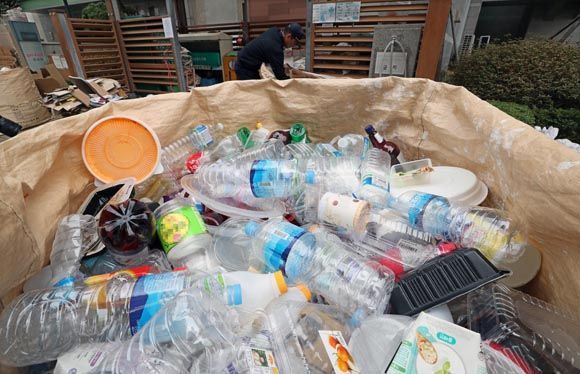
The novel coronavirus disease (COVID-19) crisis is attacking the weakest parts of our society. This time, it is the recycling industry. Due to the global economic downturn, demand for recyclables has decreased, and the sharp drop in international oil prices has caused recycling prices to fall for three consecutive months. As export routes have been blocked and recyclables have piled up in warehouses, small collection companies have taken the hardest hit. The more recyclables collected from apartments were sold, the more losses were incurred. Additionally, with social distancing and avoidance of going out, parcel delivery and food delivery consumption have increased, leading to a rise in disposable product waste. As waste increases but profitability does not, some companies have even refused to collect. There are concerns about a 'second waste crisis.'
According to the Ministry of Environment on the 26th, the selling price of recycled plastic raw materials in March fell 14% compared to the same period last year. Last month, the storage volume of recycled PET bottles reached 13,000 tons, which is 80% of the total allowable storage capacity, effectively reaching saturation. The price of waste paper per kilogram dropped 32.5%, from 83 won in February last year to 56 won in March this year. However, collection companies reported that when they proposed price adjustment plans to apartment complexes to meet the price, they were often rejected. Park (56), who has operated a collection company in Gimpo City, Gyeonggi Province for 15 years, said, "Even if we promise to restore the amount if recycling prices rise, many do not accept it and terminate contracts," adding, "Each company has no choice but to compete in a 'cutting their own flesh' style." Some companies are heading toward closure. A collection company in Busan said, "Two clients who used to give about 2 tons of work every two weeks terminated contracts," and added, "We are reducing factory operations and are practically preparing to close."
Due to cost-cutting measures by companies amid the COVID-19 impact, residents are also experiencing inconvenience. Kim (33), living in a residential-commercial complex apartment, said, "The apartment announced that if residents do not remove the plastic labels attached to PET bottles themselves, they will not collect them," explaining, "If labels are not removed, the outsourced collection company has to remove them directly."
The Ministry of Environment and local governments are implementing measures such as a price linkage system reflecting and adjusting recycling price declines in contracts between multi-family housing (apartments) and collection companies, separate collection of colorless waste PET bottles, public stockpiling of 10,000 tons of recycled PET raw materials, and a ban on waste imports. However, the policy effects are not easily reaching the field. In particular, collection companies find it difficult to change existing contract terms with apartments, and if contracts are terminated, they fall into a vicious cycle of financial difficulties. A Ministry of Environment official stated, "We are taking measures to prevent a repeat of the 2018 waste crisis."
© The Asia Business Daily(www.asiae.co.kr). All rights reserved.
![User Who Sold Erroneously Deposited Bitcoins to Repay Debt and Fund Entertainment... What Did the Supreme Court Decide in 2021? [Legal Issue Check]](https://cwcontent.asiae.co.kr/asiaresize/183/2026020910431234020_1770601391.png)