Korea Federation of SMEs Announces Results of 'COVID-19 Related SME Workforce Supply and Demand Survey'
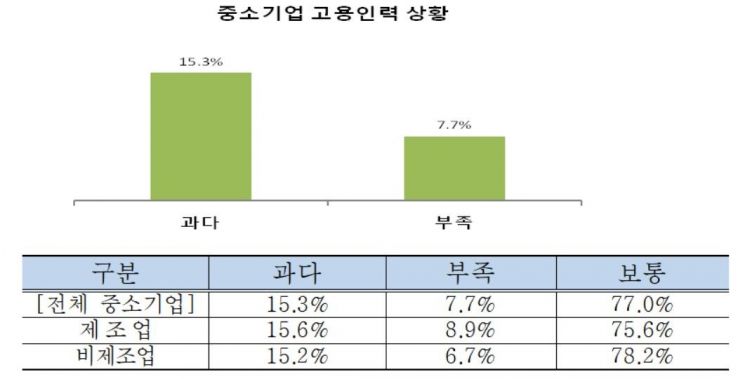
[Asia Economy Reporter Kim Cheol-hyun] While 15.3% of small and medium-sized enterprises (SMEs) reported that their workforce is excessive, only 7.7% of SMEs said their workforce is insufficient. The employment market is expected to become unstable in the future. On the 26th, the Korea Federation of SMEs (Chairman Kim Ki-moon) announced the results of the 'COVID-19 Related SME Workforce Supply and Demand Survey' conducted from the 20th to the 22nd on 300 SMEs, revealing these findings.
According to the survey, among companies that responded that their workforce is 'excessive,' 3 out of 10 reported having already reduced an average of 10.2 employees since the outbreak of the novel coronavirus infection (COVID-19). Manufacturing industries reduced an average of 20.3 employees, while non-manufacturing industries reduced an average of 7.2 employees. Overall, 4.3% of all surveyed SMEs reported workforce reductions.
The main reason for having an excessive workforce was 'reduced workload due to COVID-19' at 95.7%, followed by 'seasonal factors causing short-term workload reduction' at 28.3%, and 'several years of stagnant company growth' at 17.4%. Additionally, the reasons for planning workforce reductions this year were 'lack of operating funds such as labor costs' at 61.5%, 'preemptive response to expected economic downturn' at 26.9%, and 'decrease in sales' at 7.7%, respectively.
Regarding additional hiring plans, only 18.5% of companies that responded their workforce was insufficient or average said they have hiring plans this year, with an average of 3.3 new hires. As for support measures needed to promote employment and job creation, 'subsidies for SME employment' was the most common response at 70.3%, followed by 'expansion of preferential support policies and social awareness improvement for SME employees' at 57.0%, 'restraining minimum wage increases and applying differentiated rates by industry and size' at 51.7%, and 'flexible working hours such as supplementary legislation for the 52-hour workweek' at 41.0%.
Choo Moon-gap, Head of the Economic Policy Division at the Korea Federation of SMEs, stated, "Due to the economic downturn caused by COVID-19, the majority of SMEs and small business owners have already reduced or need to reduce their workforce, making workforce management worse than ever." He added, "Effective employment and job policies are needed through rational institutional improvements such as expanding government employment retention subsidies, preparing supplementary legislation for the 52-hour workweek, and determining minimum wages considering the recent economic situation and companies' payment capacity."
© The Asia Business Daily(www.asiae.co.kr). All rights reserved.

















