[Asia Economy Reporter Hwang Yoon-joo] SKC is set to secure mass production technology for biodegradable bioplastics with dramatically enhanced strength. This material, licensed from the Korea Research Institute of Chemical Technology (KRICT), is a high-strength PBAT (polybutylene adipate-co-terephthalate) reinforced with nanocellulose extracted from wood pulp, overcoming the weaknesses of conventional PBAT, which tends to tear easily or stretch excessively.
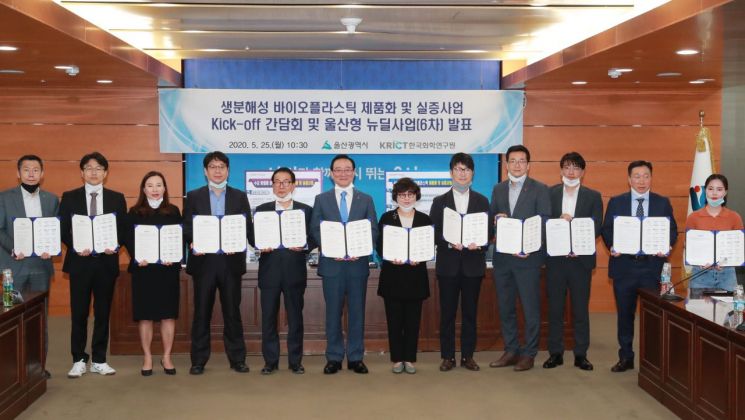
On the 25th, SKC announced that it signed an MOU with Ulsan Metropolitan City, along with KRICT and others, at Ulsan City Hall to participate in the Ministry of Trade, Industry and Energy’s “Biodegradable Bioplastics Commercialization and Demonstration Project.” A total of 16 organizations, including SKC, KRICT, and material companies, are involved in this ministry-led demonstration project.
SKC and KRICT, which are directly participating in the project, will develop mass production technology for the material, expand its applications, and develop biodegradation rate control technology. Ulsan, which has cooperated with KRICT in developing high-strength PBAT technology, will provide facilities necessary for the demonstration project such as landfill sites and will handle administrative support including ordinance enactment.
High-strength PBAT is a biodegradable bioplastic improved from conventional PBAT, which has low tensile strength. PBAT, made from petroleum-based substances, boasts eco-friendliness by decomposing 100% within six months underground and flexibility, but its tendency to tear easily limited its application range. To address this, KRICT utilized nanocellulose from wood as a reinforcing agent for PBAT.
As a result, high-strength PBAT now possesses tensile strength comparable to widely used petroleum-based plastics. This new PBAT can replace petroleum-based non-degradable plastic materials such as single-use plastic bags, mulch films, and injection-molded products, contributing to solving the plastic waste problem.
Recognizing this potential, SKC decided to acquire the technology license from KRICT. SKC, which commercialized the world’s first biodegradable PLA film, is expanding its business by making eco-friendly materials a key item in its BM innovation. Last year, SKC joined the Alliance to End Plastic Waste (AEPW) and is promoting projects for plastic waste recycling and resource recovery.
SKC will collaborate with KRICT and others participating in the demonstration project to rapidly secure mass production technology. SKC plans to supply the high-strength PBAT raw material it produces to companies manufacturing plastic bags, straws, and injection-molded products, identify areas for improvement, and make enhancements. At the same time, it is reviewing various measures including investments with a goal of commercialization in 2021.
© The Asia Business Daily(www.asiae.co.kr). All rights reserved.

















