[Asia Economy Honam Reporting Headquarters Reporter Park Seon-gang] Gwangju Metropolitan City announced on the 25th that it is actively promoting support measures to solidly advance the ‘2020 Gwangju-type Cooperative Governance Village Model Project,’ which supports residents' autonomous activities through village communities.
Through the ‘Gwangju City Village Community Integrated Contest’ held last March, the 2020 Gwangju-type Cooperative Governance Villages selected were ▲Bangnim 2-dong as a village preparing for the Residents' Autonomy Committee, and 11 cooperative governance villages including Hakun-dong, Jisan 1-dong, Seochang-dong, Nongsung 1-dong, Sajik-dong, Wolsan-dong, Munheung 2-dong, Unam 1-dong, Seokgok-dong, and Sinhung-dong.
In the Gwangju-type Cooperative Governance Villages, based on the cooperative governance network established within the village, efforts will be made to expand resident participation and promote resident capacity-building village education, discover village agendas, select village agendas through residents' general meetings, establish village plans, and execute village agendas to address village issues and projects.
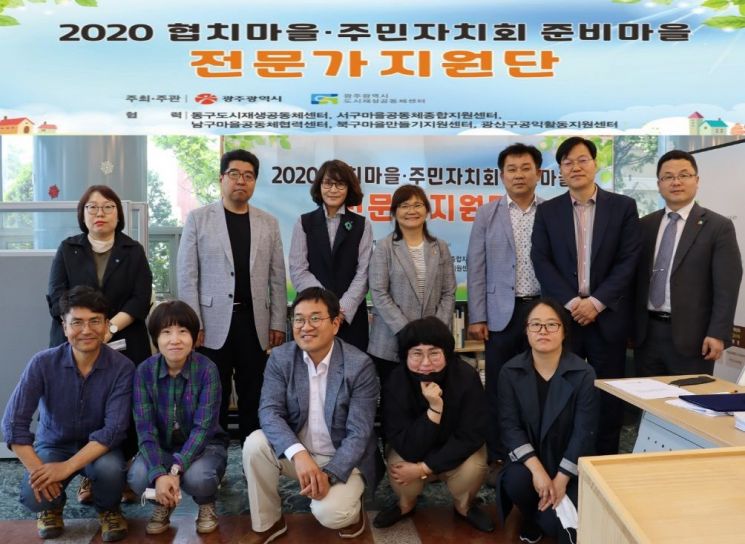
Gwangju City formed a professional support group consisting of 11 members including researchers and village activists on the 15th to help cooperative governance villages carry out projects suited to each village's characteristics and assist in solving village issues. They held a workshop to share the current status of cooperative governance villages and discuss the operation plan of the professional support group.
The professional support group will provide one-on-one advisory services to cooperative governance villages, and Gwangju City Urban Regeneration Community Center and Autonomous District Community Centers will support sharing of consulting processes and results for each village.
Gwangju City will select village coordinators from residents with village activity experience to promote village networks and activities, assigning one coordinator per village (dong) to support cooperation among various communities within the village to solve village issues.
Additionally, at the Gwangju Village School of the Gwangju City Urban Regeneration Community Center, cooperative governance village education is provided to enhance understanding and value sharing of cooperative governance between network representatives and residents, and to improve execution capabilities necessary for establishing cooperative governance culture and systems, combining theoretical and practical education on cooperative governance villages.
In particular, to prevent COVID-19 this year, educational videos were filmed, and on the 22nd, the first online video education was conducted with each village gathering separately.
The second group education is planned to be held on the 1st and 4th of next month, divided into three small groups per village, targeting residents within 20 people each, at the Happiness Meeting Room on the first floor of the city hall and other locations.
Kim Soon-ok, Director of the Autonomous Administration Division of the city, said, “It takes a long time to accumulate the residents' autonomous capabilities necessary to realize practical resident autonomy in the era of decentralized autonomy,” and added, “We will successfully promote the Gwangju-type Cooperative Governance Village Model Project to further activate village community activities.”
© The Asia Business Daily(www.asiae.co.kr). All rights reserved.

















