3rd Supplementary Budget and Nationwide Employment Insurance Funding Necessitate Tax Increase
National Research Institute KDI Also States "Tax Increase Discussions Needed in Mid to Long Term"
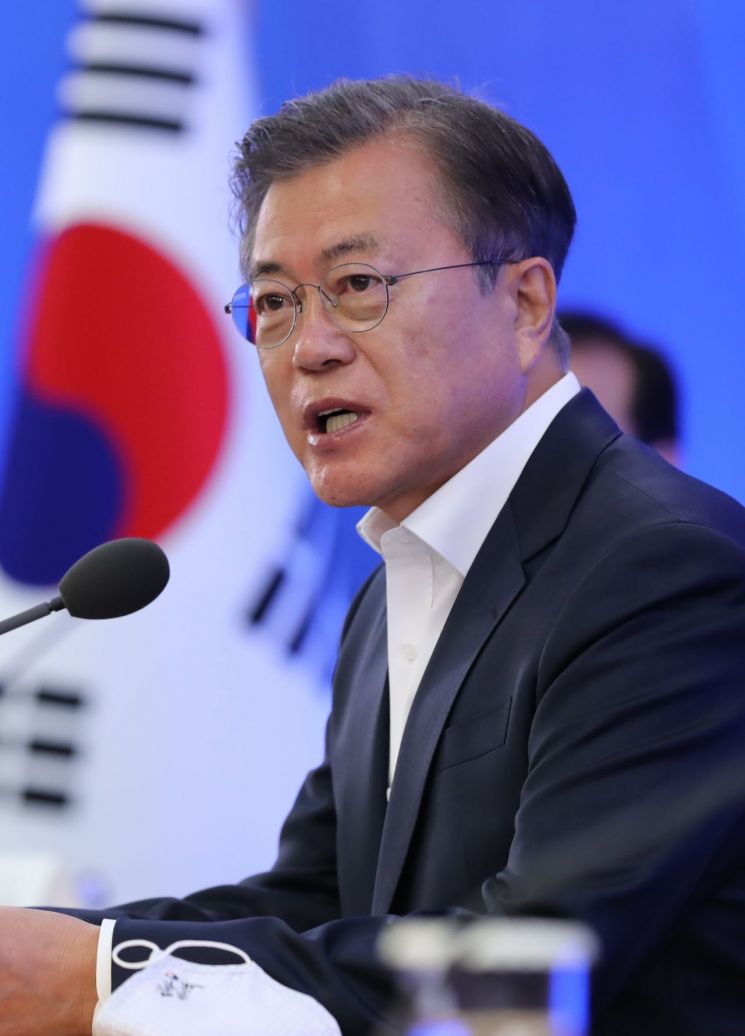
[Sejong=Asia Economy Reporter Kim Hyunjung] At the fiscal strategy meeting chaired by President Moon Jae-in on the 25th, discussions on the government's expansionary fiscal policy in response to the novel coronavirus disease (COVID-19) crisis and related tax increase measures are expected to ignite. If the ruling party's proposal for a third supplementary budget (supplementary budget) approaching 50 trillion won is formulated, the national debt-to-GDP ratio will soar above 45%, and considering the required funds for the nationwide employment insurance enrollment drive promoted by the government, a tax increase is practically inevitable.
According to the Blue House and the Ministry of Economy and Finance on the 25th, President Moon will hold a national fiscal strategy meeting involving the ruling party, government, and the Blue House to establish the fiscal management plan for 2020?2024. In particular, the government’s fiscal execution scale in response to COVID-19 will be discussed, and the current status of fiscal soundness indicators will also be shared.
Following two supplementary budgets amounting to 11.7 trillion won (1st) and 12.2 trillion won (2nd), respectively, the government’s national debt ratio has already risen to 42.5%, based on national debt of 819 trillion won and a potential growth rate (real growth rate + inflation rate) of 0.6% (Korea Development Institute, KDI). If the third supplementary budget is pushed forward at the ruling party’s proposed maximum scale of 50 trillion won, the national debt ratio will surge to 45.1%. Even if the third supplementary budget is formulated at the ruling party’s low estimate of around 40 trillion won, the debt ratio will reach 44.6%, and this ratio will increase further if growth underperforms expectations.
Regarding concerns about deteriorating fiscal soundness raised steadily since the supplementary budget formulation process, a "tax increase" is identified as almost the only breakthrough. Considering the high uncertainty, active fiscal spending is unavoidable, but to prevent this fiscal condition from becoming entrenched by shouldering the burden entirely as national debt, fiscal revenue to cover expenditures is necessary. On the 20th, Jung Kyu-chul, head of the Economic Outlook Office at KDI, a government-affiliated policy research institute under the Ministry of Economy and Finance, also stated, "Due to worsening corporate performance and the spread of COVID-19, national tax revenue this year will fall significantly short of budget plans," and added, "Mid- to long-term discussions on tax increases are necessary."
Furthermore, considering the government’s push for nationwide employment insurance enrollment expanding the scope of beneficiaries and active discussions on Finland-style basic income based on the multiplier effect model, it is pointed out that a de facto tax increase, including raising insurance premium rates, is inevitable. Based on the second supplementary budget, this year’s total expenditure (531.1 trillion won) increased by 13.1% compared to the previous year. The increasingly significant social security funds have already turned to deficits since 2018. The employment insurance fund recorded a deficit of 2 trillion won last year.
However, public opposition to tax increases is also expected to be considerable. According to an analysis by Rep. Chu Kyung-ho of the United Future Party on annual national and local taxes (provisional figures) and social security contributions with quasi-tax characteristics, the per capita national burden last year exceeded 10.14 million won for the first time. The national burden rate, calculated by dividing the national burden amount by GDP, also reached an all-time high of 27.4% last year. If the currently proposed tax increases materialize, the already high tax burden rate and national burden rate will rise even further.
© The Asia Business Daily(www.asiae.co.kr). All rights reserved.

















