Investigation of 40 Sites Over One Year Starting from Daeseongdong Village in Paju
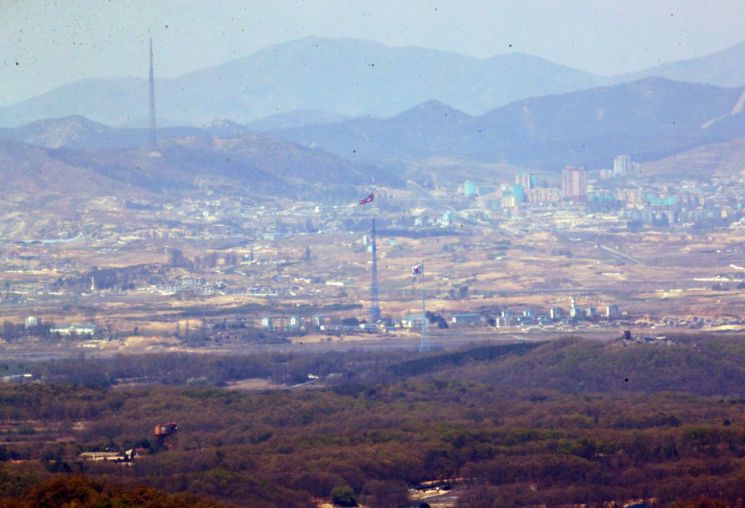
The Cultural Heritage Administration and the Gyeonggi and Gangwon provinces are launching a survey of the Demilitarized Zone (DMZ).
On the 25th, the Cultural Heritage Administration announced that starting from Daeseongdong Village in Paju on the 26th, they will conduct investigations over about a year in forty locations including the Joint Security Area (JSA) in Panmunjom, Taebong Cheorwon Fortress, the northeasternmost Guard Post (GP) in Choseong, the Daemamsan and Daewoo Mountain Natural Protection Areas, and the Geonbongsan and Hyangrobong Natural Protection Areas. This is part of the project for the peaceful transformation of the DMZ agreed upon by South and North Korea in the April 27 Panmunjom Declaration.
An official stated, “This is the first comprehensive cultural and natural heritage survey conducted across the DMZ, which has remained an unknown land for over 70 years,” adding, “We plan to discover the value of the DMZ as a symbolic space of national reconciliation and peace and use the findings as foundational data for various efforts toward peaceful transformation.”
The government’s four main goals for the peaceful transformation of the DMZ are: ▲jointly pursuing UNESCO World Heritage registration by South and North Korea ▲designating a peace cooperation zone connecting Panmunjom and Kaesong ▲attracting UN agencies and peace, ecological, and cultural organizations within the DMZ ▲and cooperating with UN mine action organizations for the removal of landmines in the DMZ.
This survey is the first step in a grand plan. The official said, “We have been closely coordinating with the Ministry of National Defense, Ministry of Unification, and the UN Command to prepare an implementation plan for the DMZ cultural heritage survey.” The survey, led by the National Research Institute of Cultural Heritage, Gyeonggi Cultural Foundation, and Gangwon Cultural Heritage Research Institute, will involve fifty-five researchers specializing in cultural, natural, and world heritage fields. At the launch ceremony to be held tomorrow (the 26th) at 10 a.m. at the Paju Traditional Architecture Repair Technology Promotion Foundation, important notes and detailed schedules will be shared before the survey begins.
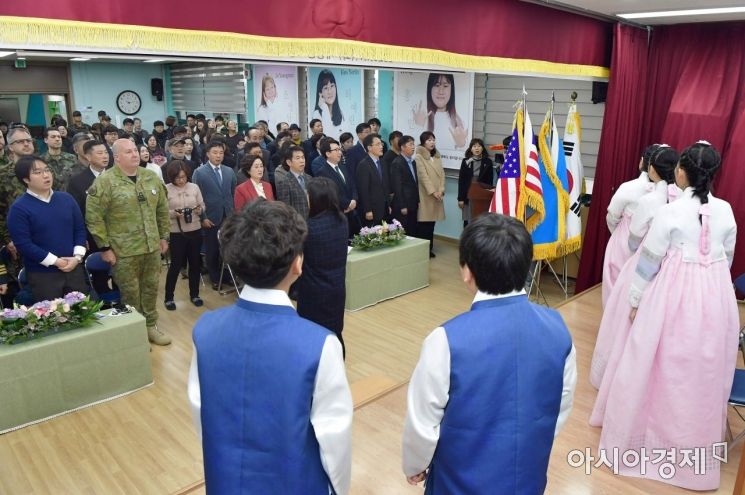 On the morning of the 7th, the graduation ceremony of Daeseongdong Elementary School, located within the DMZ in Paju, Gyeonggi Province, was held. Attendees are performing the national anthem. Photo by Joint Press Corps
The first survey area, Daeseongdong Freedom Village, is administratively located in Josan-ri, Gunnae-myeon, Paju City. It was established as a civilian residential village within the Panmunjom JSA following the 1953 Armistice Agreement, where South and North Korea agreed to each have one civilian village. The distance from the village to Panmunjom is about 1 km. The distance to Gijeongdong, the North Korean civilian settlement in the DMZ, is only about 800 meters. Daeseongdong Village is under the control of the UN Command, not the South Korean government. This is based on Article 1, Paragraph 10 of the Korean Armistice Agreement, which states that “civil administration and relief work south of the Military Demarcation Line within the DMZ shall be the responsibility of the Commander of the United Nations Command.”
The survey team will examine the cultural landscape shaped by division in the lives of residents living within the DMZ. Additionally, they will verify archaeological traces at Taeseong and other sites to the west of the village, which until now could only be inferred from historical documents. Taeseong is an earthen fortress near the Military Demarcation Line. It is famous for its two-story octagonal pavilion installed for visitors. Visitors can view the North Korean scenery without binoculars, and in preparation for incidents such as shootings in 2010, bulletproof glass has been installed on three sides of the pavilion’s front.
© The Asia Business Daily(www.asiae.co.kr). All rights reserved.


















