[Asia Economy New York=Correspondent Baek Jong-min, Beijing=Correspondent Park Sun-mi, Reporter Na Ju-seok] The United States is increasing pressure to a level equivalent to an economic blockade in response to China’s enactment of the Hong Kong National Security Law. Amid the spotlight on lawsuits for damages against China following the COVID-19 pandemic, sanctions on Chinese telecommunications company Huawei, and the possibility of reconsidering the Phase One US-China trade agreement, the US has clearly stated its intention to withdraw Hong Kong’s special status. This can be interpreted as a de facto economic blockade, as it could potentially paralyze the Chinese economy.
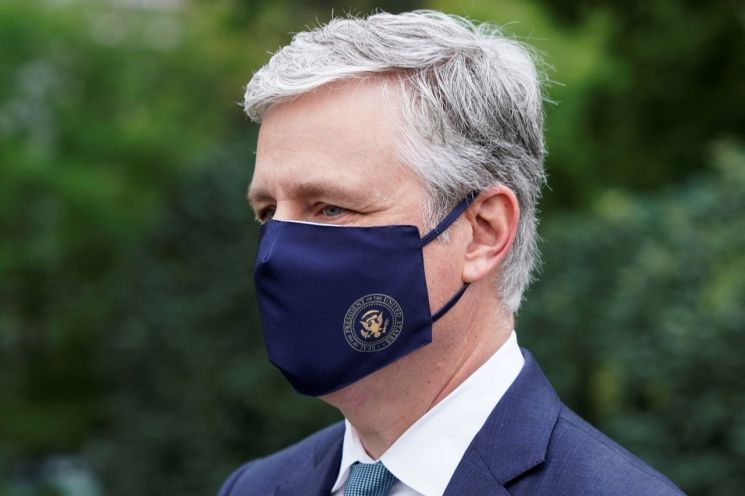
On the 24th (local time), US media including CNBC cited remarks from Robert O’Brien, US National Security Advisor, analyzing that "the US government is expected to sanction China." In an interview with CNBC and other broadcasters that day, O’Brien warned, "If China enacts the Hong Kong National Security Law, Secretary of State Mike Pompeo will not be able to certify that Hong Kong maintains autonomy," adding, "If this happens, sanctions will be imposed on Hong Kong and China."
If China pushes forward with the enactment of the Hong Kong Security Law, the US will reassess and revoke the special status granted to Hong Kong. This reassessment could ultimately affect the mainland Chinese economy, effectively resulting in an economic blockade against China. O’Brien said, "We are in a completely different world than when negotiations began. We want to respect the Phase One agreement, but we are negotiating in the era of COVID-19," indicating that US-China conflicts are clearly impacting trade negotiations between the two countries. After Secretary Pompeo issued a statement that the US could revoke Hong Kong’s special status if the National Security Law is enforced and China showed no change in stance, the US intensified its pressure.
Since the COVID-19 outbreak, the US has continuously increased sanctions against China. Following the halt of semiconductor sales targeting Huawei, the US also revealed plans for a new economic bloc centered on allies. On the 20th, the US Senate unanimously passed the "Foreign Company Accountability Act," which regulates Chinese companies’ listings on US stock exchanges, drawing attention. This bill includes provisions that companies failing to prove they are not controlled by foreign governments or failing to pass audits by the Public Company Accounting Oversight Board (PCAOB) for three consecutive years will face delisting and trading bans.
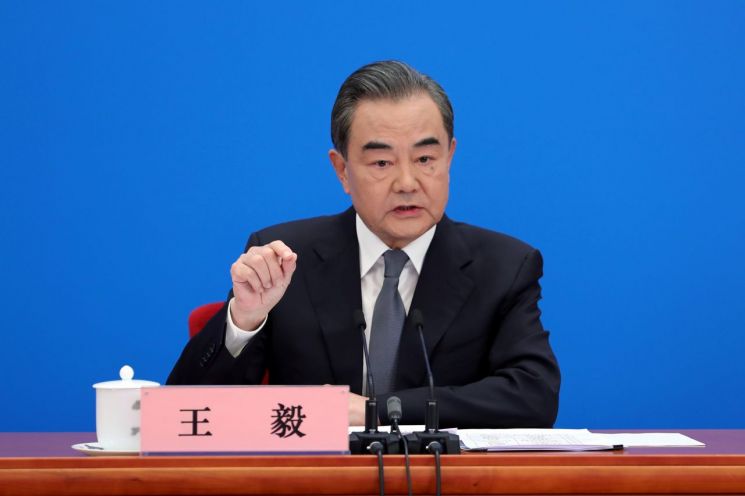
In response to the US’s economic blockade-level pressure, China also expressed a tough stance. Wang Yi, Foreign Minister and State Councilor, strongly countered the US attacks at a press conference of the National People’s Congress (NPC) held in Beijing on the 24th, directly mentioning the term "new Cold War" despite US warnings.
Wang said, "Besides the COVID-19 virus, another political virus is spreading in the US," criticizing, "Some (US) politicians fabricate too many lies about China, ignoring even the most basic facts, and are doing malicious acts targeting China." He also emphasized, "The Hong Kong issue is China’s internal affair, and no external interference is acceptable," adding, "The establishment of legal systems and enforcement mechanisms to safeguard national security in the Hong Kong Special Administrative Region cannot be delayed even for a moment. Protecting national security is the right of the Chinese central government."
Amid concerns that this could lead to economic blockade measures, the China Securities Regulatory Commission (CSRC) unusually issued a warning statement to the US. Regarding the US Senate’s passage of the "Foreign Company Accountability Act," the CSRC stated, "Judging from the content of the bill and remarks by key US congressional figures, it is directly aimed at China," and declared, "China firmly opposes politicizing securities regulation." It further warned, "This bill harms the interests of both countries and could hinder foreign companies’ listings in the US. It could undermine global investors’ trust in the US capital market and the US’s international status."
China’s strong tit-for-tat response reflects past experiences where the US imposed economic blockade measures based on political and diplomatic issues but achieved little effect. In June 1989, the US Congress passed strong economic sanctions related to the Chinese government’s harsh crackdown on pro-democracy protests in Tiananmen Square.
The sanctions passed by Congress at that time included bans on technology transfers to China and opposition to economic loans to China from international financial institutions. Earlier, then-US President George H.W. Bush suspended high-level talks with China and banned arms sales. The sanctions also included conditions that they would not be lifted unless China improved its human rights situation. Due to sanctions from the US, Europe, and other countries, China’s GDP growth rate fell to 3.9% in 1990.
However, most sanctions were lifted without being maintained for long. In Congress, bills linking China’s Most Favored Nation (MFN) status to human rights were submitted but repeatedly failed due to presidential vetoes. In 1994, then-US President Bill Clinton announced that human rights and trade with China would no longer be linked.
© The Asia Business Daily(www.asiae.co.kr). All rights reserved.
![User Who Sold Erroneously Deposited Bitcoins to Repay Debt and Fund Entertainment... What Did the Supreme Court Decide in 2021? [Legal Issue Check]](https://cwcontent.asiae.co.kr/asiaresize/183/2026020910431234020_1770601391.png)

















