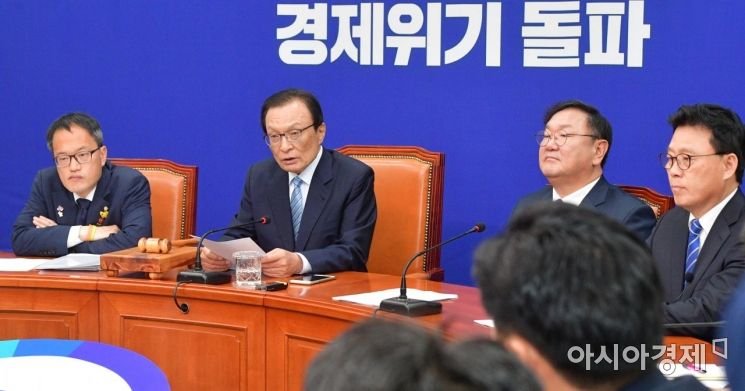
 Lee Hae-chan, leader of the Democratic Party of Korea, is attending the Supreme Council meeting held at the National Assembly on the 25th and delivering opening remarks. Photo by Yoon Dong-joo doso7@
[Asia Economy Reporter Park Cheol-eung] The 'Green New Deal' will be prioritized for schools and factories. This includes methods such as installing solar panels to produce electricity independently and replacing windows with triple glazing to improve energy efficiency. Subsidies for purchasing future vehicles like electric and hydrogen cars will be expanded, and the industry will also consider introducing mandatory sales of future vehicles. In the mid to long term, a basic roadmap for a major transition to a carbon-neutral civilization within the next 30 years will be included.
On the 25th, according to the Korean New Deal TF of the Democratic Party's COVID-19 National Crisis Overcoming Committee and related government ministries, the so-called 'Smart Green' concept will be applied to schools, factories, and industrial complexes, and detailed projects to be reflected in the 3rd supplementary budget are being refined.
TF leader Assemblyman Kim Seong-hwan said in a phone interview with Asia Economy, "Solar panels will be installed on school building roofs, windows will be replaced with triple glazing, and classrooms will be digitized. Similar models will be created for factories and industrial complexes," adding, "We need to rapidly change infrastructure to keep pace with the 4th Industrial Revolution and overcome the climate crisis."
Some school buildings already have solar power facilities installed, and the key issue is how much to expand this. Especially, replacing windows with triple glazing requires a much larger budget than solar power, so the level to be reflected in the 3rd supplementary budget must be decided through party-government consultations.
The budget for future vehicle purchase subsidies set until 2022 will be executed early by next year, and the introduction of subsidies for exchanging old cars for electric vehicles, as well as the introduction of a mandatory electric vehicle sales system, are also expected to be included in the Democratic Party's Green New Deal plan. Assemblyman Kim said, "We will include the expansion of future vehicles in the Green New Deal plan, but we need to assess the production capacity and price gaps of finished car manufacturers," adding, "We will review a roadmap to part ways with fossil fuel vehicles in the next 10 to 20 years and realize the policies that need to be prioritized."
Although 'Digital' was presented first as the direction of the Korean New Deal and 'Green' was included later, both will be promoted with equal importance and signify the first step of a major transition. Assemblyman Kim said, "Neither Digital nor Green will be subordinate concepts; they will become two main pillars," adding, "This is the full-scale start of a major transition to change from a carbon civilization to a carbon-neutral civilization by 2050. It is a direction to create new industries, jobs, and growth engines while using less carbon energy."
© The Asia Business Daily(www.asiae.co.kr). All rights reserved.

















