Ahead of July Announcement, Evaluation Begins Next Month
Investment Tight Due to COVID-19 Impact
Industry Tension Rises Over 'Number One Battle'
[Asia Economy Reporter Seol Gina Jo] Ahead of the first-ever 5G mobile communication service quality evaluation, the three mobile carriers have fallen into an investment dilemma. Although the evaluation will be in full swing from next month with the results scheduled to be announced in July, 5G network investment has been difficult due to the impact of the novel coronavirus disease (COVID-19). Some argue that a flexible approach to ICT policies, including quality evaluations, is necessary considering the unprecedented situation caused by COVID-19.
According to the related industry on the 25th, the Ministry of Science and ICT plans to start quality evaluations of 5G services provided by the three mobile carriers?SK Telecom, KT, and LG Uplus?from next month and announce the results in July. This is the first time that official results of 5G service quality evaluations will be released. The 5G quality evaluation was originally scheduled to begin last month but was delayed due to the impact of COVID-19 and the preparation of the evaluation system. A Ministry of Science and ICT official explained, "As of the end of May, the evaluation has not yet started," adding, "It took time to prepare in order to ensure fairness. The results will be announced in July."
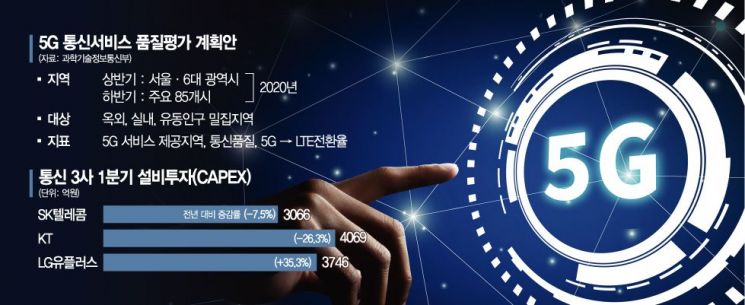
◆Investment Difficult but "Fight for First Place" = Tension in the industry is rising ahead of the evaluation that will determine '5G leadership.' However, the atmosphere is quite different from last year when carriers engaged in fierce disputes over 5G quality such as 'fastest speed' and 'most base stations.' Since there is still a long way to go to build a nationwide 5G network, and if the fight for first place is repeated, it could only increase public backlash.
The network investment situation, which is the evaluation criterion, was also unfavorable. The 5G in-building construction work, directly related to quality in subways and buildings, reached only half of last year’s target. This year, compounded by the impact of COVID-19, the capital expenditure (CAPEX) of the three mobile carriers in the first quarter was 1.0881 trillion KRW. In particular, KT’s (406.9 billion KRW) investment decrease was as much as 26.3%. An industry insider said, "It is true that network investment was sluggish at the beginning of the year," adding, "Since the 5G first-place title is at stake, subtle tensions are inevitable."
The first quality evaluation conducted in the first half of the year is limited to Seoul and six major metropolitan cities. Evaluation factors include whether 5G service is provided, call quality, and LTE fallback rate. However, the evaluation time has not been disclosed, and unlike private evaluations, it is noted that quality is comprehensively surveyed across entire administrative districts rather than specific locations. A Ministry of Science and ICT official said, "Detailed criteria are not disclosed to ensure a fairer evaluation." The quality evaluation, which will expand to 85 major cities in the second half of the year, is scheduled to be announced in November.
◆Calls for "Flexible Administrative Power" = For mobile carriers hit hard by COVID-19, it is not easy to increase investment recklessly. The CAPEX of the three carriers this year is also expected to decrease compared to the previous year. KT and LG Uplus have set annual CAPEX targets of 3.1 trillion KRW and 2.5 trillion KRW, respectively. SK Telecom has not disclosed specific figures but stated that it will decrease compared to last year.
However, even amid uncertainty about scheduled 5G investments, government demands for increased investment are becoming more explicit. The 'Korean New Deal,' presented recently as part of the government's 'post-COVID' measures, is a representative example. The ruling Democratic Party, which won a landslide victory in last month’s general election, is also expected to intensify its offensive soon with its first pledge, such as expanding free Wi-Fi. This is the background for repeated calls for more flexible administrative power across ICT policies.
An industry insider pointed out, "The government should operate policies flexibly, considering companies’ investment capacity," adding, "It is also necessary to provide institutional support such as adjusting 5G frequency allocation and usage fees or offering tax incentives for related facility investments, taking into account the impact of COVID-19."
© The Asia Business Daily(www.asiae.co.kr). All rights reserved.

















