"Disaster Relief Fund Choices Welcome" VS "Large Marts Excluded, Reverse Discrimination"
IKEA Employee "Customer Numbers Will Greatly Increase When June Discount Sales Start"
Kim Hwa-man, Chairman of Furniture Cooperative Federation "Local Businesses Harmed, Small Furniture Industry Faces Mass Bankruptcies"
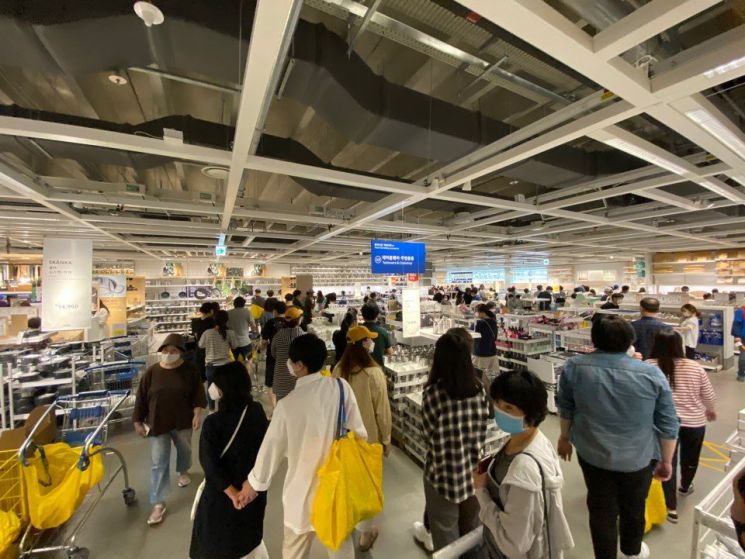 Last weekend afternoon (24th), IKEA Goyang store was crowded with about 70-80% of the usual number of customers. At IKEA, the use of the government's emergency disaster relief funds is still a subject of controversy.
[Asia Economy Reporters Kim Heeyoon and Moon Hyewon] #On Sunday the 24th afternoon, the IKEA Goyang store in Goyang-si, Gyeonggi-do was bustling with crowds looking to buy furniture and household goods. Although there were some empty spots in the parking lot and parts of the restaurant, it was not at the pre-COVID-19 pandemic level, but seemed to have recovered to about 70-80% of that time. Customers with young children noticeably decreased, but middle-aged family groups and couples filled those spots.
Kim Gaeun (25, pseudonym), who visited the store with her parents in their 60s from Ilsan, said, "I came to buy furniture for my studio apartment as I am moving out independently from my parents this time," adding, "It's good that the disaster relief funds can be used at places with a wide selection like IKEA, not just traditional markets." A couple in their 40s from Gupabal said, "We didn't know the disaster relief funds could be used at IKEA," and expressed, "The support funds are intended to help local merchants, so if they can be used at foreign companies like this, we don't understand why their use is blocked at large supermarkets."
A store employee said, "As the spread from Itaewon subsides and the June discount sales begin, we expect family visitors to increase again." Although the crowd has decreased compared to the past, it was still bustling. About 50 people were tightly packed in line at the food and beverage store near the checkout area.
IKEA stores have been controversial as places where the government's emergency disaster relief funds can be used. Compared to large supermarkets like E-Mart and Lotte Mart where the funds cannot be used, there are criticisms about the lack of fairness. IKEA became a place where the disaster relief funds can be used because it is classified as a furniture specialty store. IKEA sells a wide variety of household goods comparable to large supermarkets, including interior goods, pots, dishes, towels, and blankets. Small and medium-sized furniture industries and local small business owners, who are suffering from IKEA's entry, are even more opposed for this reason.
Kim Hwamman, chairman of the Korea Furniture Industry Cooperative Federation, a small and medium furniture industry group, raised his voice, saying, "It is neither in line with public sentiment nor fairness to allow the use of disaster relief funds at IKEA while banning it at E-Mart and Lotte Mart."
The disaster relief fund controversy has poured fuel on the fire for native furniture companies already uneasy about IKEA, a giant global furniture distributor expanding its business in Korea. The furniture industry is strongly opposing by issuing a statement demanding the government to reconsider the use of disaster relief funds at IKEA.
Starting with the first store in Gwangmyeong in January 2014, IKEA aggressively expanded its nationwide network by opening its fourth store, Dongbusan, the first outside the metropolitan area, in February this year. Last year's sales reached 503.2 billion KRW, showing an average annual growth rate of 16% since entering the Korean market. It ranks third in furniture company sales after Hanssem and Livart.
Before IKEA's entry into Korea, small and medium-sized enterprises and non-branded furniture companies accounted for 70% of the domestic furniture market sales, but they are now facing not only sales declines but also bankruptcy risks due to IKEA.
In February this year, IKEA faced controversy again for potentially infringing on the local commercial districts of traditional markets and small business owners in the Busan, Ulsan, and Gyeongbuk areas by opening the Dongbusan store. The Dongbusan store is expected to generate annual sales of 200 billion KRW, which some claim is equivalent to the total sales of traditional markets and small business owners in the Busan-Ulsan-Gyeongbuk region.
Chairman Kim said, "When the first IKEA store opened in Gwangmyeong, we strongly opposed it, saying 'native furniture companies will go bankrupt,' but they have already expanded to the fourth store," adding, "We are currently on the verge of collapse."
© The Asia Business Daily(www.asiae.co.kr). All rights reserved.

















