Transition to In-Person Classes for 2nd Year High, 3rd Year Middle, 1st and 2nd Year Elementary, and Kindergarten Students
Recommendation to Limit Total Attendance at Schools in High-Risk Areas to No More Than Two-Thirds
30,000 After-School Teachers Deployed to Support Quarantine Efforts
Policy to Minimize Teacher Workload Throughout June
Comprehensive Inspections Canceled and Cross-Curricular Hours Reduced
Elementary Care Continues with Biweekly and Alternate-Day Systems
"Home Study and Experiential Learning Recognized"
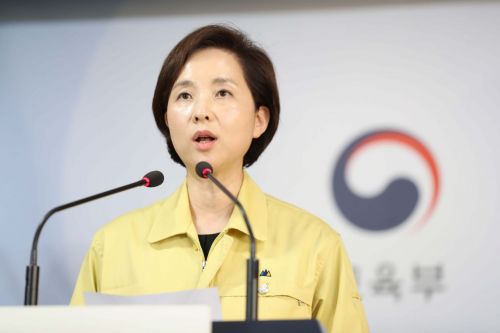 Euneh Yu, Deputy Prime Minister for Social Affairs and Minister of Education, is announcing the plan for in-person classes at elementary, middle, and high schools on the 4th at the briefing room of the Government Seoul Office in Jongno-gu, Seoul. Photo by Honam Moon munonam@
[Asia Economy Reporter Hyunju Lee] Following the 3rd-year high school students, on the 27th, the nationwide return to school for 2nd-year high school students, 3rd-year middle school students, 1st and 2nd-year elementary students, and kindergarteners is scheduled to begin as planned. The Ministry of Education is preparing measures to minimize crowding within schools to alleviate infection concerns of students and parents, while also providing quarantine support. If there are still concerns despite the education authorities' support for school classes, home study can be chosen.
On the 24th, Deputy Prime Minister and Minister of Education Yoo Eun-hye held a briefing at the Government Seoul Office on additional support measures for in-person classes, recommending that each city and provincial education office minimize the density within schools so that the number of students attending does not exceed two-thirds of the total students. About 30,000 after-school instructors, volunteers, and part-time lecturers will be deployed to support quarantine activities and student guidance.
Deputy Prime Minister Yoo said, "We intend to actively respond to the COVID-19 crisis by focusing on new in-school quarantine measures and new school class methods without indefinitely postponing in-person classes. The key is to control the number of students attending school by dispersing students, and a new school class system combining in-person and remote classes will become possible."
First, the Ministry of Education strongly recommends that in regions with high risk of infection spread, the number of students attending school should not exceed two-thirds of the total students. Additionally, to strengthen quarantine, after-school instructors, retired teachers, volunteers, and part-time lecturers will be assigned to support quarantine activities, student guidance, and operation of divided classes.
Deputy Prime Minister Yoo also stated, "June has been designated as the month to support in-person classes, and measures to reduce teachers' workload have been prepared."
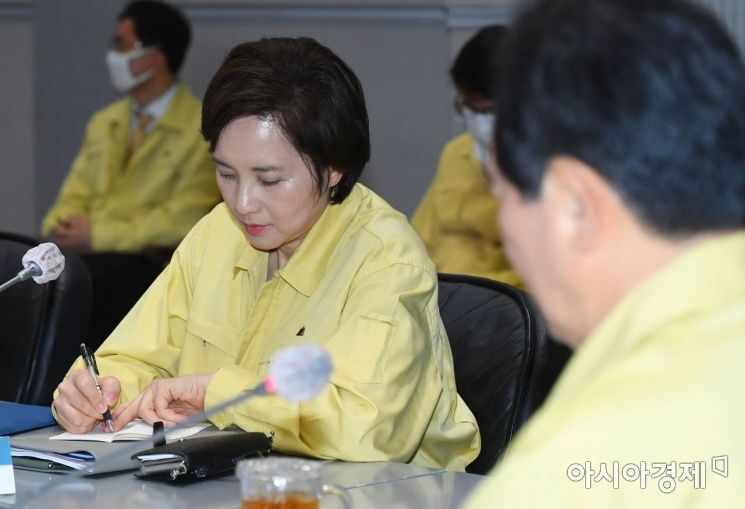 Deputy Prime Minister and Minister of Education Yoo Eun-hye is listening to Prime Minister Chung Sye-kyun's remarks at the Central Disaster and Safety Countermeasures Headquarters meeting for COVID-19 response held on the 4th at the Seoul Situation Center of the Central Disaster and Safety Situation Room in the Government Seoul Office Building, Jongno-gu, Seoul. Photo by Moon Ho-nam munonam@
During the next month, the Ministry of Education plans to significantly reduce external training, meetings, events, or business trips unrelated to classes. Even for projects promoted by the Ministry or those mandated by related laws, the Ministry will simplify project implementation methods through the deliberation of the Active Administration Support Committee and will not carry out unnecessary activities. The comprehensive audit of city and provincial education offices scheduled for this year has been canceled, and an ombudsman for reducing teachers' workload will be operated to strengthen communication with teachers. Furthermore, the school violence survey will be consolidated from twice a year to once a year, and school information disclosure will be changed to a single ad hoc input within the year. The number of hours required for cross-curricular learning will also be reduced by more than half.
For elementary after-school care, various methods such as morning, afternoon, alternate day, and alternate week systems will be operated to allow continuous use. Deputy Prime Minister Yoo said, "Elementary after-school care will be linked with academic operations to ensure that care support does not disappear."
For lower-grade elementary students, content such as EBS TV programs and learning packages will continue to be provided even during in-person class periods, and specific class types that allow for a combination of online and offline classes have been guided. To support remote classes for kindergartens, the Ministry will collaborate with city and provincial education offices and the Early Childhood Education Promotion Institute to produce and share various educational content and parent support materials, and plans to extend the provision of EBS educational broadcasting content through June.
Deputy Prime Minister Yoo said, "If parents are worried about their children's return to school despite these school class supports and wish for home study, home study is also recognized as a form of experiential learning, so please utilize off-campus experiential learning. The Ministry of Education will respond 24/7 in cooperation with the Korea Disease Control and Prevention Agency. We ask all citizens to actively participate a little more in social distancing in daily life for students' return to school and safe school life."
© The Asia Business Daily(www.asiae.co.kr). All rights reserved.
![User Who Sold Erroneously Deposited Bitcoins to Repay Debt and Fund Entertainment... What Did the Supreme Court Decide in 2021? [Legal Issue Check]](https://cwcontent.asiae.co.kr/asiaresize/183/2026020910431234020_1770601391.png)
















