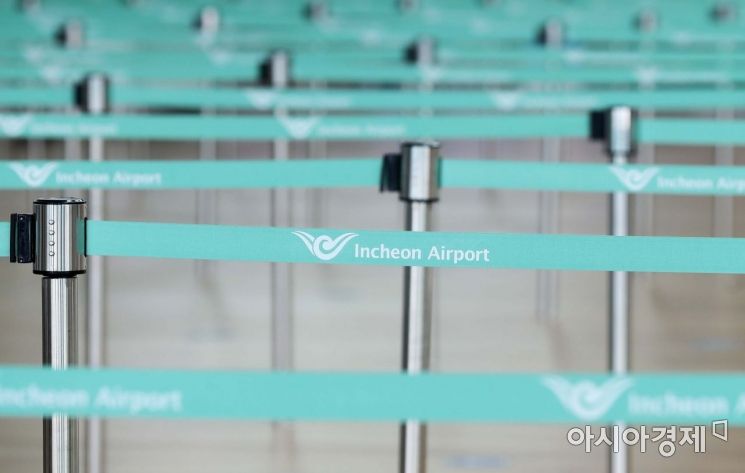
 On the 18th, the departure hall of Terminal 1 at Incheon International Airport was deserted due to the impact of the novel coronavirus disease (COVID-19), as the aviation industry, hit hard by COVID-19, faces a wave of layoffs. Photo by Mun Ho-nam munonam@
[Asia Economy Reporter Yu Je-hoon] National airlines are unlocking the tightly closed skies due to the novel coronavirus disease (COVID-19). Although there is still a long way to go before travel demand fully recovers, the possibility of business travel demand recovering is greater than ever due to the economic reopening in various countries.
According to the aviation industry on the 24th, recently low-cost carriers (LCCs) are pushing to resume international flights following the major airlines. Jeju Air is planning to resume the Incheon?Manila (Philippines) route starting in June, and Air Busan will sequentially resume international routes beginning in July, starting with routes to Hong Kong and Macau.
Major airlines have also been proactively working to resume international flights since early this month. Korean Air plans to expand its international routes to 32 starting next month, and Asiana Airlines plans to increase to 27 routes. A representative from a major airline stated, "Since China’s one airline-one route regulation has not been lifted, the suspension period for those routes has been extended by one month," adding, "Other routes are highly likely to operate as planned."
The government has also sought opinions regarding this matter. According to the industry, the Ministry of Land, Infrastructure and Transport convened airlines on the 19th to gather opinions on government support measures for the resumption of international flights.
The reason national carriers are pushing to resume international flights is interpreted as being due to the major countries’ COVID-19 spread calming down and some countries easing entry restrictions and reopening their economies. Although the overall industry consensus is that it will take at least 1 to 2 more years for travel demand to recover, business travelers such as entrepreneurs, businessmen, or residents maintain steady demand.
An industry official said, "This is a proactive move considering future business travel demand rather than actual current demand," adding, "Just as the 'Fast Track for Business Travelers' between our authorities and China has been effective, it is worth considering ways to enhance passenger convenience by exempting or shortening mandatory quarantine under certain conditions."
© The Asia Business Daily(www.asiae.co.kr). All rights reserved.

















