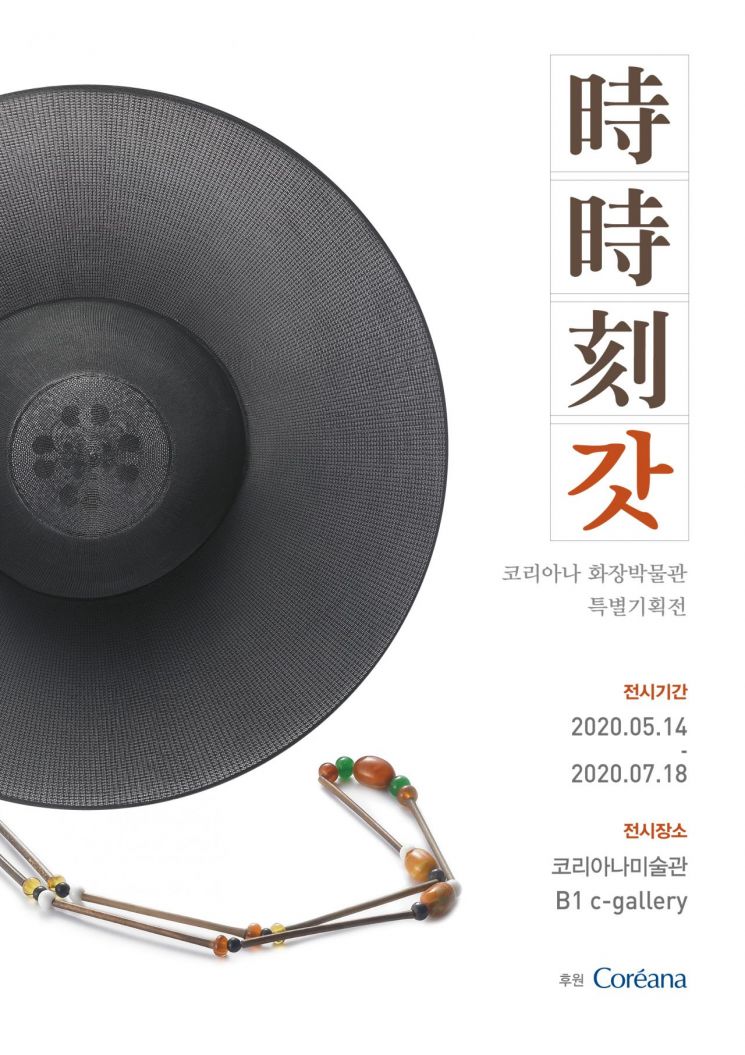
[Asia Economy Reporter Park Byung-hee] The Coreana Cosmetics Museum is hosting an exhibition titled "Sisikgak (時時刻갓)" until July 18, where visitors can explore the elegance of the traditional Korean men's hat, the gat, alongside contemporary artworks. The exhibition features over 70 artifacts including traditional gats, men's head ornaments, modern books, and postcards from the museum's collection, displayed together with works by traditional craft artisans, painters, architects, and photographers.
Since ancient times, hats in Korean culture have held significant symbolic meaning beyond their practical and decorative purposes. Especially for men who valued proper attire (uigwan jeongje, 衣冠整齊), hats that completed formal dress were particularly important. Among these, the gat stood out for its material, shape, color, and symbolism, reflecting the authority and dignity of the yangban aristocracy.
The gat has been used since the Three Kingdoms period and was established as an official headgear for government officials during the Goryeo Dynasty, thereby acquiring social significance as a marker of status. In the Joseon Dynasty, the gat evolved from the paeraengi style to the straw hat (chorip, 草笠), and finally to the black gat (heukrip, 黑笠), which was worn as the everyday official hat of the yangban class.
The gat is primarily made from horsehair and bamboo, with various types distinguished by materials, colors, and uses. These include the silk gat (sarip, 絲笠) made by threading fine silk threads one by one, the cloth-covered gat (porip, 布笠), the bamboo silk gat (juksarip, 竹絲笠), the horsehair gat (mamirip, 馬尾笠), as well as black gat (heukrip, 黑笠), white gat (baekrip, 白笠), and red gat (jurip, 朱笠). The gat, which expressed the status and style of the yangban, changed over time in height and brim width according to the era.
The gat is characterized by its delicate materials such as horsehair and bamboo, creating a subtle translucency and wave patterns formed by overlapping different materials, smooth curves, and the contrast of its black color against white clothing. Although a men's hat, it was decorated with various floral patterns called "jeongkkot" and adorned with hat strings made of beads such as jade (ok, 玉), amber (hobak, 琥珀), and gold shell (geumpae, 錦貝).
During the modernization period, the diverse types of hats worn by Koreans attracted the attention of many foreign visitors. Observing men and women of all ages wearing hats made from various materials and styles on the streets, foreigners referred to Joseon as the "Land of Hats" or the "Kingdom of Hats," leaving behind numerous writings, paintings, and photographs. Their records describe the gat in various ways, such as "pyramid-like hats," "flowerpots placed on plates," "very delicate, uncomfortable, yet beautiful hats," and "astonishingly artistic works," highlighting the form and intricacy of the gat.
During the exhibition, the Cosmetics Museum will operate a hands-on program called "Wearing a Gat, Ahem!" for children aged 7 to 11. Participants will learn about the meaning, materials, appearance, and features of the gat and have the opportunity to make their own.
The process of making a gat consists of three main steps. First, the hat is crafted from bamboo silk or horsehair, then a wide brim (yangtae) is made from bamboo, and finally, the hat and brim are connected to complete the gat. Each step requires delicate skills, and the production is divided among specialized craftsmen: the hat maker (chongmojajang), brim maker (yangtaejang), and assembler (ipjajang). It takes over 40 days of time and effort to create a single gat. Since each part utilizes different material properties, cooperation and harmony are essential throughout the process.
© The Asia Business Daily(www.asiae.co.kr). All rights reserved.

















