[Asia Economy Reporter Ki-min Lee] Amid the economic crisis caused by the novel coronavirus infection (COVID-19), it has been argued that the key 'Smart City' of the Korean New Deal policy must be led by the private sector to succeed.
The Federation of Korean Industries (FKI) stated on the 24th that after analyzing the key success factors of overseas smart cities, Korea also needs to create an institutional environment where private companies can lead the smart city industry.
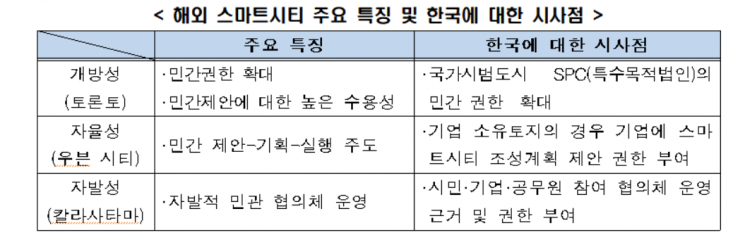
The FKI identified the main success factors of overseas smart cities as ▲government openness ▲autonomy allowing private proposals and leadership ▲voluntary participation of local businesses and residents. Successful examples of overseas smart cities include ▲Waterfront in Toronto, Canada ▲Woven City in Toyota, Japan ▲Kalasatama in Helsinki, Finland.
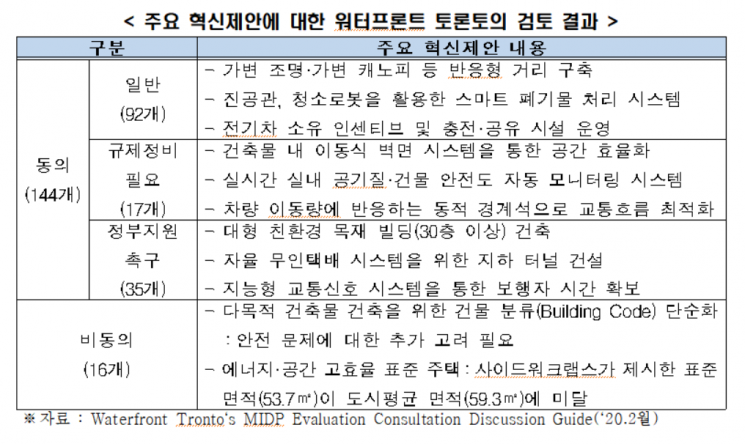
First, the Toronto Waterfront project is characterized by government proposal and private sector-led business with high government openness that accepts private companies' planning and ideas, the FKI explained. In 2001, the Canadian government established a corporation called 'Waterfront Toronto' to develop the relatively underdeveloped eastern waterfront area of Toronto. In 2017, it invited business proposals from companies worldwide and adopted the plan of Sidewalk Labs, a subsidiary of Google Alphabet and a city innovation specialist company, in the same year. Sidewalk Labs, granted full authority, submitted the 'Midtown Innovation Development Plan (MIDP)' to Waterfront Toronto in June 2019, and Waterfront Toronto agreed to 144 out of 160 innovation proposals, accounting for 90%.
Next, the FKI explained that Toyota's Woven City in Japan is a smart city notable for autonomy because the private company leads from proposal and planning to execution. Earlier, on January 6, Toyota Group announced plans to build the corporate smart city Woven City at CES, the global consumer electronics and IT exhibition. The plan is to create a city on the site of Toyota's closed factory in Susono City, Shizuoka Prefecture, Japan, where 4th Industrial Revolution technologies can be tested without restrictions. Takamura Kenji, mayor of Susono, immediately welcomed the Woven City concept, and Shizuoka Prefecture also launched a dedicated task force. Toyota is currently collecting ideas for city construction online from around the world and is building a close cooperative system by exchanging shares with domestic ICT companies such as Panasonic and NTT to increase the likelihood of project success.
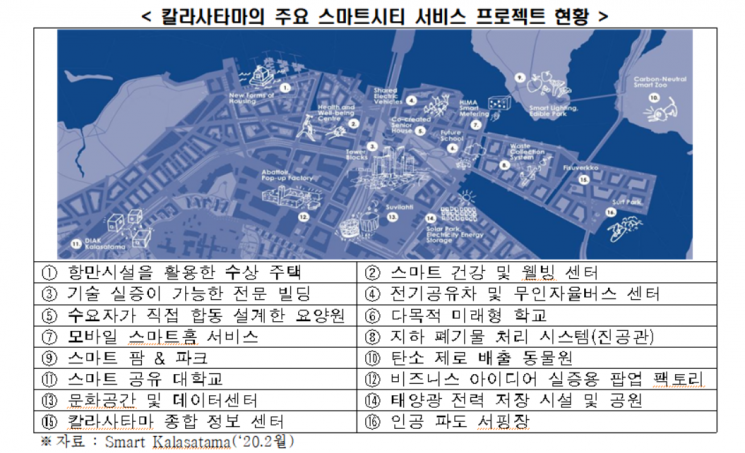
Furthermore, the FKI introduced the success secret of Kalasatama in Helsinki, Finland, as the voluntary participation of each stakeholder. The Finnish government is promoting the creation of a smart district in Kalasatama under the slogan 'One More Hour a Day.' Through the 'Innovator's Club,' composed of residents, companies, civic groups, and public officials, a system has been established to identify urban problems and verify solutions. Through this system, Finland demonstrated its competitiveness by piloting the world's first unmanned autonomous bus on public roads in 2017 and implementing about 20 smart city service projects.
The FKI argued that Korea should also work on building an environment where the private sector can lead the smart city industry while introducing these three smart cities. The FKI pointed out that, first, as in the Waterfront Toronto case, the special purpose corporation (SPC) responsible for building and operating the Sejong and Busan smart city national pilot cities should expand private sector authority and grant leadership, while the government should focus on administrative support. It also suggested that, like Toyota's Woven City, when constructing on company-owned land, companies should be allowed to propose smart city development. Lastly, it added that it is necessary to grant authority to smart city operation councils led by local residents and businesses to promote voluntary smartification.
Yoo Hwan-ik, head of corporate policy at FKI, emphasized, "In the post-COVID era, the smart city industry is the core of the Korean New Deal, which combines social overhead capital (SOC) and new industries," adding, "Creating an environment where innovative private companies can lead the industry will be the key to success."
© The Asia Business Daily(www.asiae.co.kr). All rights reserved.



















