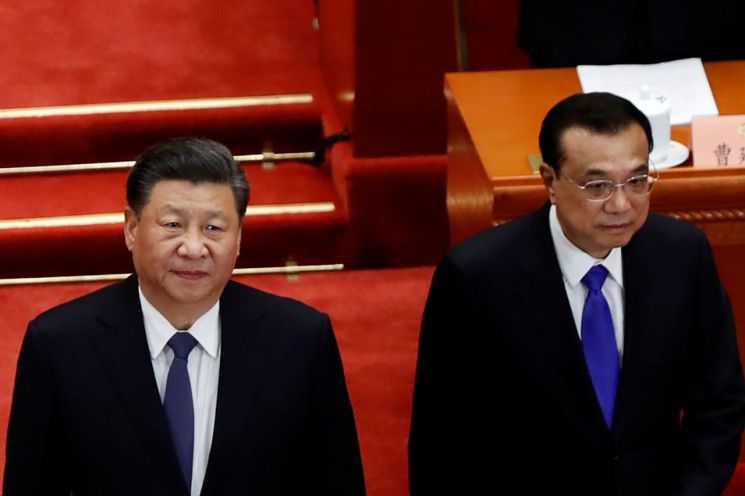
[Asia Economy Reporter Seungjin Lee] Chinese Premier Li Keqiang did not mention 'peaceful reunification' with Taiwan in this year's government work report during the Two Sessions, leading to speculation that the Chinese government is signaling the possibility of using force.
The Two Sessions refer to the annual meetings of the National People's Congress and the Chinese People's Political Consultative Conference, the largest political events in China. This year, the sessions were delayed by two and a half months due to the COVID-19 pandemic and opened on the 21st.
Hong Kong media South China Morning Post (SCMP) cited experts on the 23rd who evaluated Premier Li's government work report delivered at the third annual meeting of the 13th National People's Congress (NPC) the previous day in this way.
In his report, Premier Li emphasized, "China will adhere to its major principles and policies regarding Taiwan-related affairs," and stated, "We firmly oppose and will resolutely prevent any separatist actions seeking Taiwan independence." He also said, "We will encourage our compatriots in Taiwan to oppose Taiwan independence and participate in promoting China's reunification."
SCMP analyzed that under President Xi Jinping's administration, the previous six work reports all mentioned peaceful reunification with Taiwan and the '1992 Consensus' (the agreement reached in 1992 recognizing one China while allowing each side to use its own name), but this year was an exception.
Tang Shaocheng, a professor at Taiwan's National Chengchi University, said, "The change in expression and tone can be read as a warning to the independence-leaning Democratic Progressive Party (DPP) led by President Tsai Ing-wen," adding, "The omission of 'peace' suggests that China is considering both peaceful and forceful means for reunification."
Derek Grossman of the U.S. think tank RAND Corporation said China will continue to pressure Taiwan using diplomatic, military, economic, and psychological means, noting, "China may continue to send military aircraft near Taiwan and could decide to terminate the Economic Cooperation Framework Agreement (ECFA), which functions like a free trade agreement between the two sides."
Sun Yun, a China analyst at the U.S. think tank Stimson Center, stated, "If political and economic approaches prove ineffective, the remaining option is a military approach," but also predicted, "Due to U.S. intervention, China will not succeed."
Meanwhile, SCMP interpreted in another article that the limited mention of international issues in Premier Li's work report is related to international criticism of China over COVID-19.
Amid ongoing criticism from the U.S. and others regarding China's initial handling of COVID-19, SCMP analyzed that Premier Li focused his speech on domestic issues such as employment. His direct mention of the U.S. was limited to stating, "We will jointly implement the U.S.-China Phase One trade agreement."
International political scientist Fang Zhongying said, "China has talked about 'changes the world has never seen before,' and now it is becoming a reality," diagnosing that "China is facing the worst international situation in over 30 years as U.S.-China relations freefall." He speculated, "It is clear that China has begun preparing for the worst-case scenario, including limited military conflict."
Meanwhile, as U.S. President Donald Trump intensifies his offensive against China ahead of the November presidential election, tensions between the two countries are escalating not only over COVID-19 responsibility but also issues surrounding Taiwan, Hong Kong, and the South China Sea.
© The Asia Business Daily(www.asiae.co.kr). All rights reserved.

















