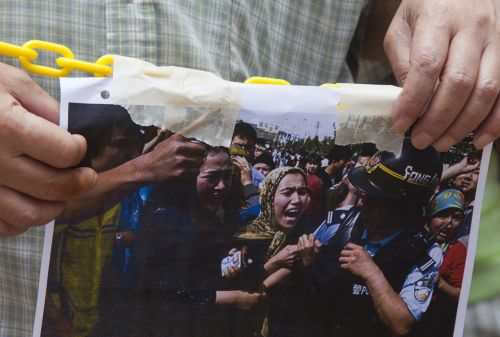
 The photo shows a participant holding a picture highlighting the Uyghur unrest during a protest against the authorities' human rights abuses in Xinjiang, outside a police station in Hong Kong on September 2nd.
 [Image source=Yonhap News]
[Asia Economy Reporter Seungjin Lee] The U.S. House of Representatives is expected to pass the '2020 Uyghur Human Rights Policy Act' next week, which allows sanctions against Chinese officials in the Xinjiang Uyghur Autonomous Region who have been accused of human rights abuses against Uyghurs and other Muslim minorities.
On the 23rd (local time), Hong Kong's South China Morning Post (SCMP) reported, citing three U.S. congressional sources, that the House is scheduled to consider the Uyghur Human Rights Policy Act, which recently passed the Senate.
According to the report, two congressional sources said the bill is expected to be brought to the House floor on the 27th. A Democratic House official said that, following the legislative procedures for bills without opposition, it is expected to go through the approval process on the floor on the 27th.
Earlier, the U.S. Senate unanimously passed the Uyghur Human Rights Policy Act on the 14th (local time). The majority of Republican and Democratic House members also support the bill.
Last November, the House passed the 'Xinjiang Uyghur Human Rights Act' with an overwhelming vote of 407 to 1, which sanctions Chinese officials responsible for human rights abuses against Muslim minorities in the Xinjiang Uyghur Autonomous Region.
The Uyghur Human Rights Policy Act, which recently passed the Senate, requires the White House to identify and report to Congress within 180 days the individuals responsible for human rights abuses such as torture, unlawful detention, and disappearances in the Xinjiang Uyghur Autonomous Region.
It also mandates sanctions such as freezing assets in the U.S. and banning entry into the U.S. for those responsible for the repression of Uyghur human rights.
Additionally, the bill orders the U.S. State Department to produce reports estimating the number of detainees in the so-called 're-education camps' in Xinjiang and detailing their human rights conditions.
Given the ongoing conflicts between the U.S. and China over trade wars, the COVID-19 responsibility dispute, and the 'Hong Kong National Security Law,' strong Chinese backlash is expected if the bill passes the House following the Senate.
If the House passes the bill without amendments, it will be sent directly to the White House. If the House amends it, it will require further Senate approval before being sent. President Donald Trump will have 10 days to decide whether to sign the bill into law or veto it.
Meanwhile, international human rights organizations and the United Nations Committee on the Elimination of Racial Discrimination estimate that about one million Uyghurs and other Muslim minorities are undergoing 're-education' in camps within the Xinjiang Uyghur Autonomous Region.
There are allegations that the Chinese Communist Party is conducting indoctrination to deny Islam and enforce loyalty to the Communist Party among Muslims. However, Chinese authorities deny this, claiming the facilities are humanitarian vocational training centers.
© The Asia Business Daily(www.asiae.co.kr). All rights reserved.

















