-1 Trillion Yuan Special National Bonds Issued
-3.7 Trillion Yuan Local Government Bonds Issued to Fund Infrastructure Investment
-Tax and Fee Reductions Increased by 500 Billion Yuan Compared to Last Year to Support Enterprises
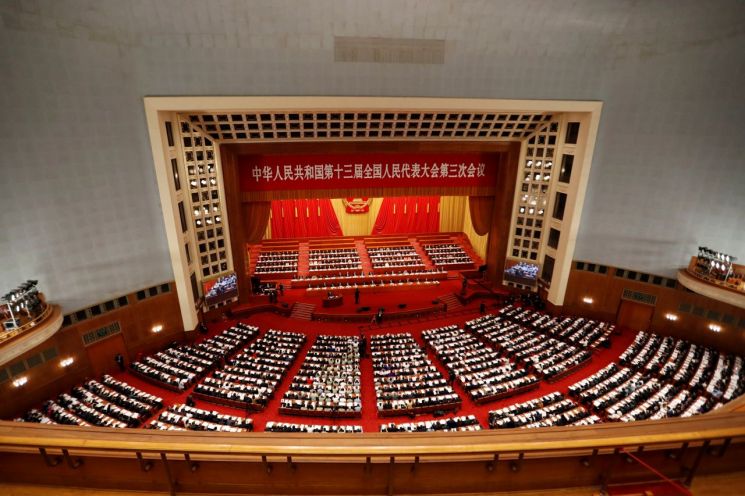
[Asia Economy Beijing=Special Correspondent Park Sun-mi] Although the Chinese government did not set an economic growth target this year in consideration of the special circumstances of COVID-19, it clearly expressed its determination to recover the damaged economy through a large-scale economic stimulus package.
On the 22nd, Premier Li Keqiang announced in the government work report at the annual session of the 13th National People's Congress (NPC) held at the Great Hall of the People in Beijing that this year's fiscal deficit ratio would be set at more than 3.6% of gross domestic product (GDP), increasing the fiscal deficit by more than 1 trillion yuan compared to last year. Considering that last year's fiscal deficit ratio was 2.8% of GDP, this represents an increase of more than 0.8 percentage points. This reflects the intention to inject funds to minimize the impact of COVID-19, even at the cost of increased debt.
He also forecasted the issuance of special government bonds worth 1 trillion yuan to control COVID-19. It is the first time in 13 years that the Chinese government has issued special government bonds that are not recorded as government fiscal deficits under accounting standards. The issuance scale of local government special purpose bonds, mainly used to secure infrastructure funding, was also increased by 1.6 trillion yuan. Last year, the issuance scale of local government special purpose bonds was 2.15 trillion yuan, but this year it was set at 3.75 trillion yuan. Infrastructure investment will focus on areas such as 5G, Internet of Things, Industrial Internet, Artificial Intelligence, and Big Data to advance industrial structure and strengthen technological competitiveness. Separately, an investment budget of 600 billion yuan at the central government level was also allocated.
Following last year, large-scale tax cuts are also expected this year. Premier Li stated in the work report that efforts will be made to reduce various taxes and fees paid by enterprises by an additional 500 billion yuan to help market entities overcome difficulties and achieve development. Accordingly, a reduction of 2.5 trillion yuan in corporate costs can be expected this year. The government policy to reduce commercial electricity rates by 5% will also be extended until the end of the year. Additionally, broadband communication and dedicated internet access service fees will be reduced by an average of 15%.
Regarding monetary policy, it was mentioned that the existing 'prudent monetary policy' will be pursued but implemented in a more flexible and effective manner. Expansion of credit provision by financial institutions using various tools and lowering loan costs are expected. Tools such as lowering the reserve requirement ratio for banks and interest rate cuts to expand loans to small and medium-sized enterprises and private enterprises were mentioned as possible monetary policy measures. It was also reported that efforts are underway to develop new monetary policy tools that did not previously exist to ensure liquidity directly stimulates the real economy.
The Chinese government set the target for new urban employment at 9 million this year, down from 11 million last year. The target unemployment rate was also raised from 5.5% last year to 6%, reflecting the deterioration of the employment market due to COVID-19. Considering the increased uncertainty in the employment market caused by COVID-19, full efforts will be made to create jobs. China plans to provide vocational training opportunities to more than 35 million people over the next two years and increase the enrollment capacity of vocational colleges by 2 million.
Meanwhile, the Chinese government did not announce an economic growth target for this year. Every year, the growth target is announced through the Two Sessions, but this year, due to the impact of the novel coronavirus infection (COVID-19), the government gave up on presenting a growth rate. This indicates the high level of uncertainty. This is the first time China has not set an economic growth target.
Premier Li Keqiang explained in the work report that "due to uncertainties regarding COVID-19, no specific target was set," and "not setting a target is expected to be more helpful in achieving the six stabilities (employment, finance, trade, foreign investment, investment, and economic outlook). This year, the priority is on job stability, livelihood security, poverty eradication, and building a moderately prosperous society (Xiaokang) where everyone lives well."
© The Asia Business Daily(www.asiae.co.kr). All rights reserved.
![From Bar Hostess to Organ Seller to High Society... The Grotesque Con of a "Human Counterfeit" [Slate]](https://cwcontent.asiae.co.kr/asiaresize/183/2026021902243444107_1771435474.jpg)
















