Reliance Industries Attracts $10 Billion in Investment Within a Month
Bold Expansion in Telecommunications Over Energy... Tremendous Potential of the Indian Market Also Plays a Role
[Asia Economy Reporter Kwon Jaehee] There is a company that invested six times more than Facebook did when acquiring Instagram (about 1.2 trillion KRW). That company is Reliance Industries, one of India's top three conglomerates.
In April, Facebook invested a whopping $5.7 billion (about 7.05 trillion KRW) in Reliance's e-commerce business, acquiring a 9.99% stake and becoming the largest shareholder. Following Facebook's investment news, U.S. private equity firms also rushed to invest. After private equity firms Silver Lake, Vista Equity Partners, and General Atlantic, KKR announced on the 21st (local time) that it would invest $1.5 billion (about 1.84 trillion KRW). Saudi Arabia's sovereign wealth fund and Abu Dhabi's sovereign wealth fund are also in investment negotiations with Reliance Industries. The total investment Reliance Industries has received in the past month alone amounts to a staggering $10 billion (about 12 trillion KRW).
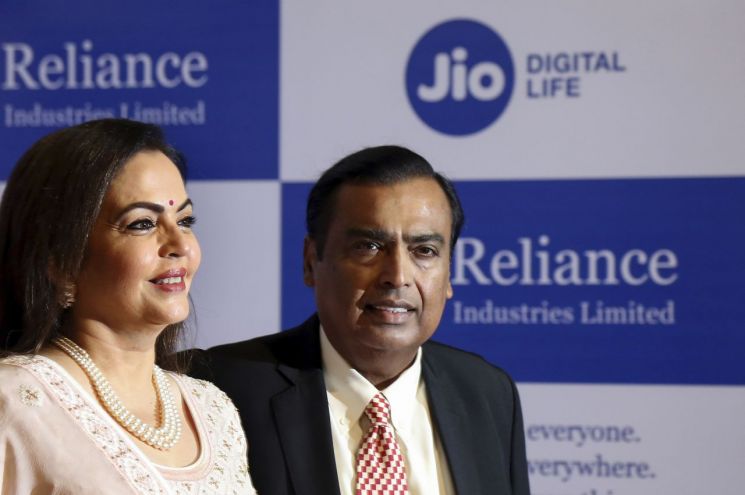
At the center of the global investors' continuous love calls to Reliance, led by Asia's richest man, Chairman Mukesh Ambani (pictured), is the new business division, the telecommunications platform 'Jio.' Jio started as a telecom operator and became the number one in the Indian market in 2014, recently expanding into the e-commerce sector.
Jio, which has become Reliance Industries' cash cow, was not the main business from the start. When the founding chairman and predecessor, Dhirubhai Ambani, passed away, a management dispute arose. Mukesh, the elder brother, took over the large-scale and core energy business, while his younger brother Anil took charge of power, telecommunications, and finance. However, Mukesh judged that the telecommunications business, which Anil managed, was promising in terms of business scalability and future growth potential, and entered the telecom sector in 2010. During this process, Anil's Reliance Communications struggled with enormous debt and was on the verge of default, so he transferred most of his shares to Mukesh and exited the mobile telecommunications business. Thanks to this, Mukesh was able to easily acquire frequency bandwidth and base stations.
Based on the solid financial strength built from the energy business, Mukesh aggressively marketed from the early days of entering the telecommunications sector. With a groundbreaking marketing strategy offering free voice calls for the first three months of subscription, he dominated the telecom market. As a result, he surpassed existing operators like Vodafone Idea and Bharti Airtel, securing 390 million subscribers by 2020 and establishing Jio as India's largest telecom operator. Leveraging the enormous subscriber base, he steadily merged other regional telecom operators and expanded the business scope to app products enabling movie streaming, online shopping, and news reading.
Jio has captivated global investors by awakening the potential of India's internet and e-commerce. Currently, India is just beginning its internet boom. Among India's 1.36 billion population, nearly 600 million have never accessed the internet.
Indian mobile users are considered 'heavy users.' While Koreans use an average of 9.7GB per month, Indians use about 15GB. According to research firm Forrester Research, India's e-commerce market is expected to more than double from $26.9 billion in 2018 to $68.4 billion by 2022. It has become a market that global IT companies cannot afford to miss. For this reason, global IT players such as Alibaba, Amazon, Google, Tencent, and SoftBank have already entered the race.
Facebook is preparing to launch an electronic payment system similar to Google Pay through its messenger service WhatsApp. The Indian market is perfect for growing the company. The fact that WhatsApp has 400 million users in India is also attractive. Mark Zuckerberg, Facebook's CEO, stated, "We aim to connect WhatsApp with Jio's online market 'JioMart' to help 60 million small businesses in India conduct online transactions." Professor James Crabtree of the National University of Singapore said, "Zuckerberg has realized that to grow significantly in the Indian IT market, he needs to maintain a good relationship with Mukesh Ambani."
© The Asia Business Daily(www.asiae.co.kr). All rights reserved.
![User Who Sold Erroneously Deposited Bitcoins to Repay Debt and Fund Entertainment... What Did the Supreme Court Decide in 2021? [Legal Issue Check]](https://cwcontent.asiae.co.kr/asiaresize/183/2026020910431234020_1770601391.png)















