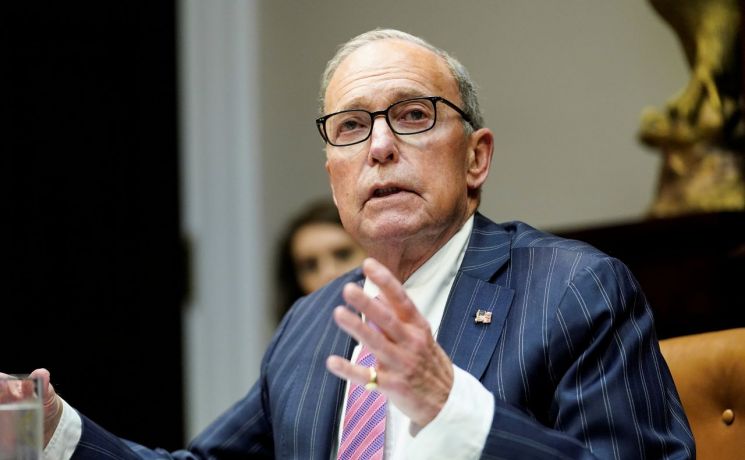
[Asia Economy Reporter Jeong Hyunjin] While U.S. President Donald Trump expresses confidence in economic recovery amid the economic fallout from the novel coronavirus disease (COVID-19), Larry Kudlow, Chairman of the White House National Economic Council (NEC) (photo), recently mentioned uncertainty, saying economic data is not good. U.S. Treasury Secretary Steven Mnuchin has changed his stance and expressed the view that additional stimulus legislation is necessary.
According to the Washington Post (WP) on the 21st (local time), Kudlow said at a WP live broadcast event that regarding the economic damage caused by COVID-19, "The numbers coming out are not good. In fact, in most cases, they are purely bad," analyzing that the overall situation is very difficult. This statement is a step back from President Trump's earlier claim that "the U.S. economy will rebound like a rocket."
Kudlow agreed with President Trump's prediction of a 'V-shaped recovery' but added that it could be a different form of V-shape or a hybrid of U-shape and V-shape. However, he also said, "There are faintly flickering small lights," expressing a prospect that dramatic improvement could occur this summer.
The sluggishness of economic activity is also confirmed by the figures. According to Bloomberg and others, the May Purchasing Managers' Index (PMI) for the U.S. and Europe, announced by financial information provider IHS Markit and Japan's Shinkin Bank, were recorded at 36.4 and 30.5, respectively. Japan's PMI for the same month also remained low at 27.4. PMI is an indicator of business activity, with 50 or below indicating contraction and above 50 indicating expansion. Since the spread of COVID-19 in January and February, PMIs of various countries have fallen significantly below 50.
However, it showed improvement compared to last month. Considering that in April, the U.S. recorded 27.0, Europe 13.6, and Japan 25.8, there was some recovery this month. But it still remains well below the benchmark of 50. By sector, in the U.S., Europe, and Japan, manufacturing PMI was more than 10 points higher than service PMI, indicating that the contraction in the service sector was more severe.
Secretary Mnuchin also emphasized the need for additional economic stimulus. In an interview with U.S. media The Hill on the same day, he said there is a high possibility that additional stimulus legislation will be needed to respond to the shock of COVID-19. This marks a change in attitude, as the White House and government had previously opposed additional stimulus.
The Bank of Japan (BOJ) held an extraordinary monetary policy meeting for the first time in nine years and decided to introduce a new system to support financing for small and medium-sized enterprises. It is operated in a form where the BOJ lends funds to financial institutions that handle virtually interest-free and unsecured loans to private financial institutions, similar to the U.S. Federal Reserve's Main Street Business Lending Program, according to foreign media.
Chris Williamson, Chief Business Economist at IHS Markit, said, "Demand is expected to remain at an extremely low level for a long time, putting pressure on companies to reduce jobs more aggressively," adding, "Therefore, a full recovery is expected to take years."
© The Asia Business Daily(www.asiae.co.kr). All rights reserved.
![User Who Sold Erroneously Deposited Bitcoins to Repay Debt and Fund Entertainment... What Did the Supreme Court Decide in 2021? [Legal Issue Check]](https://cwcontent.asiae.co.kr/asiaresize/183/2026020910431234020_1770601391.png)
















