KMA Announces Weather Forecast for June to August
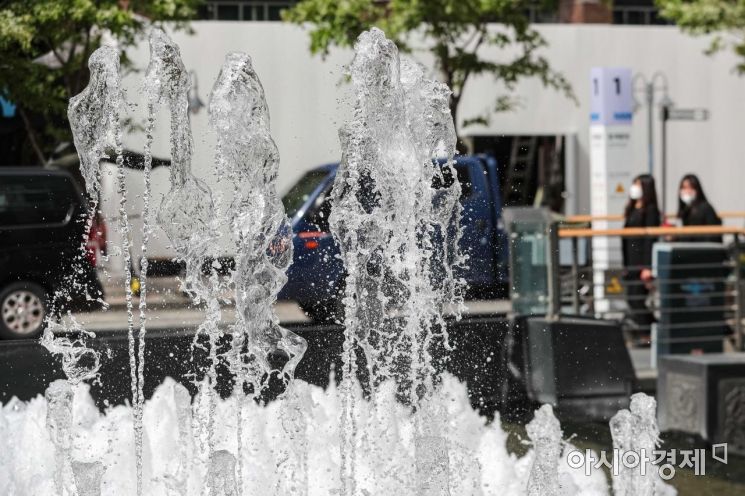 On the 14th, as daytime temperatures rose to 26 degrees Celsius, continuing early summer weather, citizens visiting Cheonggyecheon in Jongno-gu, Seoul, are cooling off from the heat. Photo by Jinhyung Kang aymsdream@
[Asia Economy Reporter Hyunju Lee] This summer is expected to bring heat levels similar to those experienced during the record-breaking heat of 2018.
On the 22nd, the Korea Meteorological Administration (KMA) held a briefing and announced the weather forecast for this summer season (June to August). Hyunsoo Lee, Director of Climate Prediction at the Climate Science Bureau, stated, "The North Pacific High is expected to move further north than usual, and influenced by hot air masses over inland China, the number of heatwave and tropical night days this summer will exceed the average." He added, "The intense heat will begin in earnest from late July after the monsoon season ends and is expected to peak by mid-August."
According to the KMA forecast, summer temperatures this year are expected to be up to 1.5 degrees Celsius higher than the average (23.6°C). Compared to last year's average temperature (24.1°C), it is projected to be between 24.6°C and 25.1°C, which is 0.5 to 1 degree higher. In 2018, the average temperature was 25.4°C, with an average maximum temperature of 30.5°C. The anticipated number of heatwave days this summer is 20 to 25, and tropical night days are expected to be 12 to 17, both exceeding the averages and last year's figures.
Until June, daytime temperatures will rise significantly, but on cloudy days, temperatures will drop considerably, resulting in large daily temperature variations. From late July, after the monsoon season ends, hot and humid air will cause daytime temperatures to rise sharply under strong sunlight, and many nights will remain warm without cooling down, leading to frequent tropical nights.
Precipitation is expected to be similar to or less than the average (678.2 to 751.9 mm), but the KMA anticipates occasions of heavy rainfall in short periods. The number of typhoons is expected to be similar to the average (11.1), with 9 to 12 typhoons forming, and about 2 to 3 of these, close to the average (2.3), are expected to affect South Korea.
© The Asia Business Daily(www.asiae.co.kr). All rights reserved.

















