[Asia Economy Reporter Junho Hwang] A new method for measuring distances from our galaxy to other galaxies has been developed. It can measure galaxies over 10 billion light-years away, expected to serve as a guide in unraveling the secrets of the universe. The Korea Astronomy and Space Science Institute announced on the 22nd the research results of an international team led by Dr. Jeffrey Hodgson and Dr. Lee Sangseong.
Measuring Cosmic Distances Using Active Galactic Nuclei
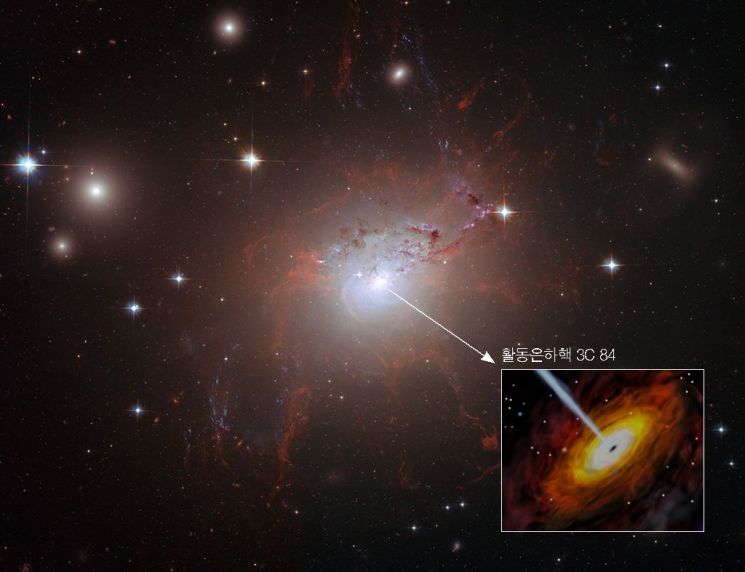
The research team developed a cosmic distance measurement method using the light from active galactic nuclei (AGN), which are considered the brightest celestial objects in the universe. An AGN refers to the center of a galaxy where a supermassive black hole, with a mass ranging from millions to billions of times that of the Sun, pulls in surrounding matter through gravity and emits enormous energy as light.
The team discovered that the jet of the AGN '3C 84' at the center of the Perseus A galaxy exhibits variability in certain regions, with its luminosity increasing by about 2.7 times over a 146-day cycle. By comparing the angular size obtained from high-resolution radio observations using the US VLBA (Very Long Baseline Array) imaging map, the team determined that the distance to the '3C 84' jet is between 220 million and 250 million light-years. This is comparable to the 200 million to 270 million light-years calculated through observations of Type Ia supernovae, a standard candle within the same galaxy.
The research team evaluated that the distance measurement method using AGN qualifies as a new standard candle candidate. If this method becomes a standard candle, it will enable measurements of the universe at even greater distances than existing standard candles.
Active Galactic Nuclei Measurement Method as a Standard Candle
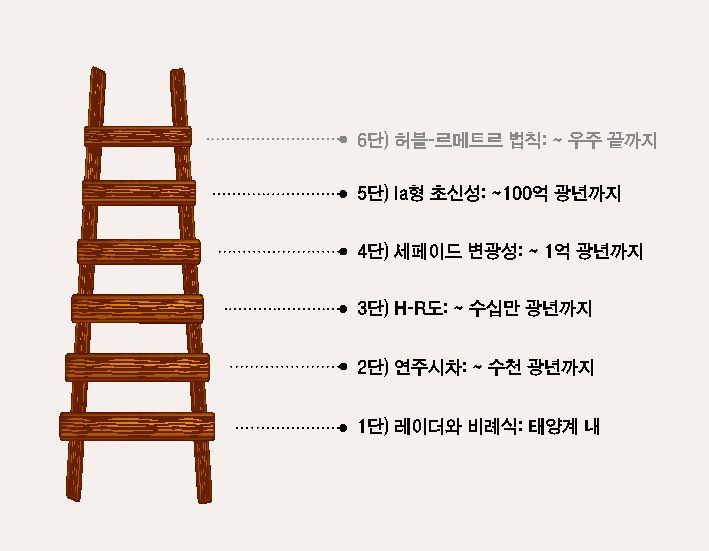
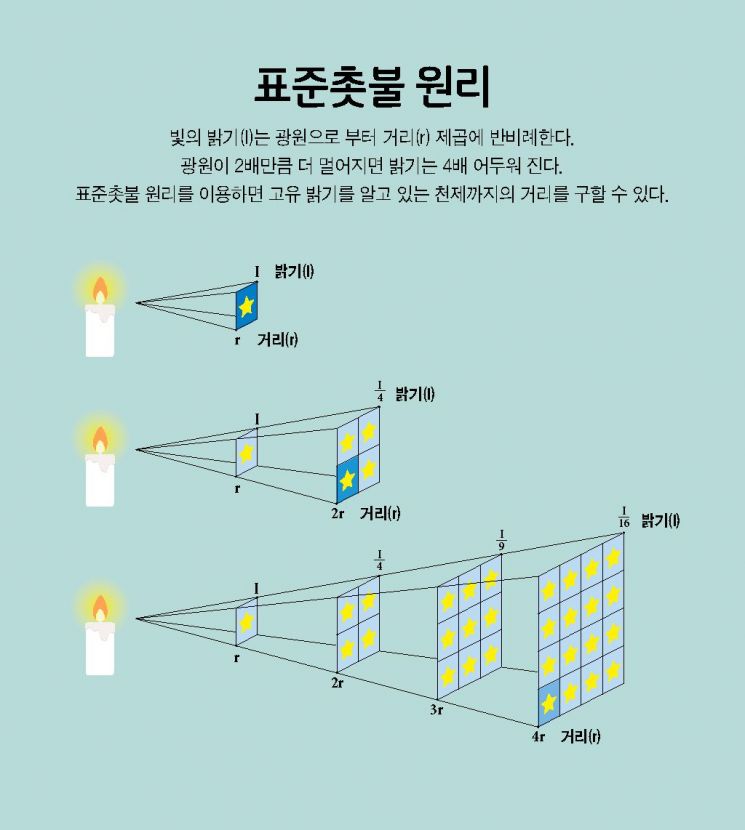
A standard candle is a celestial object with a known intrinsic brightness. By measuring the apparent brightness of this object and determining how much dimmer it appears compared to its intrinsic brightness, the distance can be calculated. Type Ia supernovae, novae, globular clusters, and Cepheid variables are used as standard candles. Among these, Type Ia supernovae can measure the farthest distances. However, due to brightness limitations, Type Ia supernovae cannot be observed in galaxies over 10 billion light-years away, limiting our understanding of the universe spanning 140 light-years in size.
Dr. Jeffrey Hodgson stated, "The new standard candle candidate verified in this study will be an important indicator enabling the measurement of the farthest distances in astronomy." Dr. Lee Sangseong added, "In future research, we will challenge distance measurements to galaxies existing in even more distant parts of the universe using the Korea VLBI Network (KVN), a very long baseline interferometer operated by the Korea Astronomy and Space Science Institute. This will be a new key to verifying cosmological models and illuminating the edge of the universe."
The research team plans to measure distances to even more distant active galactic nuclei and verify their potential as standard candles. Furthermore, for follow-up research, the KVN operated by the Korea Astronomy and Space Science Institute will be linked with radio telescopes in Australia, Spain, and Italy. Through this, they plan to build an international high-resolution radio observation network surpassing the US VLBA.
The research results were published in the latest issue of the Monthly Notices of the Royal Astronomical Society.
© The Asia Business Daily(www.asiae.co.kr). All rights reserved.
![User Who Sold Erroneously Deposited Bitcoins to Repay Debt and Fund Entertainment... What Did the Supreme Court Decide in 2021? [Legal Issue Check]](https://cwcontent.asiae.co.kr/asiaresize/183/2026020910431234020_1770601391.png)

















