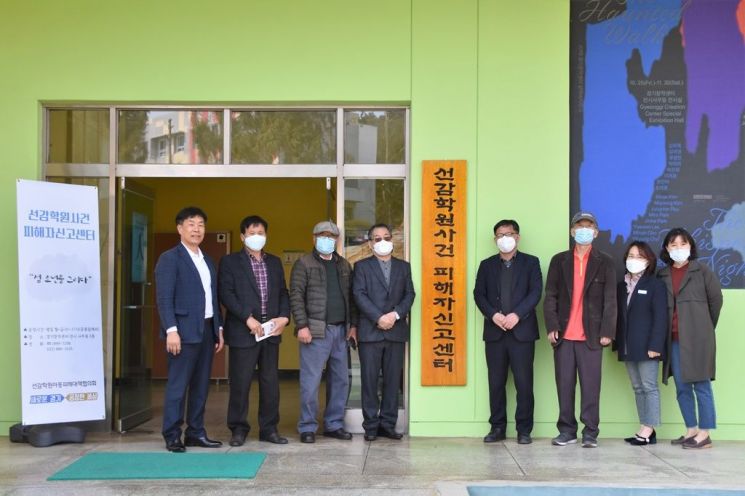
[Asia Economy (Suwon) = Reporter Lee Young-gyu] A new turning point has been established for uncovering victims and revealing the truth about the former Seongam School (Ansan, Gyeonggi Province), which violated children's human rights for over 40 years.
Gyeonggi Province announced on the 22nd that, following the recent passage of the amendment to the 'Basic Act on Past Affairs Settlement for Truth and Reconciliation' by the National Assembly, it will actively uncover victims of human rights violations at Seongam School and strive to reveal the truth.
The recent amendment to the National Assembly aims to reorganize the 'Past Affairs Settlement Committee for Truth and Reconciliation,' which was dissolved after investigations and activities from 2006 to 2010, to clarify the truth about human rights violations that occurred from the Japanese colonial period through authoritarian rule.
With the passage of the amendment, the Truth and Reconciliation Commission will be reactivated in December, and the province will collect victim cases necessary for fact-finding through the 'Seongam School Incident Victim Reporting Center.' So far, a total of 26 victim cases have been received at the center.
The province plans to verify the received victim cases through its own operating committee, assess the scale of the damage, and submit the data to the Truth and Reconciliation Commission.
Park Chan-gu, Gyeonggi Province's Human Rights Officer, said, "Victims of Seongam School, whose accurate damage investigations and truth revelations have not been properly conducted, can now resolve their grievances through the amendment of the Past Affairs Settlement Act. We will find victims nationwide through the center and contribute to revealing the truth."
Seongam School was established in May 1942 on Seongamdo Island in Ansan during the Japanese colonial period for the purpose of juvenile reform. After liberation, Gyeonggi Province took over and used it as a facility for vagrants under national policy until its closure in October 1982.
About 4,700 boys were forcibly brought in and subjected to forced labor for reasons such as shabby clothing, bad behavior, and unclear residence. They suffered human rights abuses including beatings and malnutrition, and some lost their lives attempting to escape.
Those who remain continue to suffer from various aftereffects even more than 30 years after Seongam School closed.
The province has so far promoted preliminary investigation plans for victim remains excavation, operated victim support and memorial project committees, visited the Ministry of the Interior and Safety for special law enactment, provided materials to the National Assembly, and supported budgets for memorial cultural events.
In April last year, a Seongam School Countermeasure Task Force (TF) was formed, and in January this year, Gyeonggi Province Governor Lee Jae-myung apologized via social media and promised to initiate a truth investigation.
Victims or families of victims of Seongam School can visit the center (2nd floor, Exhibition Office Building, Gyeonggi Creative Center, Seongam-ro, Danwon-gu, Ansan City) by making a reservation via phone (1899-7298). The center operates on weekdays from 10 a.m. to 5 p.m.
© The Asia Business Daily(www.asiae.co.kr). All rights reserved.

















