Regulatory Costs Reduced by $44.6 Billion Over 3 Years
"Korea's Regulatory Management Must Deliver Real Results"
[Asia Economy Reporter Dongwoo Lee] A survey revealed that the Trump administration in the United States implemented regulatory reform policies over the past three years, abolishing 7.6 existing regulations for every new regulation introduced. There are calls for South Korea to also enhance the effectiveness of managing regulatory costs and the number of regulations.
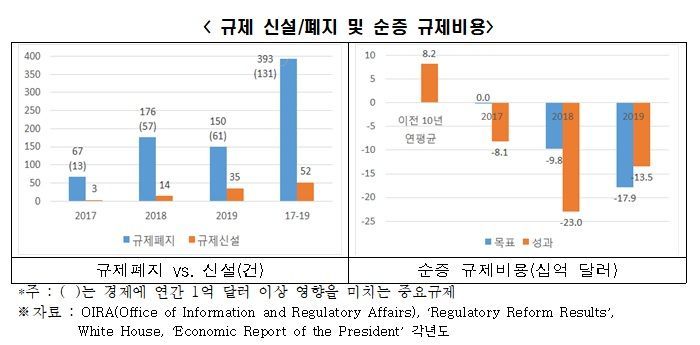
The Federation of Korean Industries (FKI) announced on the 21st that the Trump administration's two-for-one rule, which requires abolishing two existing regulations for every new regulation introduced, exceeded its original goal by more than three times by abolishing 7.6 existing regulations per new regulation. The policy to reduce the net increase in regulatory costs caused by new regulations also cut $44.6 billion, which is 1.6 times the original target of $27.7 billion.
In the first year of the two-for-one rule in 2017, 22.3 existing regulations were abolished per new regulation introduced, and in 2018 and 2019, 12.6 and 4.3 regulations were abolished respectively, exceeding the original targets. Over the entire three years, 7.6 existing regulations were abolished per new regulation introduced.
When considering major regulations that impact the economy by more than $100 million annually, 2.5 existing regulations were abolished per new regulation introduced. The net increase in total regulatory costs was reduced by $8.1 billion in 2017, when the goal was to keep it at zero or below, $23 billion in 2018, and $13.5 billion in 2019. The target for reducing net increase in regulatory costs in 2020 is $51.6 billion.
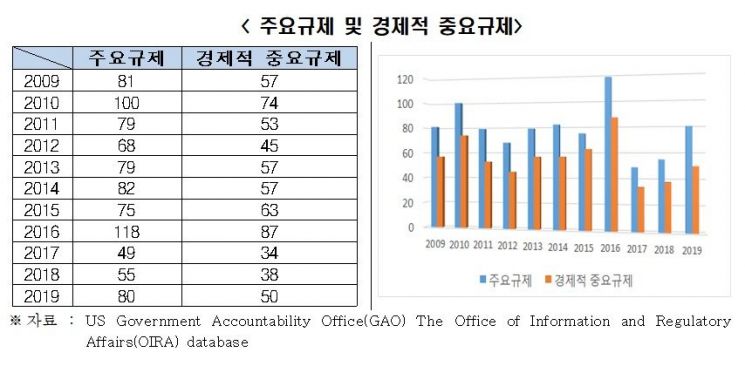
During this period, the total number of pages in the Federal Register, the number of pages related to regulations, and the number of final rules all significantly decreased compared to previous administrations. The 2,964 final rules published in the Federal Register last year were the lowest since records began in 1976.
Businesses also showed positive responses to the Trump administration's regulatory reforms. According to the monthly survey of small businesses conducted by the National Federation of Independent Business (NFIB), government regulations were never identified as the biggest obstacle since Trump's election. The NFIB small business optimism index also rose during this period.
The FKI argued that South Korea should improve the effectiveness of its regulatory cost management system, which has been in place since 2016, and simultaneously manage the number of regulations.
Yoo Hwan-ik, head of corporate policy at FKI, said, "As seen in the U.S. case, South Korea should strengthen the operation of the regulatory cost management system to produce tangible effects," adding, "It is also necessary to manage the quantity by comparing and disclosing the number and details of newly introduced, strengthened, abolished, and eased regulations along with the number of registered regulations."
© The Asia Business Daily(www.asiae.co.kr). All rights reserved.
![Clutching a Stolen Dior Bag, Saying "I Hate Being Poor but Real"... The Grotesque Con of a "Human Knockoff" [Slate]](https://cwcontent.asiae.co.kr/asiaresize/183/2026021902243444107_1771435474.jpg)

















