After COVID-19, countries resume economic activities
Global 'De-China' GVC restructuring active
"US-China conflict reignites, global trade contracts"
Negative impact on export-dependent Korea
"Hard to return to pre-COVID-19 state"
[Asia Economy Reporter Moon Chaeseok] South Korea's exports have not fully recovered from the impact of the novel coronavirus disease (COVID-19), with export values from May 1 to 20 dropping by more than 20% compared to the previous year. Signs of renewed US-China trade tensions and an expected decline in global trade volume have led to pessimism that even if the crisis in the second quarter is weathered, achieving a dramatic 'export rebound' will be difficult.
According to the Korea Customs Service on the 21st, the export value from May 1 to 20 (provisional customs clearance basis) was $20.318 billion, down 20.3% ($5.18 billion) from the same period last year. The number of working days during this period was 13.5, the same as the previous year. Considering the number of working days, the average daily export value was $1.51 billion, a 20.3% decrease from $1.89 billion during the same period last year.
Imports during this period decreased by 16.9% ($4.66 billion) compared to the same period last year, totaling $22.998 billion. The trade balance recorded a deficit of $2.68 billion.
Due to the impact of COVID-19 reducing global demand, export performance inevitably suffered. There were significant declines in passenger cars (-58.6%) and petroleum products (-68.6%), and wireless communication devices (-11.2%) also decreased. Ship exports increased by 31.4%. Semiconductor exports rose by 13.4% compared to the same period last year, showing signs of recovery from last month's -14.9% and the -17.8% recorded from May 1 to 10.
Looking at export performance by country, most countries including China (-1.7%), the United States (-27.9%), the European Union (EU, -18.4%), Vietnam (-26.5%), Japan (-22.4%), and the Middle East (-1.2%) remained in decline. However, exports to China, which account for 25.1% of South Korea's exports, decreased by only 1.7%, a smaller decline compared to -29.4% from May 1 to 10.
Although major countries such as the United States are resuming economic activities, uncertainties in quarantine measures and the rekindling of US-China conflicts make it difficult for South Korean exports to rebound sharply. According to the Korea International Trade Association, as of last year, China accounted for 25.1% and the United States 13.5% of South Korea's total exports, ranking first and second respectively.
As the world moves toward a 'de-China' focused reorganization of the global value chain (GVC), the already shrinking trade volume is a concerning sign.
According to the International Monetary Fund (IMF)'s "April World Economic Outlook," global trade volume decreased by 11% compared to the previous year, shrinking by 13.9 percentage points compared to January. This is bad news for South Korea, which has a high export dependency. According to the Korea International Trade Association, South Korea's export dependency ratio was as high as 33% of nominal gross domestic product (GDP) last year.
Professor Kang Insu of the Department of Economics at Sookmyung Women's University said, "Even if economic activities resume due to the reorganization of global value chains and reshoring policies, it seems difficult for trade levels to recover to pre-COVID-19 levels," adding, "It is not possible to rule out the possibility of stronger additional policies such as bans on investments and mergers & acquisitions (M&A) by companies from the opposing side between the US and China."
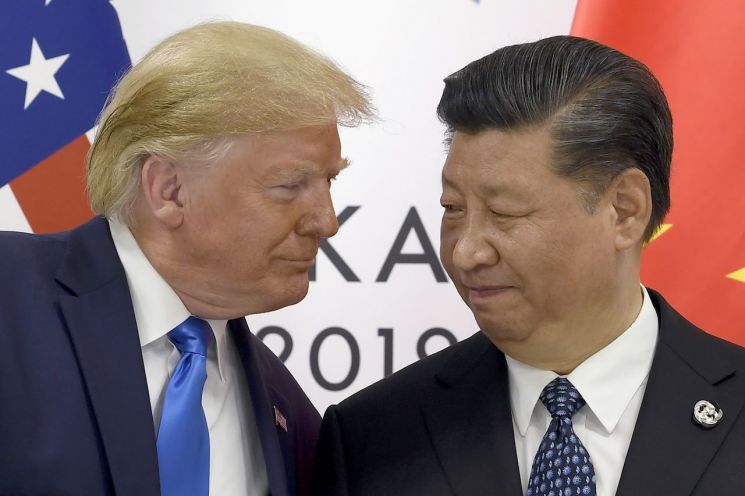
US President Donald Trump has prohibited semiconductor exports to Huawei not only by US companies but also by foreign companies. China has warned that it is prepared to retaliate against US companies such as Apple and Qualcomm. Luixing Coffee, known as the 'Chinese Starbucks,' received a delisting notice from Nasdaq due to accounting fraud.
© The Asia Business Daily(www.asiae.co.kr). All rights reserved.

















