Expected Saturation Point of Former Radioactive Waste Society Extended by 4 Months from November 2021
Local Residents Oppose... Korea Hydro & Nuclear Power Says "Construction Must Start by First Half at the Latest"
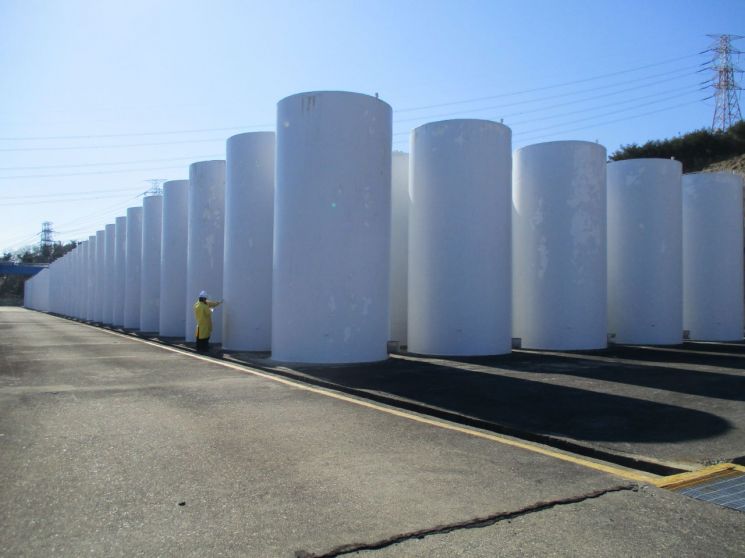 A view of the dry storage facility canister for spent nuclear fuel, constructed prior to the MACSTOR at the Wolseong Nuclear Power Plant. (Photo by Korea Hydro & Nuclear Power) [Image source=Yonhap News]
[Asia Economy Reporter Moon Chaeseok] As the three Wolseong nuclear power plants face the risk of shutdown, a research report has emerged stating that the second phase of the spent nuclear fuel dense dry storage facility (MACSTOR) only needs to be completed by March 2022. Although this deadline is four months later than the previous November 2021 deadline, considering local residents' opinion gathering and approval procedures, the prevailing view is that construction must begin by the first half of the year at the latest.
The Spent Nuclear Fuel Reexamination Committee announced the results of the saturation forecast reassessment research on the 21st. Based on the saturation forecast reassessment results from the Radioactive Waste Society (RWS), the committee stated that the Wolseong nuclear power plant MACSTOR is expected to reach saturation around March 2022. Previously, the RWS had estimated in December 2018 that the Wolseong MACSTOR would be saturated by November 2021. The committee explained that this forecast did not reflect variables affecting the saturation timing, such as extended nuclear power plant maintenance schedules occurring since January last year.
Earlier, in February, the committee announced that the Wolseong saturation would occur about four months later than the RWS estimate, in March 2022, and reiterated the same forecast on this day. The committee explained that after the February announcement of the saturation extension delay, the RWS conducted research comprehensively considering the latest spent nuclear fuel storage status, output fluctuations of Wolseong Units 2 to 4, and planned preventive maintenance schedules.
A committee official stated, "Considering the newly presented saturation forecast by the RWS, we plan to ensure that opinion gathering is completed timely through fair and objective procedures."
Separate from the committee's explanation, a challenging process remains from 'gathering residents' opinions → approval of construction by the Ministry of Trade, Industry and Energy's Nuclear Environment Division → Korea Hydro & Nuclear Power (KHNP) construction' for MACSTOR expansion.
On the 21st of last month, the Reexamination Committee began selecting a citizen participation group for opinion gathering on MACSTOR expansion, but civic groups in Gyeongju and Ulsan opposed it. The Gyeongju environmental group "Anti-Nuclear Gyeongju Citizens' Joint Action" submitted an application for a certificate of representative petitioners for a resident referendum to Gyeongju City, proposing to replace the MACSTOR expansion decision with a resident referendum. Additionally, the "Wolseong Nuclear Waste Site Opposition Resident Referendum Ulsan Movement Headquarters," a coalition of Ulsan regional groups, issued a statement opposing the selection of the citizen participation group by the Spent Nuclear Fuel Management Policy Reexamination Committee.
Generally, since MACSTOR expansion takes 19 months, the consensus within the nuclear industry, including KHNP, is that construction must begin by August at the latest. Considering that approval procedures take about three months, construction should have already started, and KHNP has consistently advocated for "construction by the first half of the year at the latest."
Because there is no permanent storage facility for spent nuclear fuel in Korea, MACSTOR expansion is essential to safely operate existing nuclear power plants. The reason for calls to issue a recommendation for MACSTOR expansion after gathering residents' opinions within the first half of the year is to prevent saturation of existing storage facilities and the shutdown of Wolseong Units 2 to 4.
Earlier, on January 10, the Nuclear Safety and Security Commission held its 113th meeting and approved the operational change permit (draft) for constructing MACSTOR Units 1 to 4 at Wolseong. This was three and a half years after KHNP applied for MACSTOR expansion. As of the first quarter, the saturation rate of dry storage facilities for spent nuclear fuel is as high as 97.6%.
A KHNP official said, "Construction can only begin after gathering opinions from local residents," adding, "If construction starts promptly, MACSTOR expansion can be stably completed before Wolseong nuclear power plant reaches saturation."
© The Asia Business Daily(www.asiae.co.kr). All rights reserved.

















