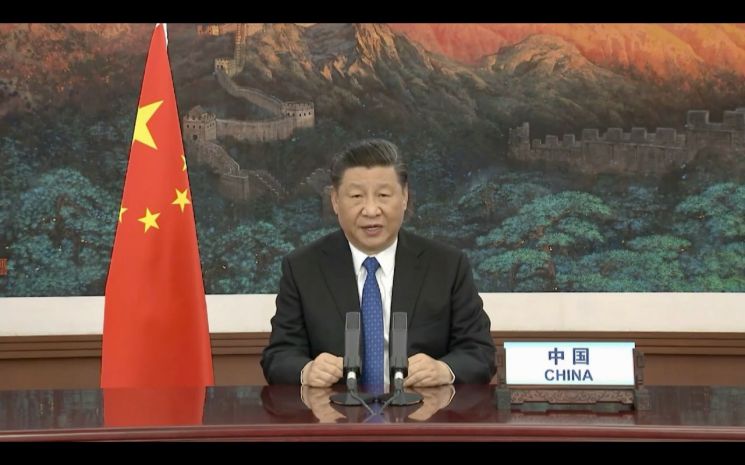
[Asia Economy Reporter Hyunwoo Lee] It has been revealed that the debt owed by developing countries to China amounts to $520 billion (approximately 636 trillion KRW) worldwide. Although Chinese President Xi Jinping pledged $2 billion to the international community in his keynote speech at the World Health Assembly (WHA) to combat COVID-19, developing countries are responding that debt relief is more urgent than anything else.
On the 18th (local time), at the opening ceremony of the 73rd WHA virtual meeting held in Geneva, Switzerland, President Xi stated, "We will provide $2 billion to the international community over two years to support COVID-19 response," adding, "This will be especially used to support developing countries' fight against the pandemic and their socio-economic recovery and development." This is a strategy to win over developing countries as allies amid increased attacks from the U.S. and Europe blaming China for COVID-19.
However, developing countries are emphasizing the urgent need for debt relief and restructuring in response to President Xi's proposal. The Kiel Institute for the World Economy in Germany reported that the total debt of developing countries to China exceeds $520 billion globally. Among the $350 billion debt lent through the Belt and Road Initiative (land and maritime Silk Road) projects, more than half is known to be high-risk loans that are nearly impossible to repay. Therefore, there is an assessment that China's COVID-19 response funding is unlikely to gain widespread support from developing countries.
In Africa, Djibouti's debt to China has exceeded 80% of its annual Gross Domestic Product (GDP), Kyrgyzstan's is about 40%, and Ethiopia's is 20%. In Sri Lanka, when it became difficult to repay $1.1 billion of debt in 2017, the Chinese government received the operating rights of Hambantota Port for 99 years in a long-term lease instead of repayment. As Chinese warships and submarines frequently dock at the port, concerns about the potential misuse of debt owed to China are rising among developing countries.
Developing countries struggle with Chinese debt because loan approvals are easier compared to the World Bank (WB) or the International Monetary Fund (IMF). However, the interest rates are high and the maturities are short, which places a heavy repayment burden on developing countries. In particular, contracts are renewed every two years with interest rates increasing each time, which has caused frequent complaints.
Despite growing dissatisfaction among developing countries, China has taken no significant action. The New York Times (NYT) reported, "Developing countries, economically hit hard by lockdown measures due to COVID-19, are rushing to request debt relief from China, but China is only adjusting repayment schedules and refusing to accept debt forgiveness requests."
China also finds it difficult to hastily forgive developing countries' debts. Given that China's economy has become very difficult, with a -6.8% growth rate in the first quarter due to the COVID-19 crisis, forgiving debts could severely worsen domestic public sentiment. The NYT reported that Chinese dissatisfaction is beginning to grow over the perceived waste of national wealth overseas, especially since the per capita income in China is still only about 25% of that in advanced countries.
Professor Carmen Reinhart of Harvard University said in an interview with Bloomberg News, "The debt problem of emerging countries is much larger than that of the poorest countries," adding, "China, as a member of the G20, needs to participate in debt relief for emerging countries because they are the largest creditor of emerging country debt."
© The Asia Business Daily(www.asiae.co.kr). All rights reserved.

















