Apartment Sales Price Index by Korea Appraisal Board Up 4.21%
Highest Increase Rate in Provinces Except Sejong
Multiple Complexes Recently Hit New Highs
Growing Expectations for Innovation City Designation Following Balanced Development Special Act Amendment
33 Urban Renewal Projects Including Complex Development of Shantytown Near Daejeon Station
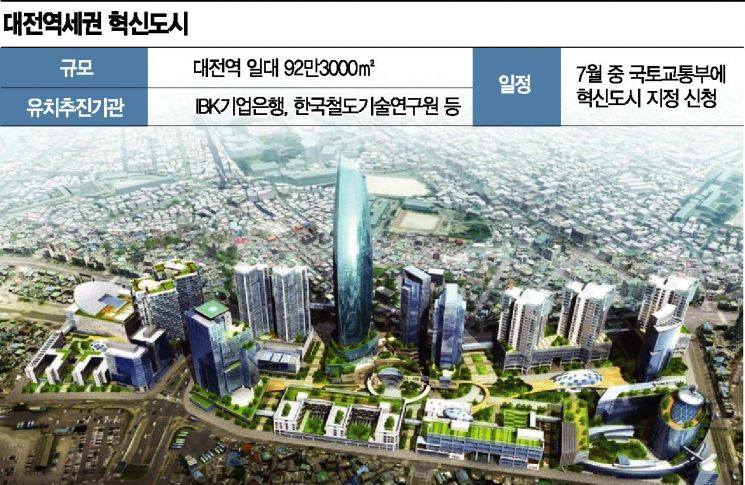
[Asia Economy Reporter Lee Chun-hee] The real estate market in Daejeon is buzzing due to a series of development prospects. Following the redevelopment plan around Daejeon Station, expectations for the creation of an innovation city have overlapped, creating a sharp upward trend in housing prices in the Dong-gu area.
According to the Korea Real Estate Board on the 19th, the weekly apartment sales price index in Dong-gu, Daejeon, has risen by 4.21% since March. This is the highest increase among local regions except for Sejong City (4.27%). This trend contrasts with the overall housing market contraction caused by the government's stringent real estate regulations and the prolonged COVID-19 pandemic.
This trend is clearly reflected in recent transactions. Last month, an 84㎡ (exclusive area) apartment in Eun-eo Song Village 3 Complex, Gaodong, Dong-gu, was traded at 324 million KRW. Compared to the actual transaction price of 308 million KRW in February, the price rose by 16 million KRW in two months. Compared to September last year (283 million KRW), it increased by 14%. For the 102㎡ apartment in the same complex, the most recent transaction price in March was 428 million KRW, nearly a 100 million KRW surge compared to 337 million KRW in February.
Other apartments in Dong-gu show similar trends. Complexes such as Daedong Saedeulmoe Humansia 1 Complex 84㎡ (March, 490 million KRW) and Indong Eojin Village 84㎡ (April, 365 million KRW) have recently been setting new record prices.
Locals attribute the rise in housing prices in this area to expectations for the designation of an innovation city following the revision of the "Special Act on Balanced National Development." The revised act allows metropolitan local governments outside the Seoul metropolitan area, which have not yet been designated as innovation cities, to apply to the Ministry of Land, Infrastructure and Transport for such designation.
Accordingly, on the 12th, Daejeon City announced that it had selected the Daejeon Station area in Dong-gu and the Yeonchuk area in Daedeok-gu as sites for innovation cities, considering the revitalization of the old city center and balanced east-west development, which has caused housing prices to soar. The city plans to apply for innovation city designation for these two areas to the Ministry of Land, Infrastructure and Transport, the competent authority, in July.
Daejeon City aims to attract institutions related to small and medium-sized enterprises such as IBK Industrial Bank and the Small and Medium Business Distribution Center, as well as public institutions related to transportation and knowledge industries like the Korea Railroad Research Institute. Since Daejeon and Chungnam are the only two metropolitan local governments without innovation cities, excluding the Seoul metropolitan area and Sejong, there is a high likelihood that new innovation cities will be designated in these two locations. Seong Min-gyu (34), a resident of Gaodong, Dong-gu, said, "I wondered why housing prices have been rising recently, and it turns out it's because of the expectations for the Dong-gu innovation city."
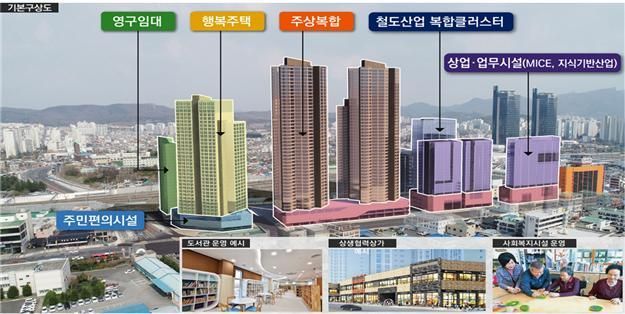 ▲ Basic Plan of Daejeon Station Public Housing District (Provided by Ministry of Land, Infrastructure and Transport)
The Daejeon Station area in Dong-gu has been considered the most likely site for innovation city designation even before the revision of the Balanced National Development Act last month. Since Daejeon Station was established in 1905, this area has served as the city center of Daejeon. However, with the development of new towns such as Dunsan and Wolpyeong-dong in Seo-gu and the establishment of Doan New Town, the commercial district has gradually declined, and the area has lost its central function, becoming a densely populated area of old low-rise residential buildings.
Various development prospects are emerging in the old city center of Daejeon. Last month, the government announced a large-scale redevelopment plan for the shantytown northwest of Daejeon Station. The plan involves combining approximately 15,500㎡ of the shantytown, which has poor residential conditions, with about 12,000㎡ of railway land to develop a complex site of about 27,000㎡. This will include 1,400 housing units, including permanent rental housing, as well as commercial facilities and officetels. Additionally, an urban regeneration New Deal plan to revitalize the old city center will be pursued.
There are 33 ongoing urban maintenance projects in the Dong-gu area. Among them, the Shinheung SK View (Shinheung 3 District Redevelopment) in Sinheung-dong, which held subscriptions last July, saw 16,944 applicants for 682 general sale units, achieving a first-priority subscription closing with an average competition rate of 24.8 to 1.
The fastest progressing project is the Gayang-dong 7 District (224 units). After receiving project implementation approval in August last year, it received management disposition approval in January, accelerating the project. Additionally, near Daejeon Station, redevelopment is underway in Mokdong 4 District (420 units) and Seonhwa District (997 units) in Jung-gu, which received management disposition approval in January and February, respectively.
© The Asia Business Daily(www.asiae.co.kr). All rights reserved.


















