Wando, Accessible Within 2 Hours from Major Fishing Grounds
Nationwide Same-Day Supply Possible, Improving Business Profitability through Fuel Cost Reduction
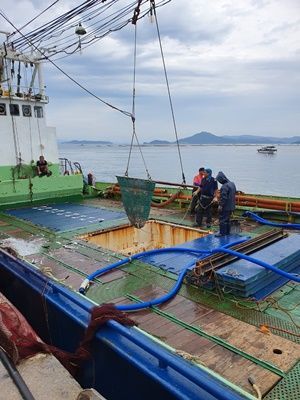
[Asia Economy Honam Reporting Headquarters Reporter Choi Kyung-pil] Some large purse seine fleets are promoting the unloading ports and auctioning of mackerel outside of Busan as a survival method, due to overlapping factors such as deficits caused by decreased catch volumes and the modernization of the Busan Joint Fish Market leading to a potential reduction in mackerel auction processing volumes. From the perspective of revitalizing the local economy, Wando-gun’s active attraction strategy appears necessary.
Busan’s “city fish” is mackerel. In Busan, there are more than 20 fleets (companies) under the large purse seine fisheries cooperative that mainly catch mackerel. Mackerel caught by large purse seine fisheries accounts for about 90% of the domestic mackerel production.
According to the Fisheries Industry Observation Center of the Korea Maritime Institute (KMI) on the 19th, the domestic mackerel production over the past five years has reached about 120,000 tons annually.
Also, according to the Fisheries Information Portal, last year the large purse seine fleets caught about 108,087 tons of mackerel.
This explains that about 90% of the total mackerel production caught by large purse seine fisheries in Korea is accounted for, and that most of the mackerel auctioning and distribution takes place in Busan.
In particular, mackerel significantly contributes to the revitalization of Busan’s local economy, and over the past five years, the large purse seine fisheries cooperative has recorded an average annual auction performance of 196.4 billion won.
Due to the fishing vessel reduction project, only 19 fleets remain currently, but calculating the average auction performance of the companies over the past five years shows that one large purse seine fleet achieves an annual auction performance of 7.8 billion won.
In other words, if one large purse seine company leaves the Busan Joint Fish Market, it will lose about 7.8 billion won annually, and if two companies leave, the loss will be about 15.6 billion won.
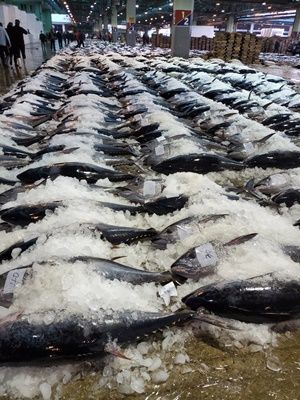
According to the financial statement of the 56th term announced at the Busan Joint Fish Market (as of December 31 last year), the market’s net loss for the current term reached 1.2232 billion won. If some large purse seine companies leave while the market is already in deficit, the deficit is expected to widen further.
However, since early this year, some Busan mackerel purse seine fleets have been actively promoting mackerel unloading ports and auctions outside of Busan. Many companies, pressured by financial difficulties threatening their existence, see these moves purely as a “survival strategy.”
Since the Korea-Japan fisheries agreement failed to be concluded in 2016, prohibiting Korean vessels from entering, the large purse seine industry, which depends on the Japanese EEZ (Exclusive Economic Zone) for about 20% of its catch, is estimated to have suffered 65.5 billion won in fishing losses over three years up to this year.
Last year, the large purse seine industry implemented a two-month fishing moratorium, resulting in increased mackerel catch volumes and larger fish sizes. However, due to a sharp increase in imports of Norwegian mackerel causing prices to fall and profitability to worsen, the industry ultimately could not escape the “quagmire of deficits.”
The industry reports that about half of the 21 companies and 22 fleets affiliated with the large purse seine fisheries cooperative are currently facing financial instability due to excessive debt.
In particular, the plan by large purse seine fleets to promote offshore mackerel auction sites is gaining momentum, overlapping with the possibility of reduced mackerel auction processing volumes in Busan.
The fisheries cooperative explains that with the modernization of the Busan Joint Fish Market, including hygienic auction facilities such as the use of sorting machines instead of “floor auctions,” the volume auctioned, which currently reaches up to about 100,000 boxes per day, will inevitably decrease to less than two-thirds.
Therefore, there is an analysis that the spawning season volume cannot be handled by the Busan Joint Fish Market alone, making the active attraction of large purse seine fleets by Wando-gun urgently necessary.
Wando-gun is a nearby port accessible within two hours from the main fishing grounds of purse seine fleets, capable of supplying fresh mackerel nationwide on the same day. It is also expected to help improve management profitability by reducing fuel costs for the fleets.
© The Asia Business Daily(www.asiae.co.kr). All rights reserved.
![User Who Sold Erroneously Deposited Bitcoins to Repay Debt and Fund Entertainment... What Did the Supreme Court Decide in 2021? [Legal Issue Check]](https://cwcontent.asiae.co.kr/asiaresize/183/2026020910431234020_1770601391.png)
















