18 Gwangju-Jeonnam Democratic Party Winners "Enact 5.18 Historical Distortion Punishment Act as Bill No. 1"
Defamation Lawsuits Alone Make Punishing 5.18 False Remarks Difficult... Need Criminal Law Provisions
Experts "Concerns Over Freedom of Expression... Punishment Should Not Target Public Interest Purposes"
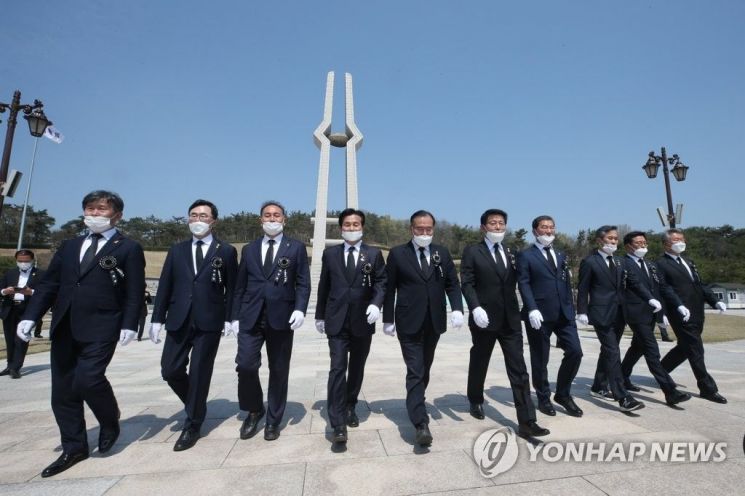 On the morning of the 16th, all 10 elected members from the Jeonnam region for the 21st National Assembly election finished paying their respects at the National 5·18 Democratic Cemetery in Buk-gu, Gwangju, and are leaving. / Photo by Yonhap News
[Asia Economy reporters Seunggon Han and intern Juhyung Lim] Some elected members of the Democratic Party of Korea from Gwangju and Jeonnam are expected to propose the so-called '5.18 Distortion Punishment Act,' which punishes distortion and disparagement related to the May 18 Democratic Uprising, sparking heated discussions around the bill.
Supporters emphasize the necessity of the bill to prevent the spread of fake news related to May 18, while some express concerns that it could restrict freedom of expression.
On the 17th, 18 elected lawmakers from the Democratic Party representing the Gwangju and Jeonnam regions issued a press release stating, "We will jointly push for amendments to the May 18-related laws immediately after the opening of the 21st National Assembly, and we will definitely complete the tasks that were not achieved in the 20th National Assembly."
The May 18-related legislation, which the elected members plan to jointly propose, is called the '8 Laws to Correct the History of May 18,' including △expansion of the role and authority of the Truth Investigation Committee △strengthening punishment for historical distortion △restoration of honor and compensation for merit recipients.
Among these, the elected members announced that they will prioritize pushing the '5.18 Distortion Punishment Act,' which strengthens penalties for distortion and disparagement remarks.
Lee Hyung-seok, chairman of the Democratic Party's 5.18 40th Anniversary Special Committee, said, "Distorting the May 18 Democratic Uprising, which has been legally and historically evaluated, denies the Constitution and undermines democracy," adding, "We will ensure that the Historical Distortion Punishment Act is enacted as the first bill in the 21st National Assembly."
The 5.18 Distortion Punishment Act was previously proposed in the 20th National Assembly but ultimately failed to pass. At that time, the Democratic Party, along with three opposition parties?the Bareunmirae Party, the Party for Democracy and Peace, and the Justice Party?proposed the 'Special Act on the May 18 Democratic Uprising, etc.' The bill's core was to impose imprisonment of up to seven years or a fine of up to 70 million won on those who defame, distort, fabricate, or spread false information about May 18 through publications, exhibitions, the internet, performances, and other means.
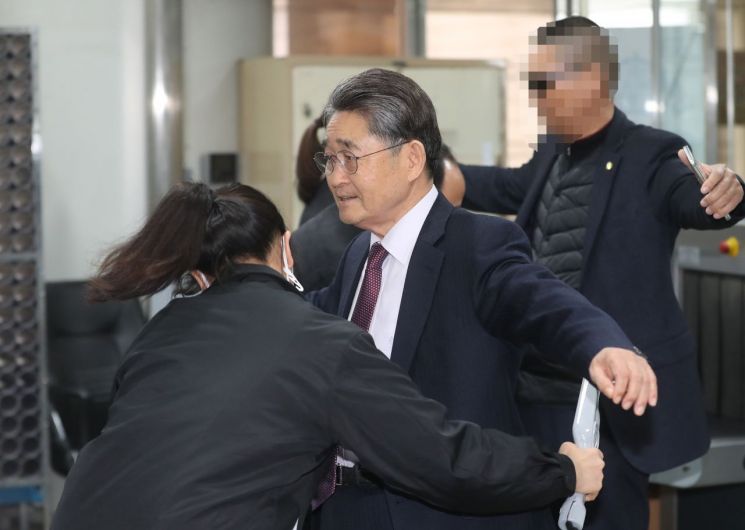 Mr. Ji Man-won, who was accused of defamation for claiming that Gwangju citizens who participated in the May 18 Democratic Uprising were North Korean special forces, attended the first trial sentencing hearing held at the Seoul Central District Court in Seocho-dong on February 13 last year and was being searched before entering the courtroom. / Photo by Yonhap News
Supporters of the 5.18 Distortion Punishment Act argue that although a historical consensus on May 18 has already been reached, there is no law to punish those who deny or defame it, which has prevented blocking fake news related to May 18 or protecting the honor of merit recipients.
Currently, there is no criminal law provision to punish defamatory remarks about May 18. Because of this, organizations related to May 18 have been filing defamation lawsuits against individuals who make such remarks one by one. The problem lies in the difficulty of punishing defamation if the victim is not specifically identified.
In 2008, Ji Man-won, who claimed the 'North Korean military intervention theory' regarding May 18 and was sued for defamation, was acquitted by the Supreme Court four years later.
At that time, the court acknowledged that Ji distorted May 18 but ruled, "Since no specific victim was identified," and "The May 18 Democratic Uprising has an established legal and historical evaluation, it is unlikely that social evaluation of those related to May 18 would fundamentally change due to Ji's posts."
Regarding this, Park Kwang-on, a Democratic Party lawmaker who proposed the 5.18 Distortion Punishment Act last year, explained the legislative intent at a policy lawmakers' meeting held in the National Assembly on February 20 last year, saying, "We need to establish regulations that prohibit and punish regardless of whether defamation is involved," and "It is necessary to prevent distortion of historical truth and ensure that the public recognizes the correct historical facts."
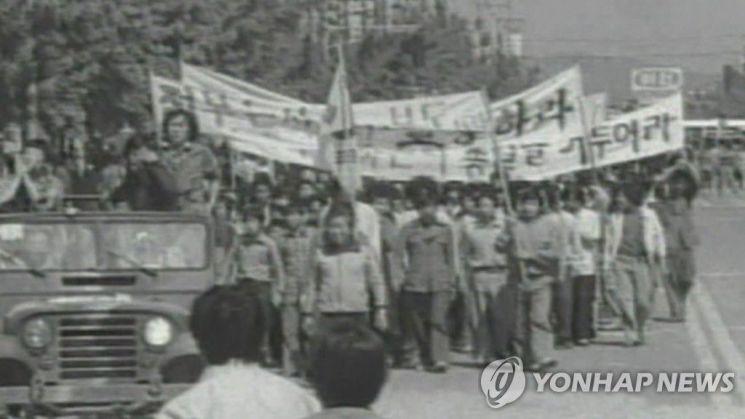
On the other hand, some express concerns that the 5.18 Distortion Punishment Act could restrict freedom of expression.
Son Ji-won, a lawyer at the nonprofit organization 'Open Net,' said at a meeting held at Open Net's office in Seocho-gu, Seoul, on April 22 last year, "The significance of May 18 holds a noble value. Everyone would agree that acts that damage it should be responded to," but added, "Legislation needs to be approached from the perspective of freedom of expression. The precedent of the state defining historical facts and criminally punishing denial could hinder the development of democracy."
He continued, "Such regulations can also be used by the state and political power as a means to suppress opponents," emphasizing, "Criminal punishment for expression should be considered as a last resort, only when the harm caused by the expression is serious and there is a clear, present, and substantial danger."
Experts suggest a cautious approach that introduces both self-regulation and criminal punishment for defamatory remarks about May 18.
Kim Jae-yoon, a professor at Chonnam National University Law School, said at a forum titled 'How to Punish Defamatory Remarks about May 18' held at the National Assembly Members' Office Building on February 13 last year, "Punishing defamation, distortion, and fabrication of May 18 excessively restricts freedom of expression and the press," adding, "It is necessary to strengthen self-regulation as a basic premise and impose criminal sanctions only if that fails."
He added, "It is necessary to include a justification clause that exempts punishment under the distortion punishment law when the expression contributes to academic research, current affairs reporting, and other purposes to avoid infringing on freedom of expression."
© The Asia Business Daily(www.asiae.co.kr). All rights reserved.



















