Government to Hold 'Tax Burden Reform Plan' Forum on 19th
Electronic Cigarette Association Federation "Unaware of Event"
"Suspicion of Prior Coordination with Cigarette Companies"
Disagreement Over Tax Rates... Harm Controversy Likely to Cause Significant Impact
[Asia Economy Reporter Choi Sunghye] Liquid-type electronic cigarettes have become embroiled in conflict over the tax system reform following controversies about their harmfulness.
On the 18th, the Electronic Cigarette Association Federation issued a statement strongly opposing the discussion forum titled ‘Reform Plan for Liquid-type Electronic Cigarette Tax Burden’ hosted by the Korea Institute of Public Finance and the Korea Local Tax Research Institute on the 19th, calling it mere "armchair theorizing." They claimed that while large tobacco companies focusing on combustible cigarettes were asked about panel participation, the federation, which exclusively sells liquid-type electronic cigarettes, was not even informed about the event.
The Ministry of Economy and Finance, responsible for excise tax, is reportedly planning to incorporate the liquid-type electronic cigarette tax system reform plan into the tax reform scheduled for the end of July after comprehensively reviewing the discussion forum on the 19th and the research report to be submitted at the end of next month.
Kim Dohwan, spokesperson for the Electronic Cigarette Association Federation, said, "We only learned about the forum’s holding a few days ago through media reports," and criticized, "The organizers inquired about panel participation from large combustible cigarette companies during the preparation process, but they neither consulted nor even notified the federation?a nonprofit organization established by about 70 liquid-type electronic cigarette manufacturers, importers, distributors, and over 2,000 retail stores nationwide?about panel selection or the event itself in advance."
The federation expressed strong suspicion, stating, "We wonder if there was any prior consultation or coordination with combustible cigarette companies or organizations that could influence the direction and content of the forum."
The conflict over the tax system reform plan is deepening. Inside and outside government agencies and the industry, there have been ongoing criticisms that the tax burden on liquid-type electronic cigarettes is lower than that on regular cigarettes (combustible type). It is expected that, considering tax fairness and social costs such as harm to public health, the conclusion will lean toward raising excise tax, tobacco consumption tax, and local consumption tax.
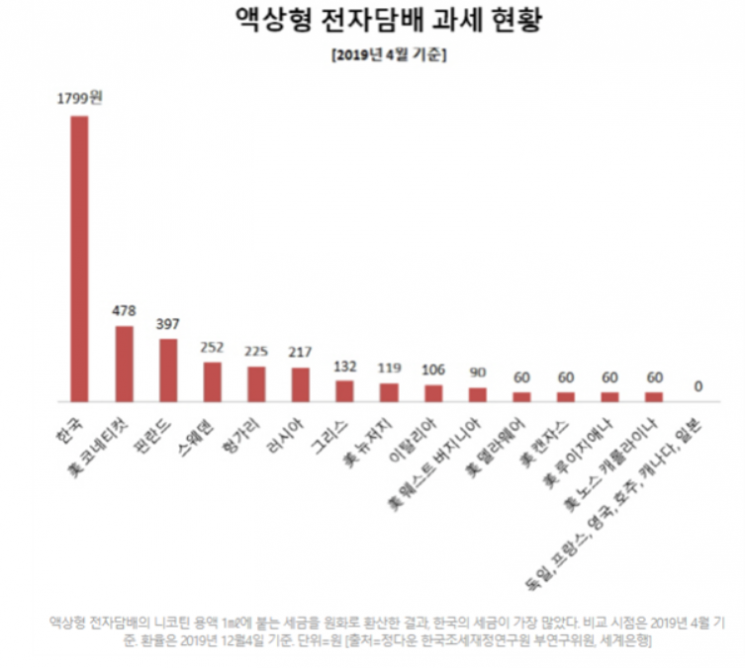
However, the federation argued the unfairness of tax increases, stating, "When converted to Korean won, the tax on 1㎖ of nicotine solution in liquid-type electronic cigarettes in Korea is 1,799 won, the highest level in the world," adding, "This is more than three times the 478 won in second-ranked Connecticut, USA."
The federation said, "We are astonished that in 2020 Korea, people who have never used liquid-type electronic cigarettes in their lives are deciding the market’s fate through armchair theorizing, and we urge the organizers to awaken so that realistic industry opinions can be reflected even now."
Meanwhile, liquid-type electronic cigarettes are effectively being phased out in Korea. Sales have plummeted since last October following the government’s recommendation to stop using liquid-type electronic cigarettes, leading to consumer rejection. At that time, the Ministry of Health and Welfare made the decision due to ongoing cases of severe lung injury caused by liquid-type electronic cigarettes in the United States. Two months later, a Food and Drug Safety Ministry investigation found vitamin E acetate, which can cause severe lung disease, in some products including Juul, worsening the situation.
On the 7th, Juul Labs Korea announced its withdrawal from the domestic market, about one year after entering in May last year. Some products of KT&G’s liquid-type electronic cigarette ‘Seed’ (Toba, Tundra), which were also subject to the government’s usage suspension recommendation, have disappeared from the market. Sales of liquid-type (CSV standard) electronic cigarettes in the domestic market continue to decline. According to the Ministry of Economy and Finance, sales of CSV electronic cigarettes in the first quarter of this year were 900,000 pods (liquid container units, with 1 pod counted as 1 pack), marking the lowest quarterly sales since their launch in May last year.
© The Asia Business Daily(www.asiae.co.kr). All rights reserved.

















