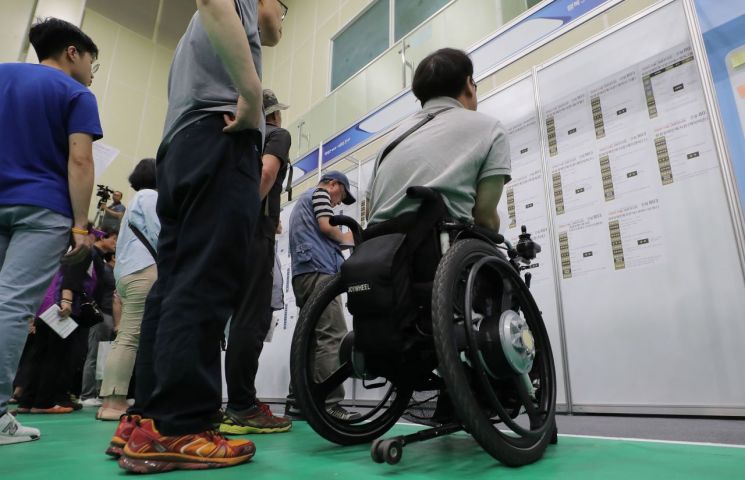
[Asia Economy Reporter Kim Bo-kyung] The government has decided to raise the mandatory employment rate for persons with disabilities by 0.4 percentage points in 2024. It aims to increase quality jobs for persons with disabilities and expand support for workplaces that employ them.
The Ministry of Employment and Labor announced a "Plan to Strengthen Customized Job Policies for Persons with Disabilities" jointly with related ministries at the Job Committee meeting held on the 15th. This is to enhance policy outcomes amid concerns over employment instability for vulnerable groups such as persons with disabilities due to the recent COVID-19 pandemic.
The policy tasks of the currently implemented "5th Basic Plan for the Promotion of Employment and Vocational Rehabilitation of Persons with Disabilities (2018?2022)" were reviewed and redesigned to be demand-oriented.
First, the statutory mandatory employment rate under the mandatory employment system for persons with disabilities in both the private and public sectors will be gradually increased.
Currently, private companies with 50 or more employees must employ persons with disabilities at a rate of 3.1%. This will be raised to 3.3% in 2022?2023 and to 3.5% from 2024 onward.
For the public sector, the current rate of 3.4% will be increased to 3.6% in 2022?2023 and to 3.8% from 2024 onward.
Workplaces that repeatedly fail to fulfill their employment obligations for persons with disabilities will be required to submit employment improvement plans.
Additionally, the establishment types of standard workplaces for persons with disabilities will be expanded to include consortium types and social economy enterprises, and support for market access such as building online shopping systems will be strengthened.
New job models for persons with disabilities in the cultural and artistic fields will also be developed. Initiatives include operating special school curricula in arts and physical education, expanding and supporting linked employment in performing arts, pilot introduction of public job cultural and artistic roles, and establishing mid- to long-term plans to support disability culture and arts.
A three-stage customized program for reemployment of persons with disabilities who have acquired physical or mental impairments will be newly introduced next year.
The employment environment for persons with disabilities will also improve. Support for installation and purchase costs of convenience facilities for persons with disabilities and commuter vans at small workplaces employing persons with disabilities will be expanded and eligibility requirements relaxed.
Currently, support is provided up to 40 million KRW per instance for workplaces with 20 or more disabled employees. From next year, this will change to up to 20 million KRW per instance for workplaces with at least 10 disabled employees, and up to 40 million KRW for those with 20 or more.
A new project to partially support commuting costs for persons with severe disabilities will also be launched next year.
Following the abolition of the disability grading system, a testing tool to measure vocational limitations caused by disabilities will be developed. Next year, the Korea Employment Agency for Persons with Disabilities will establish an "Employment Service Assessment Team (tentative name)" to provide customized employment services using this testing tool.
The categories of disabilities eligible for employment services are also expected to expand. The government is considering including dyslexia, mild brain lesions that can be classified as severe vocationally, and unregistered disabled persons among special education targets who have difficulty with vocational life within the disability categories.
Minister of Employment Lee Jae-gap said, "Through this policy strengthening plan, we expect to provide demand-centered employment services that persons with disabilities can truly feel. We will strive to expand opportunities for persons with disabilities to confidently become independent members of society through work."
© The Asia Business Daily(www.asiae.co.kr). All rights reserved.
![Clutching a Stolen Dior Bag, Saying "I Hate Being Poor but Real"... The Grotesque Con of a "Human Knockoff" [Slate]](https://cwcontent.asiae.co.kr/asiaresize/183/2026021902243444107_1771435474.jpg)
















