[Asia Economy Reporter Jang Hyowon] The aviation industry posted poor performance in the first quarter of this year due to the impact of the novel coronavirus disease (COVID-19). In particular, Korean Air and Jin Air recorded a decrease in the number of employees compared to the same period last year.
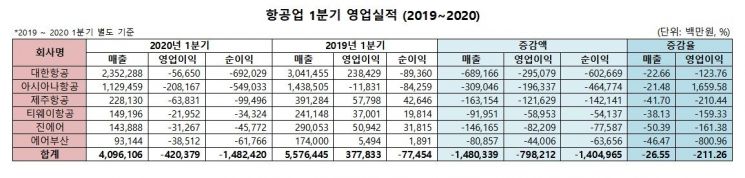
According to the Financial Supervisory Service on the 16th, the total sales of six listed airlines?Korean Air, Asiana Airlines, Jeju Air, T'way Air, Jin Air, and Air Busan?in the first quarter of this year amounted to 1.4803 trillion KRW, down 26.55% from the same period last year.
The company with the largest decline was Jin Air, whose sales dropped by 50.39% compared to the same period last year. On the other hand, the company with the smallest decrease was Asiana Airlines, which saw a 21.48% decline during the same period.
Operating profit turned into a loss. The total operating loss of airlines in the first quarter of this year was 420.3 billion KRW. This represents a decrease of 798.2 billion KRW from an operating profit of 377.8 billion KRW in the same period last year.
Korean Air showed the largest drop in operating profit, decreasing by 295 billion KRW compared to the same period last year. Korean Air recorded an operating profit of 238.4 billion KRW in the first quarter of last year but posted an operating loss of 56.6 billion KRW in the first quarter of this year.
Asiana Airlines had already posted a loss of 11.8 billion KRW in the first quarter of last year, but its loss increased by 196.3 billion KRW to record an operating loss of 208.1 billion KRW in the first quarter of this year. Jeju Air, T'way Air, Jin Air, and Air Busan also all turned to losses.
Although the airline industry's performance declined, only Korean Air and Jin Air reduced their workforce. As of the first quarter of this year, these companies cut 627 and 24 employees respectively compared to the same period last year. Asiana Airlines (80 employees), Jeju Air (281 employees), T'way Air (242 employees), and Air Busan (74 employees) actually increased their number of employees.
Executive salaries generally decreased. Jin Air paid a total of 87 million KRW to 9 executives in the first quarter of this year, down 84.01% from the 544 million KRW paid to 7 executives last year. Korean Air also paid 676 million KRW to 11 executives in the first quarter of this year, a 37.65% decrease from the 1.084 billion KRW paid to 10 executives last year.
This trend is expected to continue as COVID-19 shows signs of resurgence and prolongation. Last month, the number of international passengers transported through nationwide airports was 154,000, a 97.9% decrease compared to the same period last year. Demand for international air cargo also dropped by 13.3%.
Kim Yoo-hyuk, a researcher at Hanwha Investment & Securities, analyzed, “Since 186 countries currently maintain entry restrictions on travelers from Korea, international passenger demand in May is expected to be similar to that of April. It will take more time for a full recovery.”
© The Asia Business Daily(www.asiae.co.kr). All rights reserved.

















