Offline Applications for Local Love Gift Certificates and Prepaid Cards Available from the 18th
8 out of 10 Consumers Expected to Boost Economy by Using Local Currency
Some Local Governments Criticize Government Subsidy Method
COVID-19 National Crisis Overcoming Committee Pushes to Expand Government Disaster Relief Fund Usage
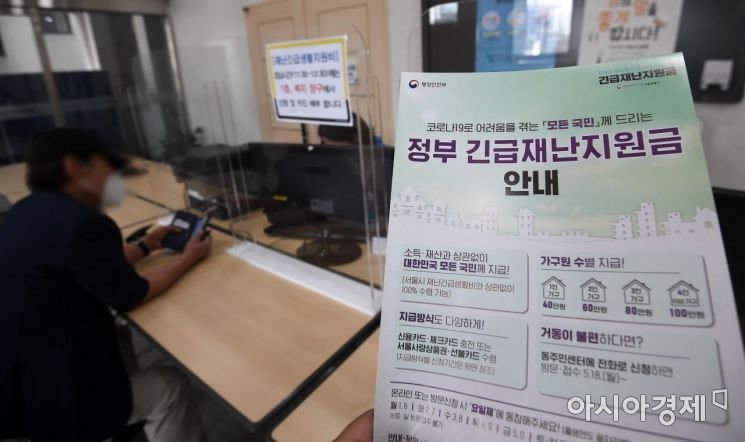 The government's emergency disaster relief fund credit and debit card recharge application began on the morning of the 11th through the websites of nine card companies at 7 a.m. Similar to the public mask 5-day rotation system, the application follows a day-of-the-week schedule, but from the 16th, applications can be made at any time. The support amounts are 400,000 KRW for single-person households, 600,000 KRW for two-person households, 800,000 KRW for three-person households, and 1,000,000 KRW for households of four or more. The photo shows a citizen visiting a community center in Jongno-gu, Seoul, on that day, inquiring about the support fund application. Photo by Kim Hyun-min kimhyun81@
[Asia Economy Reporter Kim Suwan] "Surely, local currency will help revitalize the local economy, right?"
To overcome the damage caused by the novel coronavirus infection (COVID-19), the government decided to provide emergency disaster relief funds to all citizens. In particular, usage is restricted at department stores, large marts, large electronics retailers, and entertainment bars to support small business owners and stimulate the local economy.
Currently, each local government issues disaster relief funds as local currency (local love gift certificates) or cards. Accordingly, public interest in 'local currency' is increasing.
On the 15th, the Ministry of the Interior and Safety announced that from the 11th to the 14th, over four days, 7.8 million households nationwide applied for a total of 5.2283 trillion won in emergency disaster relief fund credit/check card recharges. On the 14th, the fourth day of applications, 2.08 million households applied for 1.3906 trillion won in a single day.
By region, Gyeonggi-do accounted for 26.2% of the total application amount, with 2,043,528 households applying for 1.2855 trillion won.
Next were Seoul with 1,722,575 households applying for 1.1333 trillion won (22.1%), Busan with 474,727 households and 330.2 billion won (6.1%), Incheon with 456,370 households and 320 billion won (5.8%), Gyeongnam with 430,991 households and 308.4 billion won (5.5%), Daegu with 357,408 households and 254.1 billion won (4.6%), and Gyeongbuk with 342,734 households and 235.5 billion won (4.4%).
Since the 11th, applications for emergency disaster relief funds via credit/check card recharge have been accepted online. Applications for local love gift certificates and prepaid card disaster relief funds will be accepted offline starting on the 18th. Eligibility for local currency applications can be checked on the respective local government websites.
 According to a survey, 8 out of 10 consumers feel that the use of local currency helps revitalize the local economy. Photo by Yonhap News
With such intense interest in the emergency disaster relief funds, the majority of consumers expect that local currency will help revitalize the local economy.
According to a survey, 8 out of 10 consumers feel that using local currency helps stimulate the local economy.
Market research firm Embrain Trend Monitor conducted a perception survey on 'local economy' and 'local currency' on the 13th targeting 1,000 men and women aged 15 to 64 living in Seoul and Gyeonggi-do. The results showed that 65.5% supported issuing disaster relief funds as local currency, compared to 31.5% who preferred cash payments.
Consumers anticipated that using local currency would △help increase sales for small business owners and traditional markets (59.2%) △enable the circulation of local income within the region (52.2%) △and help revive the depressed local commercial districts (45.6%).
As a result, more citizens are choosing local currency as the method for receiving disaster relief funds. A 20-something office worker, Mr. A, said, "I applied for the disaster relief funds as local currency," adding, "It depends on the region, but I chose local currency because it offers benefits compared to receiving it on a card."
Housewife Ms. B (55) also said, "Given the current COVID-19 situation, revitalizing the local economy is more urgent than ever," adding, "Issuing local currency seems helpful." She continued, "If more people buy goods at traditional markets or franchise stores run by small business owners, which have been hit hard economically, the local economy might recover to some extent."
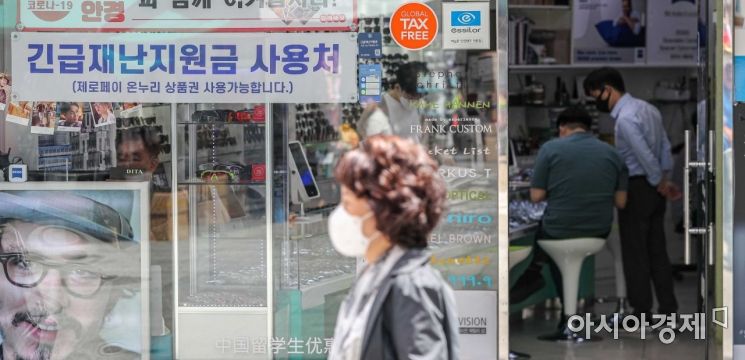 On the 14th, during the ongoing application period for the Emergency Disaster Relief Fund, a notice informing about the use of the relief fund is posted at a store located in Namdaemun Market, Jung-gu, Seoul.
 Photo by Kang Jin-hyung aymsdream@
On the other hand, some point out inconveniences due to the limited usage areas within the region and the inability to use it at large corporate franchise stores. They argue that the usage scope of the disaster relief funds should be expanded.
According to the aforementioned survey, 48.2% of consumers responded that local currency should also be usable at large franchise directly operated stores and department stores within the region.
Some local governments have criticized issues related to the government's emergency disaster relief fund support. Jeju Governor Won Heeryong said at a briefing held at the Jeju Provincial Government press room on the 14th, "There is much public dissatisfaction due to the government's disaster relief fund payment locations and usage methods," adding, "The government says the emergency disaster relief funds are for revitalizing the local economies of each city and province, but by restricting the usage period and region, there are policy blind spots."
Meanwhile, the Democratic Party's COVID-19 National Crisis Overcoming Committee announced plans to expand the usage scope of the government's emergency disaster relief funds for COVID-19 response.
Jin Seongjun, spokesperson for the COVID-19 National Crisis Overcoming Committee, said at a briefing on the 15th, "Due to the nature of the disaster relief funds, there are restrictions on where they can be used, but we have received requests to ease these restrictions, so we will actively review each case and promote expansion."
© The Asia Business Daily(www.asiae.co.kr). All rights reserved.



















