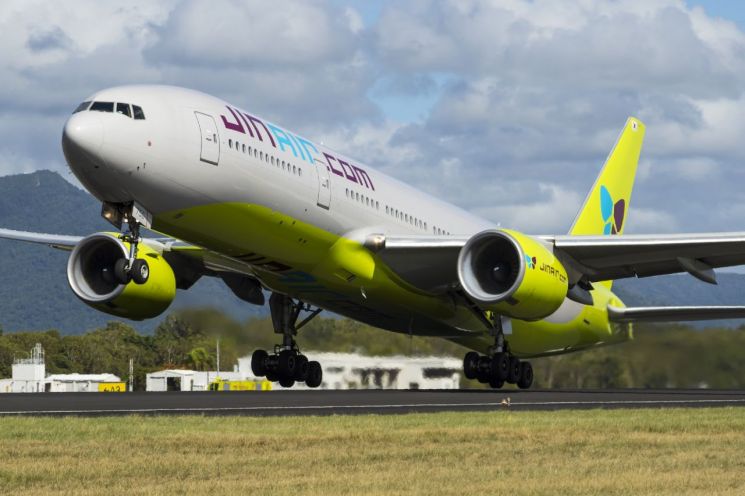
[Asia Economy Reporter Lee Chun-hee] Additional allocation of new traffic rights has been made to airlines struggling due to the novel coronavirus infection (COVID-19). Through this allocation, Jin Air, which was released from sanctions such as the refusal of new traffic rights after 19 months on March, newly acquired traffic rights.
The Ministry of Land, Infrastructure and Transport announced on the 15th that it held an Aviation Traffic Deliberation Committee meeting and allocated a total of 25 routes among the traffic rights held by the government to 9 domestic airlines.
International air traffic rights have been allocated annually through deliberation by the Aviation Traffic Deliberation Committee in accordance with the 'Regulations on the Allocation of International Air Traffic Rights and Overflight Rights.' This year, following the regular allocation in February, the first occasional allocation was made on this day.
In particular, Jin Air, which had been blocked from acquiring new traffic rights due to sanctions, obtained traffic rights for the Cheongju-Zhengzhou route (3 times a week). Since August 2018, Jin Air had been under sanctions from the Ministry of Land, Infrastructure and Transport, including refusal of new traffic rights, restrictions on new aircraft registration, and prohibition of irregular flight operation permits.
These sanctions were imposed after it was revealed that Cho Hyun-min, former Vice President of Jin Air and Executive Director of Hanjin Kal, was a foreigner. In April 2018, allegations arose that Cho had committed 'gapjil' (abuse of power) by spraying water on an advertising agency employee. As the controversy expanded, it was revealed that Cho, a U.S. national, had served as a registered executive of Jin Air for six years from 2010 to 2016. Under current law, if a foreigner is registered as an executive, an air transport business license cannot be granted, making his tenure illegal. Violating this could lead to license cancellation.
However, the Ministry of Land, Infrastructure and Transport stated, "We judged that the negative ripple effects of license cancellation outweigh the social benefits achievable by cancellation," and instead of canceling the license, announced sanctions prohibiting new route launches until Jin Air fully implements the self-submitted improvement plan, effectively restricting business expansion.
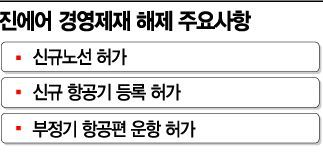
Then, in March, Jin Air reached an agreement with the Ministry of Land, Infrastructure and Transport to establish governance improvements that strengthened board independence and checks on management, which was finalized at the shareholders' meeting. The Ministry decided to lift the sanctions. This traffic rights allocation is the first since the lifting of Jin Air's sanctions.
In addition, the allocation included traffic rights under the Korea-ASEAN Special Summit agreement for the fifth freedom intermediate traffic rights (Korea-third country-Singapore). Jeju Air can now operate the Singapore fifth freedom route twice a week through this allocation.
Kim Itak, Director of Aviation Policy at the Ministry of Land, Infrastructure and Transport, said, "Considering the difficulties faced by domestic airlines due to COVID-19, we promoted occasional allocations to support airlines in stabilizing operations after overcoming COVID-19," adding, "The allocated routes will be operated after safety is secured between Korea and the counterpart countries regarding COVID-19, followed by aviation authority approvals and ground handling contracts."
© The Asia Business Daily(www.asiae.co.kr). All rights reserved.


















