40th Anniversary of the May 18 Gwangju Democratization Movement
At South Korean Government's Request, US Releases May 18 Secret Documents to Public for the First Time...Includes Commander Jeon Du-hwan's Profile and President Choi Kyu-hah's Blue House Situation
Government Continues to Request Records from US Government for Truth Verification
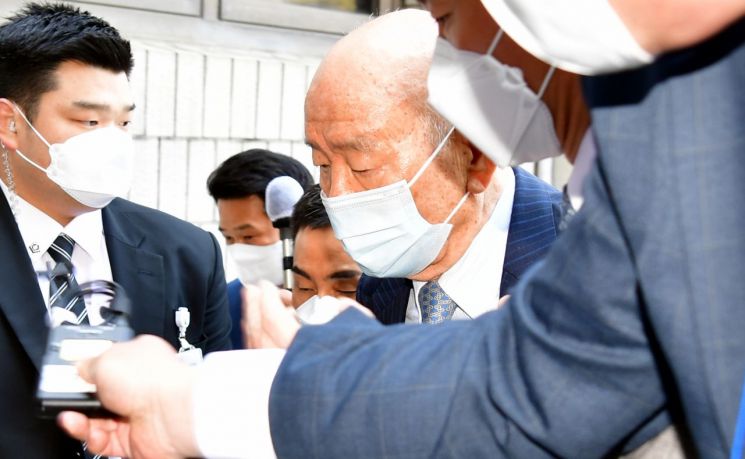
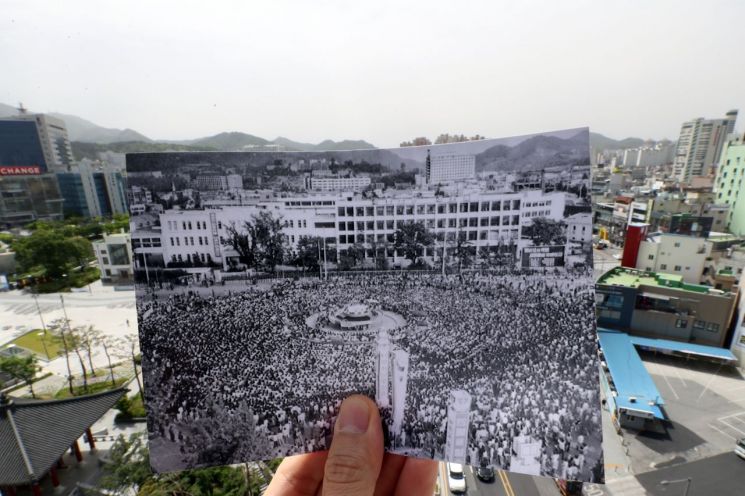
[Asia Economy Reporter Lim Cheol-young] Ahead of the 40th anniversary of the May 18 Gwangju Democratization Movement, additional U.S. State Department documents revealing the situation around May 1980 have been disclosed. Although over 3,000 pages of documents were released in 1996, some content had been redacted. This time, the U.S. delivered a complete copy with all remaining parts fully disclosed to the South Korean government on the 11th (local time). The documents consist of a total of 43 cases, spanning 140 pages.
After a preliminary review by the Ministry of Foreign Affairs, related government agencies, and experts, the U.S. State Department documents released on the 15th officially confirmed for the first time that Jeon Du-hwan, then Security Commander, requested assistance from the U.S. government following the December 12 military coup, and that the U.S. government expressed a negative stance toward mediation requests from Gwangju citizens. The documents are telegrams sent by William Gleysteen, the U.S. Ambassador to South Korea, between December 1979 and December 1980.
However, the documents do not include more detailed content supporting the May incident where orders to open fire were given, resulting in many Gwangju citizens being killed or injured, indicating that more effort and time will be needed to uncover the full truth.
U.S. Ambassador to South Korea Met Jeon Du-hwan Immediately After December 12 Incident, "Jeon Requested U.S. Government Assistance to Seize Military Power"
Among the newly confirmed details in these diplomatic documents is that Jeon Du-hwan, then Security Commander, met Ambassador Gleysteen after the December 12 incident and requested help from the U.S. government to consolidate military control. Ambassador Gleysteen met Jeon Du-hwan shortly after the December 12 incident, which was led by Jeon and his followers, arranged by Robert Brewster, head of the CIA Korea branch. Initially, Gleysteen was reluctant to meet Jeon, fearing it might appear as recognition of the coup, but sensing the rapidly changing situation, he proceeded with the meeting. He reported the impressions of Jeon and their conversation in the telegram to his home country.
At the meeting, Jeon Du-hwan claimed he had no personal ambition in instigating the December 12 incident. He said, "I personally have no ambition. This is neither a coup nor a revolution," and added, "It is to conclude the investigation into President Park Chung-hee's assassination." He also emphasized, "I support President Choi Kyu-hah's political liberalization program, and the military will be rebuilt within a month."
Gleysteen, who had already classified the December 12 incident as a coup, included a completely different assessment in the diplomatic documents immediately after the meeting. He described Jeon as trying hard to conceal the fact that the December 12 incident was premeditated and evaluated him as a highly self-centered ambitious figure. Regarding concerns about increased North Korean provocations, Gleysteen noted Jeon's very defensive attitude and added a subjective evaluation that Jeon gave a "very long and detailed, and undoubtedly self-serving explanation."
Ambassador Gleysteen particularly conveyed to the U.S. government that Jeon Du-hwan "is very wary of internal opposition forces within the military led by Army Chief of Staff and Martial Law Commander Jeong Seung-hwa," and that a group of radical young officers, referred to as 'young turk officers,' "hope for our help to suppress the opposition." He added, "The U.S. may face very difficult choices within weeks or months."
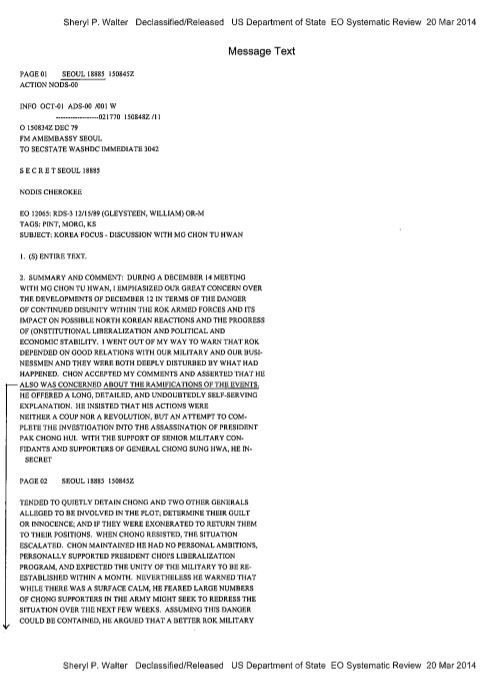 Additional diplomatic confidential documents related to the May 18 Gwangju Democratization Movement delivered by the U.S. side (Source: Ministry of Foreign Affairs)
May 1980... U.S. Embassy in South Korea Rejects Mediation Requests from Gwangju Citizens
Choi Kwang-soo, Presidential Chief of Staff, Judged Military Had Effectively Taken Over Government... "President Choi Kyu-hah Likely Has Nothing to Say About Martial Law"
Just before the martial law was expanded and strengthened and martial law troops attempted to enter the Jeonnam Provincial Office, Gwangju citizens requested mediation from the U.S. government but were rejected. Although this fact has been known through records and research, the newly released documents reveal the U.S. Embassy in South Korea and the U.S. government's perception of the situation at that time.
A telegram sent by Ambassador Gleysteen to his home country on May 26, 1980, contains information that a New York Times reporter requested Gleysteen to intervene as a mediator starting from Gwangju student leaders. However, Gleysteen wrote, "As an ambassador, if I act as a mediator in such a messy situation, the embassy could become a hostage to one side, the other side, or both." This is the first time the U.S. Embassy's rejection of Gwangju citizens' mediation requests has been confirmed through documents.
The documents also reveal, for the first time, the atmosphere within the Blue House at the time. Gleysteen, aware of the situation before the martial law expansion on May 17, 1980, met with Chief of Staff Choi and advised that the situation was being handled too harshly and that a new strategy was needed for a smooth resolution. Choi explained that the Choi Kyu-hah government was effectively watching the new military regime's moves and was trying to prepare a constitutional amendment program reflecting the demands of civil society, dissidents, and university students but was unable to push it forward. This confirms that virtually all power had already shifted to the new military regime led by Jeon Du-hwan.
Gleysteen wrote in the telegram that "Chief of Staff Choi doubted whether the president could speak about martial law," adding, "This is because the military strongly criticizes the government's conciliatory approach toward university students."
Martial Law Commander Lee Hee-seong Claims "If Gwangju Protesters Are Not Controlled, Communist Takeover Similar to Vietnam Could Occur"
Additionally, all telegrams sent by Ambassador Gleysteen after meeting Lee Hee-seong, then Army Chief of Staff and Martial Law Commander, were disclosed. On May 18, 1980, Gleysteen reported to the U.S. State Department on the relationship between Lee Hee-seong and Jeon Du-hwan, as well as the background that the situation in South Korea was inevitably heading toward a tragic outcome.
The diplomatic documents describing the meeting between Gleysteen and Lee Hee-seong, which began with Lee's dissatisfaction over not being informed in advance about the nationwide martial law expansion, include Lee's concerns about communist ideology among Gwangju protesters. Lee claimed that if the protesters were not controlled, a communist takeover similar to Vietnam could occur. He emphasized, "Communist ideology and radical tendencies are rapidly spreading among students, making it inevitable," and added, "Forty military generals gathered to discuss this, and President Choi Kyu-hah understood."
Although the documents do not include key content such as identifying those responsible for ordering the shooting of Gwangju citizens, the government plans to request the U.S. government to disclose more related records for further truth-seeking. This is because Ministry of National Defense documents are likely to contain crucial information for uncovering the truth beyond the U.S. State Department documents.
An official from the Ministry of Foreign Affairs stated, "The U.S. said that the disclosure of these records was made in the spirit of the ROK-U.S. alliance, cooperation, and friendship," adding, "In that sense, this move by the U.S. is meaningful, and now that the Truth Commission and government organizations have been established, the government will cooperate further to enable additional related documents to be disclosed."
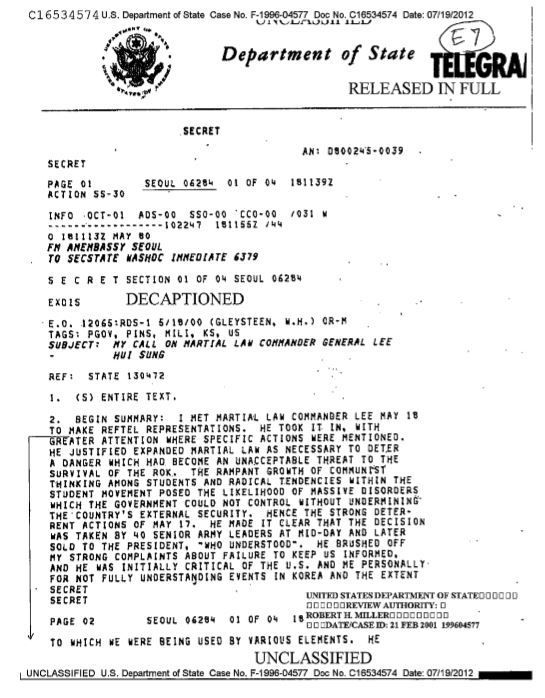 Additional diplomatic confidential documents related to the May 18 Gwangju Democratization Movement delivered by the U.S. side (Source: Ministry of Foreign Affairs)
© The Asia Business Daily(www.asiae.co.kr). All rights reserved.



















