President Trump Fox Business Interview
"Very disappointed in China... Chinese labor is never cheap"
"US economy will recover by next year... Strong dollar must continue"
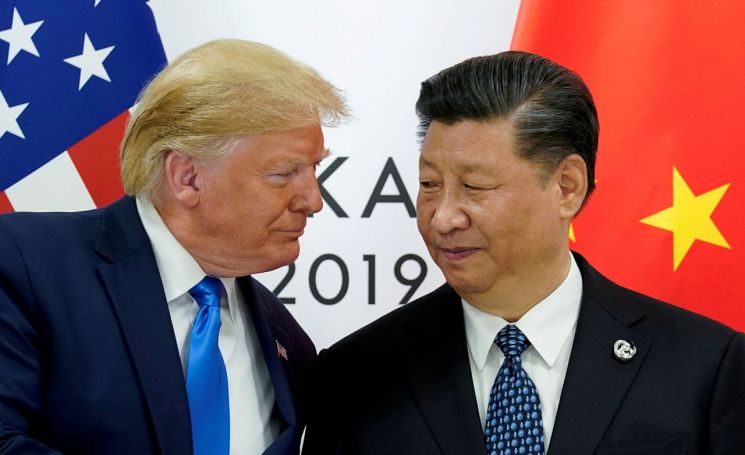
[Asia Economy Reporter Kim Eunbyeol] U.S. President Donald Trump stated that he is keeping a close eye on Chinese companies listed on the New York Stock Exchange. He explained that he is examining whether Chinese companies have violated U.S. accounting standards. This remark draws attention as it comes amid the recent deterioration of U.S.-China relations due to the COVID-19 pandemic. He also raised the warning level by saying he is very disappointed with China and could sever all relations with the country.
◆ "Chinese Companies Listed in the U.S. Must Follow the Rules" = On the morning of the 14th (local time), during an interview on Fox Business, President Trump said, "We are closely watching Chinese companies listed on the New York Stock Exchange (NYSE) and Nasdaq that do not comply with U.S. accounting standards," adding, "We are looking at them very strongly."
This statement came as President Trump criticized China. He said the COVID-19 pandemic started in China and expressed, "I am very disappointed with China." President Trump has repeatedly criticized China, saying the pandemic began there and that China did not disclose information transparently, which led to the global spread.
He also mentioned that if the U.S. cracks down on Chinese companies listed on the U.S. stock market, those companies would strongly resist. He said, "Let's assume we do that. What do you think would happen? They would probably try to move their listings to other places like London."
He added, "If we say that to trade on the NYSE and Nasdaq, you have to follow our rules, Chinese companies would respond by moving to London or Hong Kong." Although he did not elaborate further, it appears to be a criticism of China for not following overseas regulations.
He said, "China's cheap labor has turned out to be very expensive," and added, "When we were negotiating trade with China, the virus was not a topic at all."
President Trump also hinted that the U.S. is continuing efforts to block federal retirement funds from investing in Chinese stocks. Referring to the Federal Retirement Thrift Investment Board (FRTIB) decision to temporarily suspend investments in Chinese stocks within the Thrift Savings Plan (TSP) for federal employees, he warned that if Chinese stock investments are not blocked soon, he would dismiss the board members. He also rhetorically asked, "Don't you know that former President Barack Obama appointed the board?"
◆ "U.S. Economy Will Recover Next Year... Strong Dollar Policy Must Continue" = In the interview, President Trump also expressed his expectation that the U.S. economy, hit hard by the spread of COVID-19, will recover next year. He said, "The U.S. economy will rebound and turn around in the third quarter, and thanks to all the economic support measures, it will recover next year." He added that the U.S. economy next year will reach an all-time high.
This suggests that economic recovery will emerge as several states in the U.S. lift lockdown measures.
He also said that a strong dollar policy must continue for the economy to recover. President Trump said, "Because the dollar is strong, everyone wants to be included within the dollar policy. We must keep it strong."
According to Dow Jones Market Data Group, the dollar recently showed a 3.67% strength against the euro.
He also mentioned that the U.S. is maintaining zero interest rates and said the country should adopt negative interest rates like Germany and Japan. He recently stated, "If they continue with negative interest rates, we should do the same."
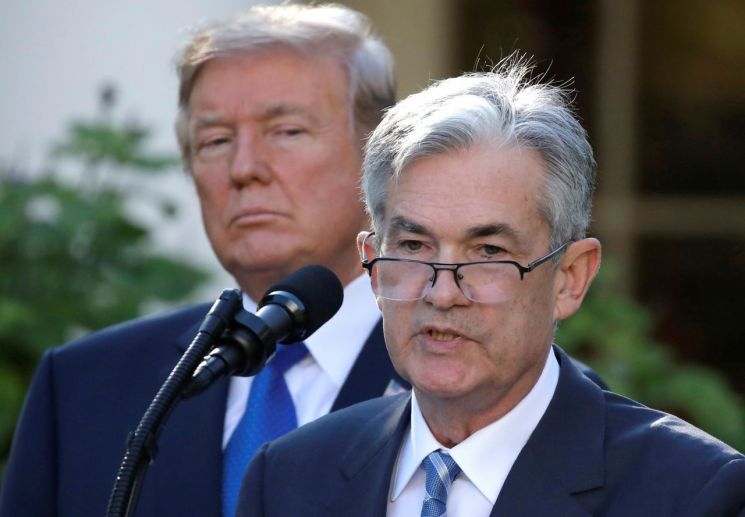
However, the day before, Federal Reserve Chairman Jerome Powell said that negative interest rates are not currently being considered. Chairman Powell said, "I know there are fans of the (negative interest rate) policy, but it is not under consideration for us at this time," adding, "We have good tools, and we will use those tools," explaining, "Interest rates, the bond purchases the Fed has done so far, and forward guidance." Forward guidance is a measure to announce the direction of monetary policy in advance, newly introduced after the 2008 financial crisis by the U.S., the U.K., and others to alleviate market concerns.
© The Asia Business Daily(www.asiae.co.kr). All rights reserved.



















