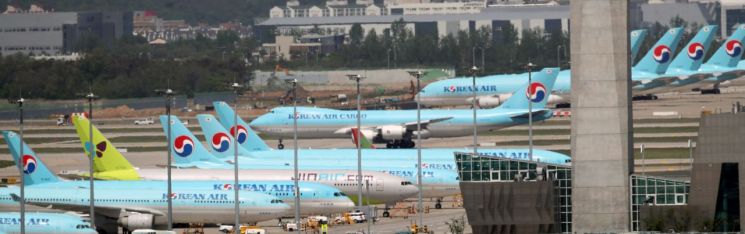
[Asia Economy Reporter Eunmo Koo] Korean Air is raising funds worth 2.2 trillion KRW, including a 1 trillion KRW rights offering, to overcome the liquidity crisis caused by the prolonged COVID-19 pandemic. While this capital increase plan is positive in terms of improving the financial structure and resolving uncertainties, the stock price continues to show sluggish performance. This is because immediate dilution of shares is inevitable and industry recovery remains uncertain.
According to the Korea Exchange on the 14th, Korean Air's stock price closed at 18,200 KRW, down 0.55% (100 KRW) from the previous trading day. This marks the third consecutive day of decline. As of 9:57 a.m. on the same day, the price was 17,950 KRW, down 1.37% from the previous day. Korean Air's stock price seemed to be gradually recovering since March 19, when the KOSPI hit its lowest point, but has weakened again since the announcement of the rights offering plan on the 20th of last month. During this period, Korean Air's stock fell by 12.9%, showing a contrasting trend to the slightly rising KOSPI (1.4%).
Korean Air's rights offering is necessary not only for capital expansion but also as a prerequisite to secure government liquidity support, so there is no disagreement on its necessity. However, immediate dilution of shareholder value is weighing on the stock price. The day before, Korean Air held a board meeting and resolved to conduct a rights offering of 1 trillion KRW through shareholder allocation followed by a general public offering of unsubscribed shares, and to issue convertible bonds (CB) worth 300 billion KRW. The number of new shares allocated per existing share is approximately 0.66, the expected issue price of the new shares is 12,600 KRW, and the final issue price will be determined on July 6.
With this rights offering, the number of Korean Air shares will increase from about 94.84 million to approximately 174.21 million, resulting in an estimated dilution of about 45.6% for existing shareholders. While the rights offering will improve the financial structure by increasing total equity instead of debt, the increase in shares will reduce earnings per share (EPS) and book value per share (BPS). Because EPS decreases, the price-earnings ratio (PER) rises, and as total equity increases, the return on equity (ROE) falls. From an investment indicator perspective, this reduces investment attractiveness.
The market situation, which was a concern, has been confirmed by indicators, negatively impacting the stock price. According to the aviation industry, the number of international passengers at nationwide airports in April was 154,000, a sharp 98% drop compared to the same month last year. Excluding overseas Koreans returning to the country, demand has almost disappeared. However, during the same period, international cargo volume at nationwide airports was 217,000 tons, down 13.3%, showing relatively better performance.
The first-quarter earnings to be announced on the 15th are also expected to be poor as anticipated. According to financial information provider FnGuide, Korean Air is estimated to record an operating loss of 201.5 billion KRW in the first quarter of this year, turning to a deficit compared to the same period last year. Sales during the same period are also expected to decrease by 21.8% to 2.4558 trillion KRW.
Kim Yoo-hyuk, a researcher at Hanwha Investment & Securities, said, "From a stock price perspective, government liquidity support, airlines' capital increase efforts, asset sales, and the possibility of additional mergers and acquisitions (M&A) could serve as short-term drivers. However, until structural recovery signals in passenger demand are confirmed, it is necessary to approach the aviation sector cautiously."
© The Asia Business Daily(www.asiae.co.kr). All rights reserved.

















