Increasing 'Backlash' Phenomenon Opposing MeToo Movement and Feminist Politicians
Campus Posters and Candidate Posters Vandalized
Steady Rise in Crimes Against Women Including Sexual Violence and Dating Violence Over the Past 5 Years
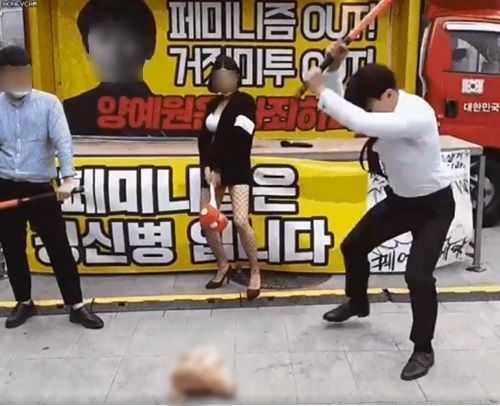 On the 10th, near Gangnam Station in Seoul, participants of the 'Antifeminist Rally' were seen striking a boiled pig's head with toy hammers. / Photo by Internet video capture
[Asia Economy reporters Seunggon Han and intern reporter Juhyung Lim] "Feminism out, fake Me Too out."
On the afternoon of the 10th, around 2 p.m., at Exit 9 of Gangnam Station in Seoul, the "1st Anti-Feminist Rally" hosted by YouTubers Wangja and Sidungi was held. The rally condemned Yang Yewon, who accused being sexually harassed while working as a model for a private studio shoot in 2018, and feminism.
The hosts, Wangja and Sidungi, had previously claimed that Yang's accusation was a "fake Me Too (Me too - I was also a victim)." At the rally, Sidungi emphasized, "There is no law that says another Yang Yewon won't come out," adding, "We need to show that if such acts happen, rallies will be held so that these incidents never happen again."
During the rally, dozens of participants marched in a line shouting slogans such as "Feminism is a mental illness," and performed an act where they placed a boiled pig's head on the ground and struck it with a toy hammer.
As social movements advocating for women's rights, such as the Me Too movement and feminism, have become more active, opposition movements have also gradually intensified.
 On May 19th, near Exit 2 of Hyehwa Station in Jongno-gu, Seoul, a protest condemning biased investigations into illegal filming took place. / Photo by Yonhap News
The Korean Me Too movement was triggered in January 2018 when Prosecutor Seo Ji-hyun revealed sexual harassment within the prosecution. Since then, it has become more active through events such as the May Hyehwa Station protest condemning police bias in digital sex crimes like illegal filming, and the December Hyehwa Station protest demanding solutions to misogynistic crimes related to the deaths of female celebrities like singer Sulli and Goo Hara.
However, as domestic women's rights movements deepened, backlash?movements opposing gender-related activism?increased. Some online communities and YouTube channels posted content criticizing Me Too and feminism, and incidents of feminist group posters and banners being vandalized occurred on university campuses such as Chung-Ang University.
This backlash also appeared against some female candidates running for office. During the 21st general election, posters of feminist female candidates were vandalized, and threats such as stones being thrown at candidates during campaigns were reported.
On the 13th of last month, the Seoul Seodaemun Police Station announced that at around 12:50 p.m. the previous day, the eye area of an election poster of independent candidate Shin Ji-ye, posted in a residential area of Bukahyeon-dong, was found burned.
Candidate Shin criticized, "The act of damaging a female candidate's poster face itself will make many women passing by feel uneasy," adding, "It openly reveals the misogyny pervasive in Korean society, not just targeting an individual politician."
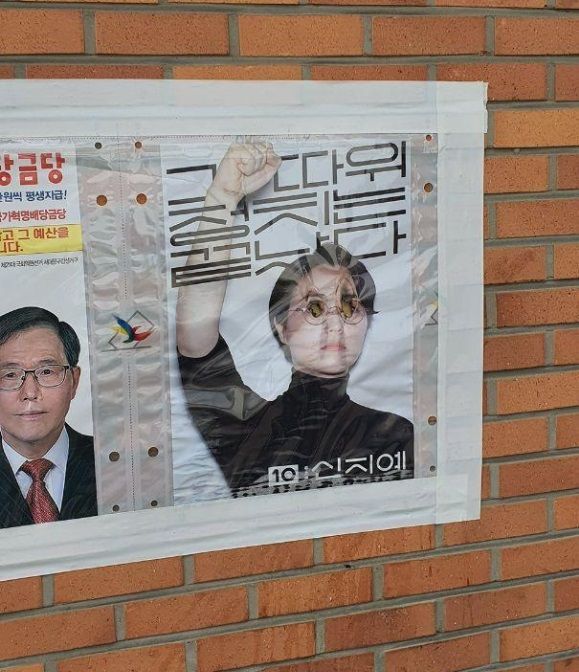 On the 12th of last month, around 12:50 PM, an election poster of candidate Shin, which was attached in a residential area in Bukahyeon-dong, was found with the eye area scorched by fire by an unidentified person, the Seoul Seodaemun Police Station and the campaign team of independent National Assembly candidate Shin Ji-ye from Seodaemun Gap announced on the 13th. / Photo by Yonhap News
On the 2nd of last month, near Exit 9 of Hongdae Entrance Station in Mapo-gu, Seoul, while Lee Ji-won, then a proportional representative candidate of the Women's Party, was campaigning, a stone suddenly flew and injured a party member assisting the campaign.
Candidate Lee pointed out, "This is violence experienced because I am a woman and attacks because I belong to the Women's Party," adding, "During the campaign, I was repeatedly threatened with remarks like 'Can you sell your body to the country too?', 'Why are women's voices so loud?', and 'I'll beat you up.'"
Crimes against women such as sexual violence, dating violence, and digital sex crimes have steadily increased over the past five years.
According to data released by the National Police Agency in December last year, from 2013 to 2018, the number of sexual violence crimes reported and arrests increased by 9%, from 28,000 to 31,000 cases; dating violence surged by 41.5%, from 7,200 to 10,200 cases; and illegal filming and distribution using cameras increased by 22.8%, from 4,800 to 5,900 cases.
Experts suggest the need to establish a culture that respects women as "public agents" who can participate in social movements and public office.
Kim Min-moonjung, head of the Korean Women's Associations United, said in a phone interview with Asia Economy on the 14th, "These problems arise because social activists and public office candidates are simply seen as 'young women,'" emphasizing, "We need to recognize that women are public agents who can take the forefront in society and send a message that society as a whole will respond firmly to violence against women."
She continued, "Because this awareness is lacking, related issues continue to be trivialized," explaining, "If this trivialization of violence continues repeatedly, a learning effect occurs, spreading backlash."
Regarding issues such as poster vandalism and sexual harassment experienced by female candidates running for office, she stressed, "Elections are not simply competitions between individual candidates," adding, "There needs to be recognition that it is a process of selecting public office candidates and appropriate management of public elections for this purpose. Clear guidelines and roles from the Election Commission are necessary."
© The Asia Business Daily(www.asiae.co.kr). All rights reserved.
![User Who Sold Erroneously Deposited Bitcoins to Repay Debt and Fund Entertainment... What Did the Supreme Court Decide in 2021? [Legal Issue Check]](https://cwcontent.asiae.co.kr/asiaresize/183/2026020910431234020_1770601391.png)

















