16.99 Million Non-Economically Active Population Without Job-Seeking Intent in April Hits Record High
Temporary Workers, Low Education, and Female Employment Indicators Worsen
Temporary Leave Workers, Who May Become Unemployed, Also Increase Over 1 Million for Two Consecutive Months

[Sejong=Asia Economy Reporters Kim Hyunjung and Joo Sangdon] Amid the rapid freezing of the employment market due to the impact of the novel coronavirus disease (COVID-19), the size of the 'non-economic active population' who have given up economic activities increased at the largest scale since the statistics began in 2000. As the non-economic population, which is not included in either employed or unemployed groups, increased significantly, a distorted phenomenon appeared where the unemployment rate actually decreased. In this situation, the COVID-19-induced unemployment shock seems to be growing even larger for vulnerable employment groups such as temporary workers, women, and low-educated individuals.
According to the 'April Employment Trends' announced by Statistics Korea on the 14th, the non-economic active population who neither sought jobs nor were employed surged by 831,000 from the same month last year to 16,991,000. This is the largest increase since June 2000, when the statistical standards were changed. The population who have the ability to work but chose to 'rest' also surged by 437,000 from the previous year to 2,408,000.
◆ 'Unemployment Time Bomb' Temporary Leave Workers Over 1 Million for Two Consecutive Months = Last month, when the number of new employed persons sharply dropped by more than 470,000, the unemployment rate actually improved by 0.2 percentage points from the previous month to 4.2%. This is due to a structural limitation where the 'resting' population, who are not economically active, are counted as non-economic active population rather than unemployed. Eun Soonhyun, Director of the Social Statistics Bureau at Statistics Korea, explained, "Job-seeking activities have slowed down compared to previous years due to the COVID-19 infection situation," adding, "The unemployment rate decreased because companies postponed hiring or interviews, or due to business suspensions or layoffs, making job-seeking difficult, so these populations were counted as non-economic active rather than unemployed." Currently, those who have given up job-seeking are counted as non-economic active, but if they start job-seeking activities in the future, they will be included as unemployed.
The number of temporary leave workers who are resting from work also remains high at 1,485,000, continuing over 1 million for two consecutive months following the previous month's 1,607,000, being pointed out as a time bomb for the unemployment shock. Temporary leave workers are defined as employed persons who are on leave for specific reasons but are scheduled to return. This includes both paid and unpaid leave workers; if the unpaid leave period exceeds six months, they are counted as non-economic active population, but before that, they are counted as employed. If the COVID-19 situation prolongs, these workers can become unemployed at any time, and some are on unpaid leave, making their status practically no different from unemployment. Hong Namki, Deputy Prime Minister and Minister of Economy and Finance, also pointed out temporary leave workers on the same day as the "Achilles' heel of the employment market," expressing concern that "if difficulties continue, it could lead to a sharp increase in unemployment."
◆ COVID-19 Cut the Weakest Links First = The shock of the COVID-19 crisis appeared first and most severely in the relatively weak links in the employment market. In particular, the number of employed persons and employment rates for temporary workers, low-educated individuals, and women, whose employment stability is low, deteriorated.
Looking at the number of employed persons by employment status, the number of regular wage workers increased by 400,000 (2.9%) from the previous month, but temporary workers with contracts less than one year and daily workers decreased by 587,000 (-12.0%) and 195,000 (-13.7%), respectively. The decrease in temporary workers is the largest since comparable statistics began in January 1990, exceeding the previous largest drop during the IMF financial crisis (447,000) by 140,000.
The employment conditions for women also worsened compared to men. When dividing the total decrease in employed persons by gender, male employment decreased by 183,000, while female employment decreased by 293,000. In terms of proportion, they account for 38.4% and 61.6%, respectively.
By education level, low-educated individuals with middle school graduation or less lost the most jobs. Although the number of unemployed in April decreased by 73,000 compared to the same period last year, the number of unemployed with middle school graduation or less increased by 48,000 following the previous month's 54,000 increase. On the other hand, unemployed persons with high school graduation and college graduation or higher decreased by 25,000 and 96,000, respectively, showing a continuous decline for 9 and 10 months. Director Eun diagnosed regarding last month's employment indicators, "It seems that youth, women, and temporary/daily workers were more affected by COVID-19."
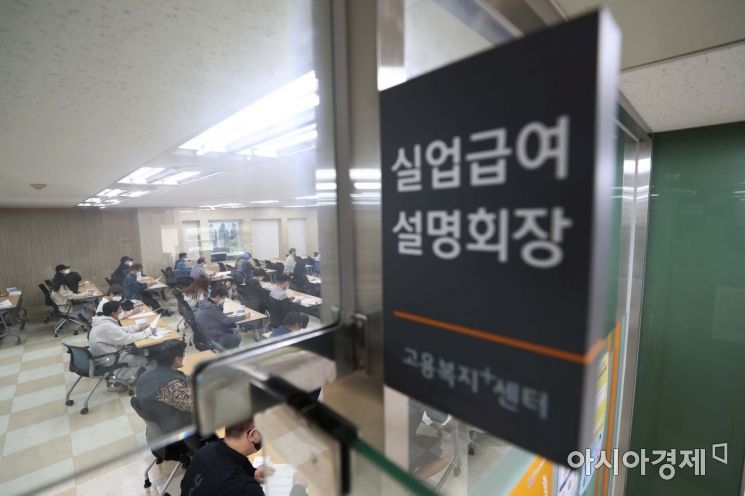 On the 13th, unemployment benefit applicants are receiving explanations from officials at the Seoul Employment Welfare Plus Center unemployment benefit briefing session in Jung-gu, Seoul. Photo by Mun Ho-nam munonam@
◆ Direct Hit to Accommodation and Food Services... Increase in Solo Business Owners = The sharpest drop in new employed persons in April since the financial crisis was largely due to the decrease in employment in face-to-face industries that directly interact with consumers. In fact, the number of employed persons in accommodation and food services, which was 2,288,000, sharply dropped by 212,000 (-9.2%) to 2,077,000 last month. This is the largest decrease among industries.
Following this, education services lost 130,000 jobs, and wholesale and retail trade lost 123,000 jobs. As accommodation and food services took a direct hit, solo business owners who laid off employees increased. The number of self-employed without employees rose by 107,000 (2.6%) from 4,088,000 in April last year to 4,195,000 in April this year. Also, the proportion of solo business owners among employed persons by employment status increased from 15.6% in March this year to 15.8%. Self-employed without employees include both those who laid off employees and new entrepreneurs. Although statistics cannot distinguish between these, considering the ongoing spread of COVID-19, it is more likely that the increase is due to self-employed persons reducing employees rather than new startups.
The shock from the decrease in accommodation, food service, and part-time employment was concentrated on the youth (ages 15-29). The number of employed youth was 3,653,000, down 245,000 from the same period last year. The employment rate also dropped by 2.0 percentage points during the same period. Both the decrease in employed persons and the drop in employment rate were the steepest among age groups.
© The Asia Business Daily(www.asiae.co.kr). All rights reserved.


















