President Moon Jae-in "Nationwide Employment Insurance Era Cannot Be Achieved Overnight"... Blue House "Legislative Process in National Assembly and Social Consensus Required"
[Asia Economy Reporter Ryu Jeong-min] "The era of nationwide employment insurance cannot be achieved overnight." The reason President Moon Jae-in's (face) message at the Cabinet meeting on the 12th is drawing attention is because it aligns with the blueprint for political management. It is a warning message to be cautious of 'overreach' during the implementation of national tasks.
When Kang Ki-jung, Senior Secretary for Political Affairs at the Blue House, raised the necessity of nationwide employment insurance on the 1st, the atmosphere inside and outside the ruling party was complex. While some viewed it as the personal opinion of Kang, a former politician, there was also analysis that it reflected President Moon's intentions.
In his special speech on the 3rd anniversary of his inauguration on the 10th, President Moon stated, "We will lay the foundation for an era of nationwide employment insurance where all employed persons receive employment insurance benefits." This confirmed that expanding the employment safety net is a national task that President Moon is interested in. However, he also proposed a pace adjustment theory by saying, "We will gradually expand the scope of employment insurance."
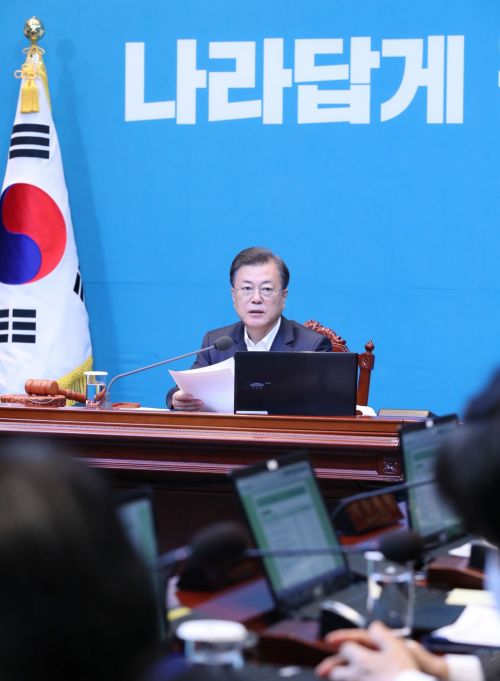
The remarks at the Cabinet meeting on the 12th were in a similar context. President Moon urged the ministers of related departments to prepare social consensus and financial measures together, saying, "Even well-intentioned systems can have adverse effects if not carefully prepared."
It is also noteworthy that President Moon urged reducing blind spots in employment insurance with a mid- to long-term plan. This implies that rather than being obsessed with short-term results, the government should take steps to stabilize the system with a long-term perspective.
Especially from the perspective of self-employed individuals, while there is a positive function in expanding the employment safety net, it also comes as a realistic burden. Moreover, preparation processes such as income assessment to establish reasonable insurance premium criteria are necessary. If the government recklessly accelerates without considering side effects, the original purpose of the system may be distorted and remain a political burden.
A Blue House official explained, "Policies cannot be implemented or changed solely based on enthusiasm," adding, "There is a legislative process in the National Assembly, and social consensus must naturally accompany it."
When the 21st National Assembly convenes on the 30th, legislative demands related to national tasks may pour in from inside and outside the ruling party. If the Blue House orders legislation and the ruling party tries to bypass the National Assembly gate by emphasizing the 'logic of power,' it will be difficult for the 21st National Assembly to avoid a catastrophe. This is why the relationship setting between the Blue House and the ruling party, and between the Blue House and the National Assembly, is important in the changed political environment.
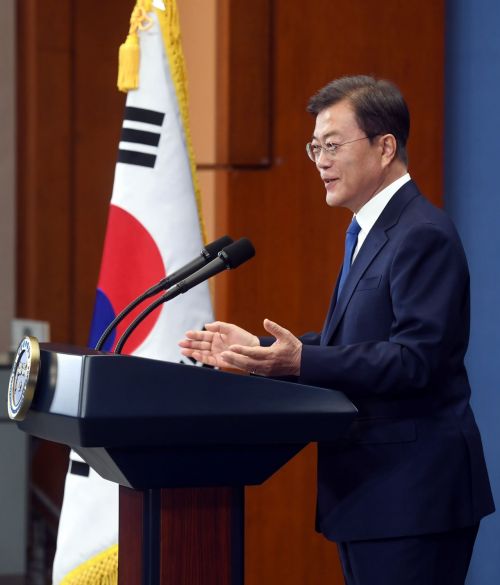
In that sense, the Blue House's emphasis on social consensus regarding the expansion of the employment insurance network can be used as a role model for a 'cooperative National Assembly.' The general evaluation is that the public's sentiment in the general election gave the ruling party the power to push policies forward but also meant they should work while respecting the opposition party and public opinion. It is a reminder that the ruling party's responsibility is as great as the authority granted to it.
What is noteworthy is that the Blue House is cautious about the political abuses of the past when the ruling party's power was excessive. Although President Moon's message, "Please do not leave essential bills to the 21st National Assembly," was issued, he refrained from specifying which bills should be processed.
A Blue House official said, "It should be refrained from making a list of bills that must be passed (by the Blue House) out of respect for the National Assembly's authority to deliberate and decide on legislation."
© The Asia Business Daily(www.asiae.co.kr). All rights reserved.


















