First National Institution... Exhibition of 1980 Materials Including 5·18 Records, a World Documentary Heritage
Mayor Lee Yong-seop: "An Important Opportunity to Get Closer to the Truth of 5·18"
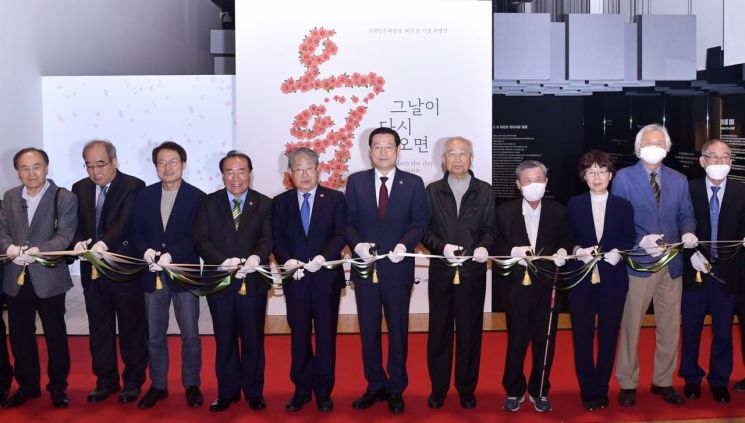 On the 12th, Lee Yong-seop, Mayor of Gwangju Metropolitan City, attended the opening ceremony of the Seoul Special Exhibition "If May That Day Comes Again," commemorating the 40th anniversary of the May 18 Democratic Uprising, held at the multipurpose hall on the 3rd floor of the National Museum of Korean Contemporary History in Seoul, and participated in the ribbon-cutting ceremony with guests. Photo by Gwangju Metropolitan City.
[Asia Economy Honam Reporting Headquarters Reporter Park Seon-gang] The special exhibition commemorating the 40th anniversary of the May 18 Democratic Movement opened in Seoul, the capital of the Republic of Korea, marking the first time a national institution has hosted it in the capital.
On the afternoon of the 12th, Gwangju City announced that the opening ceremony of the special exhibition titled "If That May Day Comes Again," commemorating the 40th anniversary of the May 18 Democratic Movement, was held at the National Museum of Korean Contemporary History. Attendees included Mayor Lee Yong-seop, Director Lee So-yeon of the National Archives of Korea, Director Joo Jin-oh of the National Museum of Korean Contemporary History, Seoul Superintendent of Education Cho Hee-yeon, Gwangju Superintendent of Education Jang Hwi-guk, Chairman Jo Gwang of the National Institute of Korean History, Director Ahn Byung-wook of the Academy of Korean Studies, and Chairman Ham Se-ung of the Institute for Korean Historical Studies.
The special exhibition was co-hosted by national institutions such as the National Archives of Korea and the National Museum of Korean Contemporary History, along with regional organizations including the Gwangju May 18 Democratic Movement Archives, the May 18 Memorial Foundation, and the Chonnam National University May 18 Research Institute.
The exhibition features materials including the May 18 Democratic Movement records, which were designated as a UNESCO Memory of the World in 2011, items previously displayed in the permanent exhibition hall of the May 18 Archives, and original documents continuously collected to date.
The special exhibition space is divided into four main areas.
▲ Government records held by the National Archives of Korea ▲ Situation logs and passes produced by the Ministry of National Defense and Gwangju Dong-gu Office, along with martial law troops’ uniforms, military boots, and batons ▲ May 18-related works by Japanese printmaker Tomiyama Taeko created in 1980 ▲ Documents produced by citizens at the time.
The documents produced by citizens, such as diaries, reporter’s notebooks, and statements, which are UNESCO Memory of the World items, along with various physical artifacts, have previously only been exhibited at the Gwangju May 18 Democratic Movement Archives. This is their first presentation in Seoul, allowing visitors to feel the earnest desire for democratization held by citizens in 1980.
The special exhibition is held on the 1st and 3rd floors of the National Museum of Korean Contemporary History, including the planned exhibition rooms, the museum corridor, and the history yard, and admission is free.
Gwangju City is showing diverse and active efforts to nationalize and globalize the May 18 Democratic Movement, which marks its 40th anniversary this year.
Starting with the special exhibition in Seoul on this day, a special exhibition commemorating the 40th anniversary of May 18 will open on the 19th at the Jeju 4.3 Peace Memorial Hall, and on the 27th, an opening ceremony for the special exhibition will be held at the May 18 Archives.
Although 40 years have passed since the May 18 Democratic Movement, many citizens still do not know the truth or accept distorted information without filtering. These special exhibitions are expected to serve as an opportunity to accurately convey the truth about the May 18 Democratic Movement.
Joo Jin-oh, Director of the National Museum of Korean Contemporary History, said, “May 18 must be firmly established as the history of Gwangju and the Republic of Korea, and the spirit and meaning of May 18 should be shared worldwide. Through this Seoul exhibition of precious materials that have never left Gwangju, I hope that by empathizing with the tears of Gwangju citizens at that time, the history of Gwangju can be properly established.”
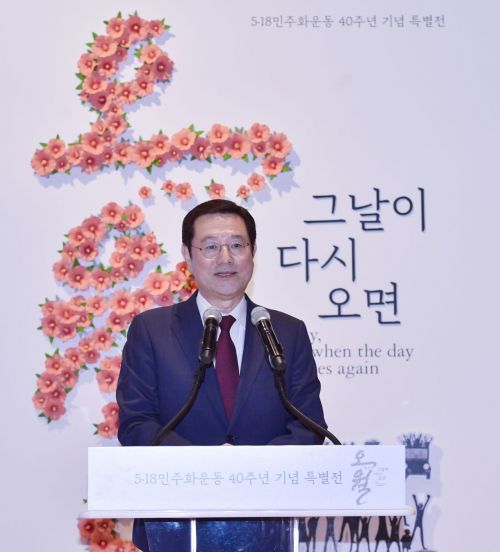 Lee Yong-seop, Mayor of Gwangju Metropolitan City, is delivering a congratulatory speech at the opening ceremony of the Seoul Special Exhibition "If May That Day Comes Again," commemorating the 40th anniversary of the May 18 Democratic Uprising, held on the afternoon of the 12th at the multipurpose hall on the 3rd floor of the National Museum of Korean Contemporary History in Seoul. Photo by Gwangju Metropolitan City
Mayor Lee Yong-seop said, “May 18 is not only the history of Gwangju but a proud history that all citizens and people worldwide must inherit and develop together. It is a milestone of democracy, human rights, and peace,” emphasizing, “The special exhibition, co-hosted by the National Archives of Korea and the National Museum of Korean Contemporary History, will be an important opportunity for the nationalization and globalization of May 18.”
He added, “History has strong power when it is remembered and recorded correctly. I hope this becomes an opportunity for Seoul citizens to get closer to the truth of May 18 through the records of those who experienced, witnessed, and tried to reveal the truth in the midst of May 18 forty years ago, as well as the records of the martial law troops and government that oppressed them.”
© The Asia Business Daily(www.asiae.co.kr). All rights reserved.


















