Revised Economic Outlook on the 28th Lowers Inflation Forecast
1.0% Forecast Adjusted Due to COVID-19 and Low Oil Prices
Government: "Temporary Factors... Disinflation, Not Deflation"
Overseas Concerns About Inflation Post-COVID-19
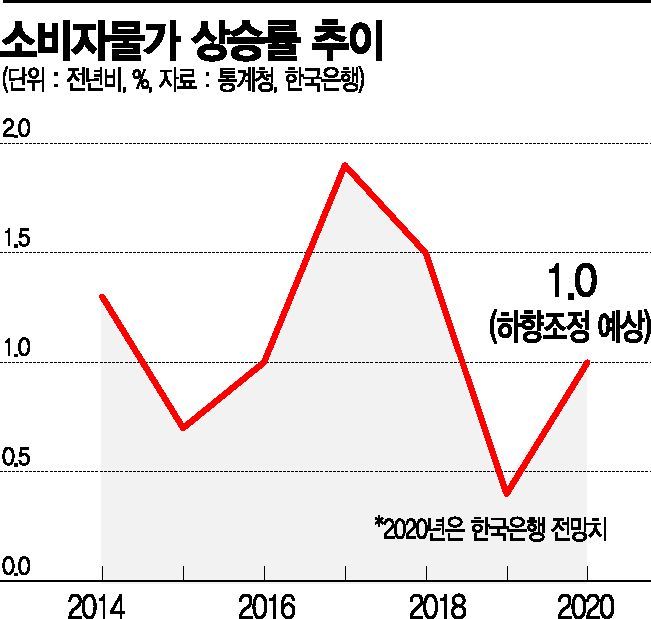
[Asia Economy Reporter Kim Eunbyeol] The Bank of Korea is lowering its inflation forecast for this year in response to the impact of the novel coronavirus infection (COVID-19). Consumer prices in April rose by only 0.1% compared to the same month last year, and there is a possibility of negative inflation next month, raising concerns that our economy might fall into deflation.
According to the Bank of Korea and others on the 12th, the annual inflation forecast for this year is expected to be revised downward in the economic outlook update scheduled for the 28th. Before COVID-19 spread overseas in February, the Bank of Korea projected consumer prices to rise by 1.0% year-on-year and core inflation by 0.7% this year. Considering the demand contraction caused by COVID-19 and the sharp drop in international oil prices, a downward revision of inflation is inevitable. The annual economic growth rate will also be revised downward.
The Bank of Korea has already sent messages to the market in various ways. First, in the Monetary Policy Direction statement from the Monetary Policy Committee on the 9th of last month, it predicted that "the consumer price inflation rate and core inflation rate will fall significantly below the February forecast." On the same day, the Monetary Policy Committee also mentioned that the GDP gap would show the largest negative value since the 2000s. The GDP gap is the difference between potential GDP and actual GDP, serving as an indicator of economic overheating or recession. A negative GDP gap means demand is below supply, increasing deflationary pressure.
The low inflation issue existed even before COVID-19. The low inflation phenomenon is part of the global 'New Normal' characterized by low growth, low inflation, and low interest rates. The development of the Fourth Industrial Revolution and globalization are cited as representative causes. The logic is that technological advancements have lowered production and delivery costs, and intensified competition has driven prices down. Korea's growth rate has slowed as it entered the ranks of advanced countries, which is also a cause of low inflation. With the addition of the pandemic issue, low inflation has prolonged, and the argument that Korea could fall into deflation like Japan has gained traction again. Once deflation sets in, monetary policy may have minimal effect because if prices are expected to fall further, consumption and investment inevitably decline.
However, the Bank of Korea and the government maintain that the current situation cannot be considered deflation. They argue that the cause is a short-term sharp drop in demand and low oil prices, and it should be distinguished from the commonly referred deflation, which is "a prolonged period of negative inflation caused by asset price collapse." Instead, they claim that the temporary low inflation situation should be seen as disinflation.
According to an analysis by the Bank of Korea of major countries since the 1990s, from the first quarter of 1990 to the second quarter of last year, consumer price declines occurred 356 times across countries, but periods of consecutive quarterly negative inflation lasted about two quarters, with a decline rate of around -0.5%. Deflation was limited to countries like Japan, and it was always accompanied by asset price adjustments. In other words, it is premature to worry about deflation just because current prices temporarily record negative inflation without a sharp drop in asset prices such as real estate.
Professor Kim Soyoung of the Department of Economics at Seoul National University said, "If negative inflation occurs, we have no choice but to call it deflation, but since the current price decline is mixed with supply factors (oil price decline), it could be temporary." She added, "If negative inflation continues even after the COVID-19 impact ends, then it will really be a problem," and noted, "It is also important to observe whether real estate prices will fall together."
Meanwhile, overseas concerns have emerged that the massive liquidity injected could rather trigger inflation after COVID-19. Bloomberg reported, "Raw material shortages, disrupted supply chains, and deglobalization could cause a return of inflation."
© The Asia Business Daily(www.asiae.co.kr). All rights reserved.

















